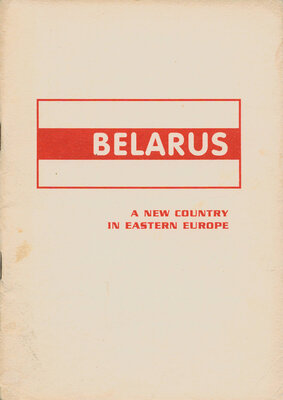
Belarus: A New Country in Eastern Europe
Выдавец: Тэхналогія
Памер: 72с.
Мінск 1994
If we make a resume of the analysis of the economic situation in Belarus we will see that despite some crisis features, mistakes and inopportune decisions of the Supreme Soviet and the government on the economic and political reforms, Belarus is a fairly stable, both economically and politically, state. It is most vividly seen against the background of the other country-members of the CIS. In Belarus there are no ethnic or religious conflicts, there is no open confrontation between political opponents, though there are different political trends in the society. All this makes us sure that the economic crisis will be overcome in the near future. The introduction of the Presidential office and the election of a professional Parliament will contribute to that.
33
5.	Culture, Education, Sports
The culture of the Belarusan society has been constantly changing in different penods but it preserved the characteristic features and organization forms of Belarusan ethnos life and activities, its mentality. The complete description of rich Belarusan culture could comprise volumes devoted to different language, history, philosophy, art, material and spiritual aspects that determine the Belarusan lifestyle. So we will describe only some of them.
The culture of any nation, its cultural environment decides its level of development. As the Belarusan lands for many centuries were the object of attention of other countries, especially of neighboring ones, these countries naturally tried to influence the Belarusan people's culture. During the years of totalitarian regime from 1919 to 1991 Belarusan culture was influenced by Communist ideology and before that it was developing under the intent attention of the Russian tsarizm. This influenced greatly the development of the normal cultural environment of Belarusan society and sometimes damaged it a lot. For example, a Western Europe citizen coming to Belarus can see in almost all cities and towns a monument to Lenin and very rarely a church or a cathedral that were so numerous in the not too distant past. Churches and cathedrals as the keepers of the nation's faith were constantly ruined during the last 70 years or were adapted for other purposes. In Belarus one can find churches in which Communists made storehouses, repair shops, sport halls. After Bolsheviks came to power in Belarus in 1919 they started to force on Belarusan people a new culture — socialist. And Communist ideology started to dominate practically in all the spheres of cultural life.
Now Belarus is going through the transition period of the transformation of the totalitarian system into a democratic society. These processes influence the culture as well because democracy cannot exist and
34
develop without the creation of a high-level culture. Without the culture environment for the Belarusan society the attempt to establish democratic rule in Belarus can end in ohlocracy or in another totalitarian regime. That is why a lot is being done now in Belarus to revive material and spiritual culture of the nation by the government as well as by the wide public circles. This includes cultural traditions, environment, public relations, material and cultural valuables that are traditional to the Belarusan lifestyle. At the beginning of the 20th century in Belarus there were a lot of beautiful parks, country estates, castles, churches and cathedrals closely linked with Belarusan history. Nowadays many of them are ruined or completely neglected. Today their reconstruction has started. It has a great significance for the revival of national self-consciousness of Belarusans. It should be noted that representatives of all the nations living in Belarus have equal rights to cultural self-expression.
Quarters of old Minsk
If we consider Belarusan culture in a narrower sense of the word, as the sphere of peoples' spiritual life then we may say that it is on a very high level. If we take into consideration material values, the cultural environment we may see that it is rather monotonous and monochrome. It
35
is the result of the construction of communism but not the lack of the will to create a comfortable and cultural environment. To get convinced of that one should have a look at the new dwelling areas of individual construction near big cities. They have grown literally during the last 5-10 years. Their planning and the dwelling conditions there are equal to those in Western Europe. Travelling around Belarus, talking to ordinary people, learning their life conditions one can see that there has started to revive the feeling of a proprietor, a land owner, which has immediately influenced the cultural environment.
The sources of Belarusan culture come from the pre-Christian times and have a lot in common with traditions of other Indo-European cultures. Traditional rites, music and art elements are widely used in contemporary cultural life, illustrating thus symbiosis of the old and young Belarusan culture.
One of the most important events in Belarusan culture is Kupalle, — a holiday of nature with its roots deep in ancient times and connected with the solstice. Many people take part in this holiday demonstrating a special repertoire of music and dance, spectacular rites. The celebration goes through the whole night. This custom shows the importance of traditions in promoting contemporary culture. In Belarus people widely celebrate such popular Christian holidays as Christmas and Easter. And these religious holidays are public holidays for Catholics as well as Orthodox believers as the Catholic church uses the Gregorian calendar and the Orthodox church the Julian calendar. For example, Christmas according to the Gregorian calendar is celebrated by Catholics and Protestants on the 25th of December, the Orthodox church celebrates it on the 7th of January. Both the dates are public holidays in Belarus which shows the tolerance in Belarusan society.
One of the most important aspects of cultural life is the existence of professional theatres which embody the bright images and events of Belarusan history in drama, music and ballet. The rich Belarusan poetry, literature and drama is admired by good-hearted Belarusan audiences that like to sing, write poems and actively influence the cultural life.
Despite the slowing-down policy in the sphere of culture of the Soviet system which promoted the Russian language and Russian culture, Belarusan cultural life still developed. Talented personalities of
36
Belanisan culture have always been an example for the definition of the contemporary Belanisan culture. This is seen most vividly in the songs of Belanisan bards who openly and emotionally reflect today's cultural climate. Through the creative process musicians, artists, actors, writers try to express their personal philosophy, to make their contribution to the development of Belanisan culture.
In Belarus there are over 5.5 thousand libraries, 5.2 thousand clubs, 139 museums, 24 professional theatres including the Opera and Ballet Theatre, 13 concert organizations with 6 philarmonies. Apart from professional organizations of culture a great role in Belanisan cultural life is played by amateur art groups and organizations. Folklore groups with folk dances and songs in their repertoire are very popular in Belarus.
Belarus is a country of readers. In 1993 in Belarus there were published 3 thousand books and brochures with the total print-run of 94.8 million. In 1993 there existed 198 magazines with an annual total circulation of 22.8 million and 351 newspaper with an annual total circulation of 611 million.
Belarus is a country with a high education level. The total number of students in 1993/1994 academic year was 2.4 million (nearly 25% of the population). In Belarus there are 38 higher education establishments including Universities, 149 specialized comprehensive educational establishments, 5.1 thousand various schools including primary and secondary ones. Among the secondary schools there are grammar school, lyceums and colleges.
A grammar school is an educational establishment of the general comprehensive education system that provides the realization of state demands to education in combination with the higher educational level, specializing in the humanities and culture. A grammar school is organized in the range of 5th-llth (12th) forms. The term of education is 7 (8) years. Grammar school can have preparatory forms (1st to 4th).
A lyceum is a professionally oriented educational establishment that provides the upgrade level of the secondary education in combination with profile preparation along the lines of higher education establishments. The main aim of a lyceum is the creation of favorable conditions for the development of the creative and intellectual potential of students, assimilation of cultural values, historic heritage of the Belanisan nation,
37
preparation of the most talented youths for the continuation of education in higher education establishments.
A college is an educational establishment in the framework of professional education providing high-level specialized comprehensive education integrated with the general one.
Secondary education in Belarus is compulsory. The state guarantees to every of its citizens the availability of a free of charge general secondary and technical secondary education. Specialized secondary and higher education is available for everyone according to his abilities. Any citizen can get free education on any level in state educational establishments.
Belarus is a sports country. In the world of sports it is known by several outstanding sport achievements which show the aspiration for the healthy way of life and the care of sport taken by the government. In Belarus there are 478 specialized children's sports schools, 8 Olympic reserve schools, 13 schools of higher sports mastership where 214 thousand students study. Belarus also has Olympic training centers: Raubichy for the winter sports training and Staiki for the summer sports training. In Belarus there is a Sports Academy where coaches and sports specialists of higher level are trained. In total in Belarus there are 70 popular sports and games. The most popular are football (soccer), ice hockey, basketball, handball, gymnastics, track and field athletics, weight-lifting, boxing, many kinds of wrestling and other sports. Many times large sport events were held in Belarus. In 1980 some of the Olympic football matches were played in Minsk.
 КНІГІ ОНЛАЙН