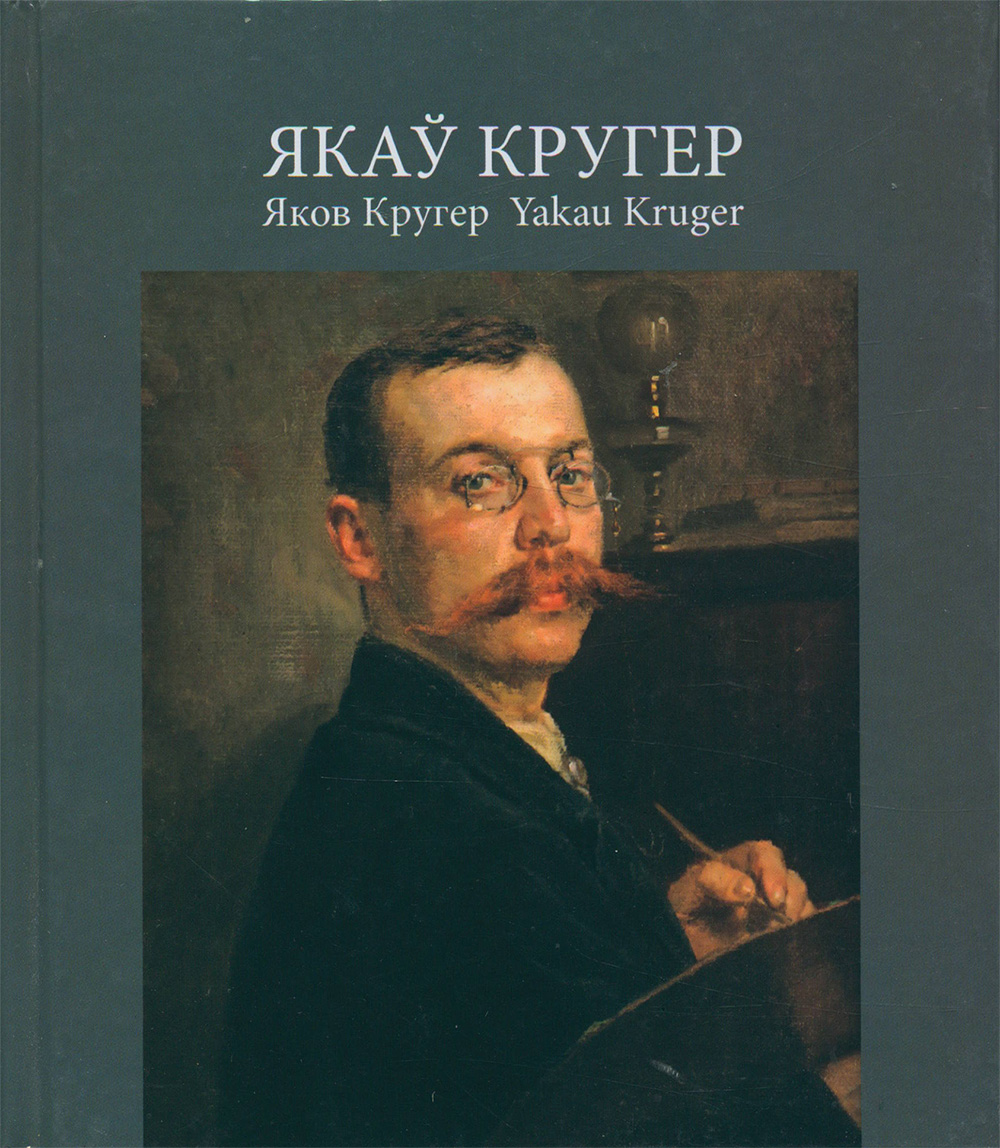
Якаў Кругер
Выдавец: Беларусь
Памер: 74с.
Мінск 2013
Надежда Усова
'3Яков Кругер (Янкель Мордуховмч Кругер. 1869—1940) // Каталог пронзведеннй / сост. В. В. Войцеховская; автор вст. ст., бмбл. н спнска выставок Н. М. Усова; под обіцей редакцмей Н. Н. Паньшяной. — Мннск : Белпрмнт, 2000. — 38 с.
14 Якаў Кругер. Пастскрыптум : новыя матэрыялы аб жыцці і творчасці мастака /I Матэрыялы навуковай канферэнцыі, прысвечанай 65годдзю Нацыянальнага мастацкага музея Рэспублікі Беларусь. — Мінск : Белпрынт, 2008. — С. 28—39.
^' he creative life of the Belarusian painter and teacher
Yakau Kruger takes first four decades of the twentieth century. During that time he turned from a provincial artist and the head of the most renowned private art school in Minsk into a leading Belarusian Soviet portrait painter who depicted the Minsk intelligentsia of his time. But he entered the history of world art much later as the first teacher of two famous artists of the Paris school — Chaim Soutine and Michele Kikoine — as he became part of their early biographies. Kruger himself remained a lesser character among famous artists but the beginning of his complicated path to success had been promising and even brilliant.
Yakau (Yankel) Markavich (Mordukhavich) Kruger was born on May 14, 1869 in Minsk into a large family of the poor artisan Mordukh Chaimavich and his wife SheinaRada loseleuna. There were five more sons and two daughters besides him in the family. Until he was 11, Yakau studied at a heder1 as all Jewish boys, then he attended a fourclass Jewish trade school. Thanks to patronage of Kazma Ermakou, the headmaster of a classical school, who noticed a portrait of I. S. Turgenev skillfully copied from a photograph, he was sent at the expense of benefactors to Kiev Drawing School of N. Murashko in 1883. This school was widely known because of its realistic traditions. After graduating from the school in 1887 and securing reference letters from Minsk philanthropists Kruger tried to enter the Imperial Academy of Arts in SaintPetersburg but with no results: he did not managed to attain the right to live in the capital which was necessary for him as a Jew. Instead, he went to Warsaw where he took lessons from the famous Polish portrait painter Leopold
1 Heder is a Jewish primary school where boys are taught the basics of Judaism.
24
Horowitz for almost a year. The lessons did not last long but did not pass in vain for a talented pupil who quickly imbibed the basics of the teacher’s creative method: striving for a maximal portrait resemblance, distinctness and some formality or “neatness” of manner.
From 1888 to 1895 Kruger continued his studies in Paris at the private Academic Julian2. The money for the studies was given by the wealthy relative Lea Kruger who was the wife of the estate manager of the Lyubansky family. Thanks to her, Kruger had the opportunity to travel to England, Germany and Belgium to visit museums and art galleries, which was considered an absolute must for an education of taste in a beginning artist. The miniature SelfPortrait in a Red Beret was sent from Paris to Minsk in 1889. The Italian Quattrocento influence is evident in it. Acquaintance with works of French and English artists cultivated in him love of traditional realism and refined pastel technique in which he later showed himself a real master.
In April 1895, Kruger returned in Minsk. Only SaintPetersburg Academy of Arts could give the right to teach in classical schools and colleges and in 1897 Yakau entered the Higher Art College under the Academy. He chose for his lessons the art studio of the Itinerant genre painter Vladimir Makovsky. It became the final part of a complicated and rather eclectic education of the artist with the mix of Polish and French salon academic traditions and Russian traditions of the late Itinerants’ epoch. Despite of greater democracy which became possible after the coming of the Itinerants to the Academy in 1894, life for Jews was not simple there. He attended the Academy as an irregular student without any rights and pledging “not to initiate requests for the title of the artist” and “to leave the studio in case there are not enough places if asked by the professor” 3. Also a residence permit to live in the capital was extended only when V. Makovsky assured the office “of the successful studies” of the academician.
2 Academie Julian is a private feepaying art school of the French artist and teacher Rodolphe Julian (1837—1908). Masters from the school under the Ecole des BeauxArts taught there.
’Лмчное дело Я. M. Кругера // Россмйскмй государственный нстормческпй архнв. — Ф. 789. — Оп. 12. — Д. 62 «Н».— С. 2.
25
Kruger was denied the financial assistance during the work at his graduation painting. It was that difficult time that SelfPortrait with a Palette was created (1899). Cheap and coarse canvas confirms extremely narrow circumstances of the painter at that period but the work shows Krugers finally completed selfsentiment as a professional artist who boldly looks into the future. Painting of this work is confident and extensive with rich colours.
Krugers graduation painting For Professors Examining (1900j was acquired by the Art Museum in Penza and published in the popular central magazine Niva. Elated by his first success, the artist returned to Minsk in November of the same year. The plan of his activities had been already prepared: to open an art school, to create the Artists’ Society and to work actively. “I was young and full of creative enthusiasm. I wanted to apply somehow my knowledge and skills”, wrote the artist later4. But in 1899, there already existed the Fine Arts Admirers’ Society in Minsk. And Kruger gave his works (Brothers Portrait, 1896; Portrait of Violin Player Y. G. Zhukhavitsky5, 1897) to the exhibitions of the Society in 1901—1903. The paintings are distinct in restrained muted colouring, inner warmth and compositional simplicity.
From 1901 Kruger also exhibited Jewishthemed paintings at exhibitions in Vilna (Caucasian Jew, 1901; Illui (“prodigy” in Hebrew), Jew with a Wine Glass — about Jewish religious rituals). Only the painting Morning Prayer (1891) has been preserved from this series. Impressed by the revolutionary events and Black Hundred pogroms of 1905 in Minsk that began immediately after the publication of the tsar’s manifesto granting constitutional freedoms, Kruger created the painting Pogrom, which was destroyed by the gendarmes right in his studio.
He continued to work hard. Soon Minsk critics appreciated a portraitpainter in Kruger: “Year after year Mr. Krugers talent grows stronger as he works a lot
'КругерЯ. M. Ha благо моей родмны // Советская Белоруссня. — 1938. — 24 дек.
5 Y. G. Zhukhavitsky (1868—1942) was a close friend of the artist, the graduate of the Imperial Conservatory in Vienna and the owner of several portraits by Kruger.
26
and with love. Paintings Old Ladies, Portrait of Mr. Falkovich and the study An Old Man are marvelous with so much life, truth and strength in them. It seems to us that Mr. Kruger starts to specialize in portraits that we warmly welcome, since, in our opinion, portraiture is a genuine calling of this gifted artist”, wrote a reviewer of the newspaper Okrainab.
In November 1904, Kruger opened private Drawing Classes with admission of all for payment. In May 1906, the Academy gave him permission to open Drawing School which existed until 1915 in the house of E K. Vyangrzhetsky at Petrapaulauskaya Street (now, the vicinity of Tsentralny supermarket). There was situated a spacious flat of the painter’s family at the same house. The committee of the City Council “found it wellequipped and with good light and ample collection of models, drawings of plaster casts, etc. The school has an experienced and dedicated leader in the person of painter Kruger”. In response to his request for financial assistance 300 rubles grant was given to the school “as a oneyear experiment” with an obligation to teach at least 6 “disadvantaged” people free of charge7.
Krugers classes were quite expensive — they cost 5 roubles a month. “Barefoot young people with a strong desire to develop their skills came to my school from faraway villages and boroughs. And how many folk talents perished with no ground for their gifts. I did everything I could to help my brethren”, recalled Kruger later8. Presumably, he was not only a teacher but also a living embodiment of the “Paris Dream” for art lovers in Minsk, the man who proved that the path to great art for a son of a poor artisan was possible. Among those who attended his school were M. Stanyuta, G. Fimentousky, V. Rutsay, I. Akhremchyk, I. Milchin, Y. Frenkel, P. Mrachkouskaya, I. Tumilovich, N. Kolatava, M. Kikoine, etc. His most famous student Chaim Soutine later repeated the path of the teacher and won not only Paris, but the whole world with his paintings.
6«Окранна». — 1908. —17 anp.
7 06 отпуске художннку Кругеру 300 рублей субслдлл на содержанме школы рлсованмя в Мннске. 1911 г. // Росснйскнй государственный лстормческнй архнв. — Ф. 2. — Оп. 1,— Д. 1053.
*Кругер Я. М. На благо моей роднны II Советская Белоруссня. — 1938. — 24 дек.
27
By the 1910s Krugers situation in Minsk strengthened: he married a daughter of a wealthy miller, became a member of the board of the Industrial Art Museum Society under the College of Commerce, gave private lessons in painting, executed commissions for the church, and also taught drawing in primary classes of the private Jewish nonclassical secondary school of E. M. Khaykin.
Gradually Kruger became a fashionable portraitpainter with commissions from all local landowners. However, his best portraits are those of the loved ones: the portrait of his wife ZlataFruma in pastel (1907), the portrait of son Mark and the painting of his eightyearold daughter Sheina (Safiya) (.Daughter’s Portrait, 1910). The portrait of the girl surpassed his other works in painterly advantages and depth of penetration into the soul of a teenager, inner concentration and integrity of the image. The painting is full of sonorous tones and shades of red, it is confident and strong, drawing is bold and accurate. He actively drew portraits in pastel with sophisticated and “aristocratic” technique which required flawless mastery, confident hand and colour instinct. Kruger introduced to provincial Minsk the trend of portraits in pastel and was faithful to it all his life. In the classic portrait from life of Palmira Lyubamirauna Mrachkouskaya, the Minsk amateur painter and philanthropist, Kruger demonstrated the highest mastery: a finely nuanced modeling of the face framed by soft, smoky shading of the background and velvety, “melting” lush hair. The artist like no other in Minsk could deliver any passing state or mood of a person with maximal accuracy, seeking the striking likeness in a portrait.
 КНІГІ ОНЛАЙН