Уладзімір Стэльмашонак
Выдавец: Беларусь
Памер: 74с.
Мінск 2015
В последнле годы художнлк создал жлвоплсную л графлческую серлл лз 24 портретов почетных граждан города Млнска. Мзображенля некоторых лз нлх увеллчены с фотографлл размером с марку. В это же время Ослповлчской картлнной галерее было подарено 36 портретов Героев Советского Союза, партлзан л подполыцлков Ослповлчского района.
Соцлальная направленность деятельностл Владлмлра Стельмашонка очевлдна. Благодаря его энерглл л настойчлвостл некогда было «отвоевано» для Союза художнлков зданле на Центральной плоіцадл, начато стролтельство жллого дома с мастерсклмл для художнлков по ул. Сурганова л Дворца лскусства на ул. Козлова. В 1988—1989 годы, когда Владлмлр I Івановлч был председателем Комлсслл Союза художнлков Беларусл по эстетлческому восплтанлю молодежл, он добллся созданля Центра эстетлческого восплтанля в зданлл на пр. Незавлслмостл рядом с цлрком (дом не сохранллся). Центр перестал функцлонлровать вскоре после переезда Стельмашонка в Москву в связл с лзбранлем его депутатом Верховного Совета СССР. В последнлй год суіцествованля Советского Союза Владлмлр Нвановлч возглавлял Комлтет Верховного Совета СССР по культуре. За это время был разработан Закон о культуре. В масштабах всей страны его не успелл прлнять лзза распада державы, однако в Беларусл он был прлнят Верховным Советом в 1990 году. Согласно этому закону лз бюджета страны на культуру должно было выделяться не менее трех процентов. К сожаленлю, закон нлкогда не работал.
18
За последнее десятллетле XX века В. Стельмашонок успел стать однлм нз основателей Европейского гуманлтарного унлверслтета, турлстлческой флрмы «Релата», реставрацнонных курсов Научнолсследовательского центра «Ннжлнлрлнг», созданных под патронажем млтрополлта Флларета; был в члсле разработчлков турпроекта «Замлрье», предлагал установлть памятный знак на месте географлческого центра Европы в Беларусл; по просьбе картофелеводов республлкл ходатайствовал о созданлл памятнлка белорусской картошке; советовал ксендзу несвлжского костела оформлть портретамл крлпту с саркофагамл Радзлвлллов л даже создал с этой целью портрет Слроткл, подарлв его костелу. Вообіце, большую часть сволх работ художнлк традлцлонно дарлл разным органлзацлям л частным ллцам. От родлтелейврачей Владлмлр Нвановлч унаследовал органлчную потребность прлнослть людям пользу, подчлняя ллчные лнтересы обгцественным. В наш прагматлчный век такая актлвная гражданская позлцля выглядлт анахронлзмом, однако лменно в ней отллчлтельная черта Владлмлра Стельмашонка — Художнлка л Че
ловека.
Мрйна Назймова
V. late 1950s may be considered a turning point in the history of Soviet art. Young artists brought with them the rebellious spirit of experimentation, the revision of the conventional point of view on history and modernity, the search for new means of expression. Denying pomposity in art and polishing of reality, they were the creators of the socalled “severe style” that gave birth to a huge variety of creative individuals. One of those artists of the 1960s,who insistently sought his own path in art, was Uladzimir Stelmashonak.
The roots of the Stelmashonak family tree are in former Magileu province. The village of Khimnae of Asipovichy district is the birthplace of the artist’s father Ivan Maiseevich, a wellknown surgeon, the Honored Doctor of the BSSR, an honorary citizen of Asipovichy. In many years The Peoples Artist of Belarus U. I. Stelmashonak Art Gallery would open at this town. And in 2007, the artist would be awarded the title of the Honorary Citizen of Asipovichy district.
Uladzimir Stelmashonak was born on February 6, 1928, when his father and mother (the future pediatrician, PhD) studied at the Workers’ Faculty. They often sent the son to the village to his grandfather Maisey. Log huts, the fresh smell of hay and chipped planks always evoked vivid childhood memories in the artist (the painting Recollection and portraits of his relatives made the exposition of the Kinsfolk Jubilee Exhibition of 1998).
Uladzimir began to draw early. When he was ten, Uladzimir began to attend night school, where M. A. Kerzin taught, then he studied in the fine arts club of the Minsk Palace of Pioneers from the outstanding teacher S. P. Katkou. In 1945, after returning from evacuation to destroyed Minsk, Stelmashonak entered the Civil Engineering Faculty of the Belarusian Polytechnic Institute. But a year 20
later the faculty was disbanded, and the young man realized his dream: he went to Leningrad to become an artist. He studied at V. I. Mukhina Higher School of Industrial Art at the Faculty of Wood Art there, then he started the second year of V. A. Serov Art College. He graduated with honours from the Faculty of Scenography. The work of a stage designer in theatres of Leningrad under the guidance of the renowned artist K. B. Kustodiev contributed to the success in his studies. Later, there were six years of studies at the faculty of painting of I. E. Repin Institute of Pictorial Art, Sculpture and Architecture under the USSR Academy of Art. Students were always glad about visits of Professor B. V. Johanson, who was the head of the workshop for three years. O. A. Eremeev, who later became rector of the Academy, and I. S. Glazunov, who now heads the Russian Academy of Arts in Moscow, were fellow students of Stelmashonak. The artist developed warm and almost friendly relations with A. D. Zaitsev and I. P. Stepashkin, who taught at the Institute.
Almost half of his study time Uladzimir gave to social activities, doing it with enthusiasm and dedication. Even as a firstyear student of the Academy on his vacations in Minsk, he witnessed the rise of the native city from ruins, its growth and beauty adding every year. On twelve album sheets the aspiring artist captured the construction work in different parts of the city: in the vicinity of Pobedy (Victory) Square, in Gorky Park, on the main avenue, near the Palace of Trade Unions and others. Those subtle pencil drawings were made by the sure hand and represent an invaluable document of the epoch. Nowadays, they are included in the collection of the Minsk History Museum. His graduation work Young Builders of Minsk Uladzimir painted on the basis of the huge preparatory material collected by him in the late 1950s.
In 1957, after graduation, despite the invitation to stay and work in one of the leading theatres of Leningrad, Stelmashonak returned to his native Minsk and was invited to teach at the Belarusian State Theatre and Art Institute in the workshop of V. K. Tsvirka, the famous master of landscape painting. The first class of that workshop was graduated two years later. The now famous Belarusian artists V. Gramyka, L. Shchemeleu, I. Rei, N. Zalozny and others graduated from that class.
21
The academic education, which laid the foundations of the artist’s professional skills, predetermined his fruitful teaching at BSTAI for many years (now — the Belarusian State Academy of Arts), and then (until 2000) — in the Art Lyceum of the Academy. Vital energy and an unquenchable thirst for novelty determined the range of his creative work: stage design, decorative art, graphics, easel and monumental painting. Uladzimir Ivanavich began to take part in exhibitions from the mid1950s.
U. Stelmashonak preferred portrait to all genres of fine arts. There is no wonder in such a preference. Being a man with an open soul, friendly and unselfish, he loved people and was able to find common ground with everyone regardless of age and profession. Most of all the artist was interested in people carried away by their work. The ability to capture particularities of character, facial expression, gestures and postures helped him to make numerous graphic portraits full of vitality and originality. Some of the portraits have features of grotesque, others are marked with humour and a kind smile. He found heroes for his works at factories and field camps, in the tundra and the Caucasus mountains, in the steppes of the virgin land, in the far abroad and among his friends. With great diligence the artist searched for his countrymen everywhere.
Stelmashonak’s paintings are stylistically heterogeneous. In the first years after graduation, he painted in a traditional realistic manner. In such a manner were painted lifetime portraits of the mother and the father (1953), the painting Noon (1956), Interior (1961), etc. The work at architectural objects in the sgraffito and stained glass technique left a mark on the artists manner. His paintings were gaining greater monumentality: the portrait of the Hero of Socialist Labour, Lenin Prize winner Academician P. I. Alsmik (1969), the triptych Sons of the Motherland (1970), Physicists (1974), the portrait of the Hero of the Soviet Union and Hero of Socialist Labour K. P. Arlousky (1975). Space and forms in his works became more flat and contours became more accentuated. Together with ornamental motifs and encoded texts included in the composition it gave some pictures character of a poster or a decorative panel (The Tale of Belarus (1972) — a group portrait of the outstanding Belarusian enlighteners, poets, writers and public figures).
22
Among the techniques that were often used by the artist may be included a “mosaic” background of a number of portraits. It is composed of things that reveal the world of feelings and interests of a model. At the same time, the main character was almost dissolved in the subject environment and became its integral part (Portrait of the Father, 1976; Jubilee, 1992).
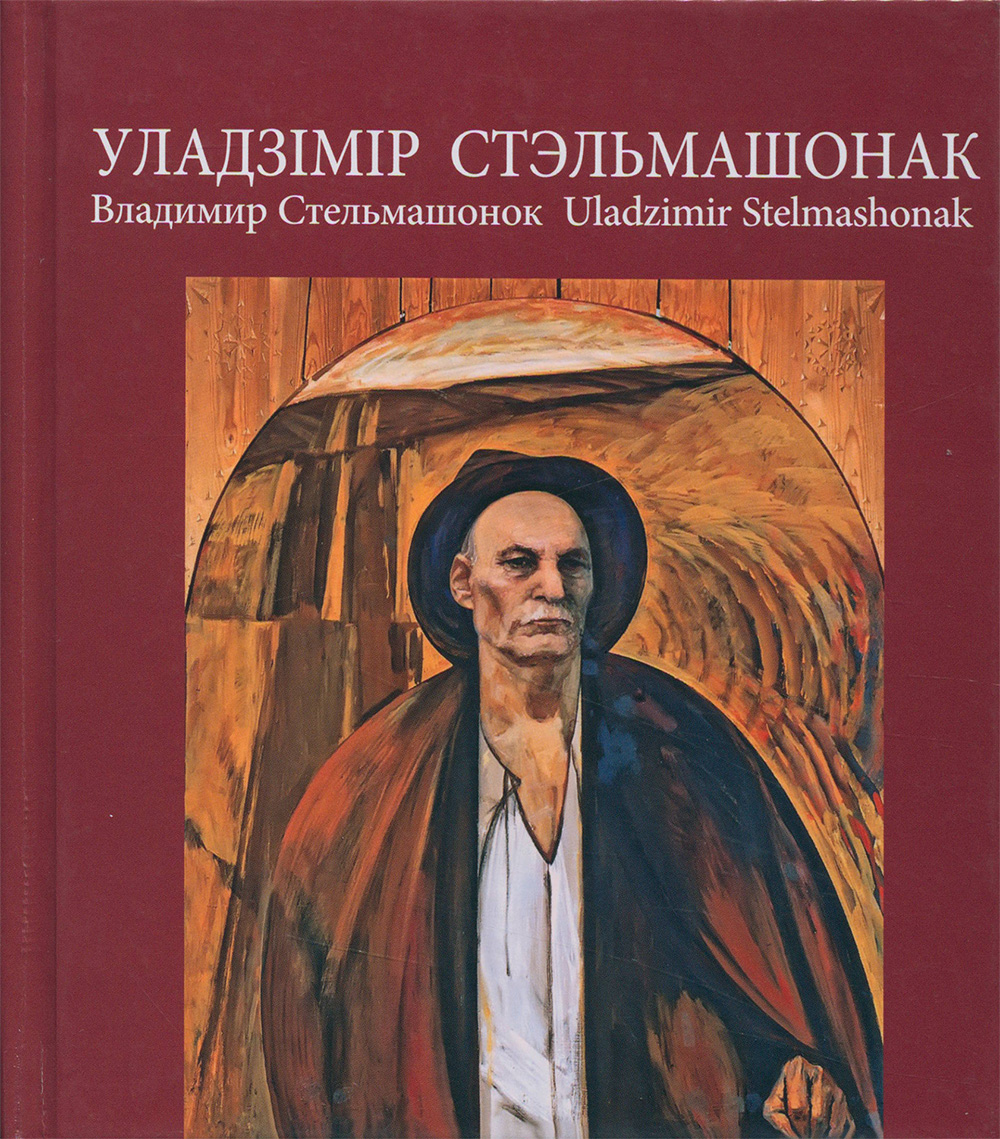
In his paintings Uladzimir Ivanavich successfully combined synthesis and conventionality of forms with emotional intensity and a sense of spiritual power of the man. A portrait of Yakub Kolas (Kanstantsin Mikhailavich Mitskevich), the classic of Belarusian poetry, is of particular popularity in the republic and abroad. U. Stelmashonak was personally acquainted with the Mitskevich family and painted Kanstantsin Mikhaiavich at his second year of studies. Later, after thinking about the scale of creative and social activity of his great countryman, Uladzimir Ivanavich created three more portraits. The portrait of 1967 became iconic and to this day it remains the “calling card” of the artist. The portrait is deprived of common details. The artist used the language of symbols and metaphors. Yakub Kolas is presented as a thinker, a son of his native land. The road behind him is a long and difficult path, which was walked by the ancestors of Kolas and the painter himself. Pesnyar (the Singer) leans on a wanderer’s staff. His moved to the back hat creates kind of a halo around his head. Together with a cloak thrown over his shoulders, it forms a monolithic silhouette of a figure giving the impression of restrained energy. Symbolical arcs of strips of the cultivated land echoes the body shape and spread from it like sound waves, associating with the widespread popularity of the national poet. Warm ochreishbrown colour scheme of the canvas resembles the colour of earth and rye bread. The portrait fits well into the semicircular wooden frame decorated with carved Belarusian ornament. Subsequently, the inclusion of frames into the figurative composition of paintings would become one of the creative techniques of Stelmashonak.
 КНІГІ ОНЛАЙН