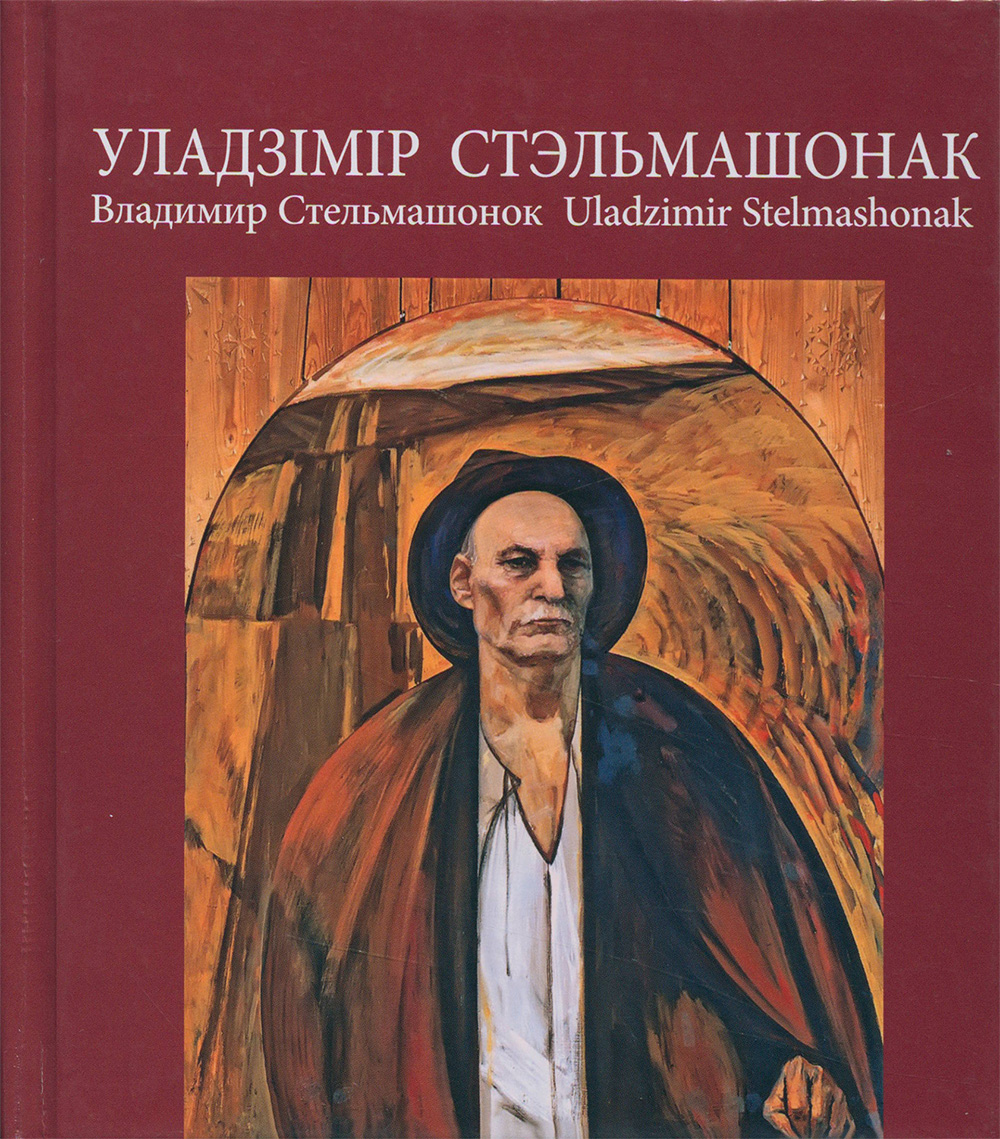
Уладзімір Стэльмашонак
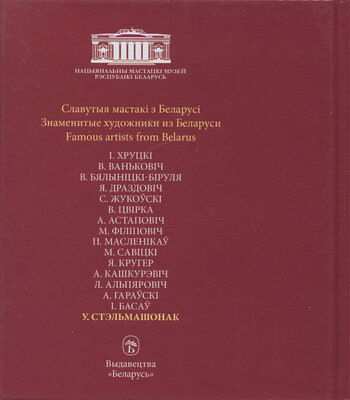
Выдавец: Беларусь
Памер: 74с.
Мінск 2015
The artist was looking for new figurative means in combination of different materials (wood, metal, paper) and in combination of painting with wood carving, collage, applique. These features are peculiar to the portraits of K. Arlousky,
23
S. Prytytsky, A. Minich, the selfportrait (1993), the male portrait (Zone, 1996), to the paintings Sun Stone (1990), Trainer of Riding Horses (1990) and others.
Stelmashonak’s reflections on the roots of professional art and of the national form issue caused scrupulous research of Belarusian folk art: originality of colour schemes of Belarusian fabrics and embroideries, symbols and rhythms of Belarusian ornament with a predominance of white over red and black colours. Numerous paintings and stained glasses of the artist are executed in this precise colour range (portraits of the Peoples Artist of the USSR G. R. Shyrma and poet M. Bagdanovich, stained glass Yanka Kupala for the Museum of Y. Kupala and The Song of the Belarusian Land for Minsk Fashion House (made in coauthorship with V. T. Daugala).
Stelmashonak started to work at monumental objects in the 1960s, when as the elected chairman of the Belarusian Union of Artists he used his organizational skills to create a department of applied arts in BSTAI. For this purpose, monumental artist G. H. Vashchanka was invited from Chisinau and A. M. Kishchanka — from Lviv, ceramist M. V. Belyaeu, fabric designers A. P. Beltyukova and I. K. Vtarushyn were also invited.
The first monumental works of Uladzimir Ivanavich were decorative panels in the sgraffito technique made in collaboration with G.H. Vashchanka for the assembly hall of Minsk Institute of Technology and on the facade of the Culture Palace of Minsk Worsted Mill (1962—1964), as well as a stained glass and paintings in the Palace of Pioneers (1963). In the following years, he created the painting Concert in the entrance hall of the Saligorsk Culture Palace of Chemists (1972), two decorative panels — Belarusian Motif and Rowan — in the sgraffito technique and the stained glass Victory in The Belarus Health Resort (Mishor, 1973), stainedglass windows in the House of Writers (1976) and in the Minsk Restaurant (Potsdam, East Germany, 1977). The latter work is awarded the Certificate of Merit and the Medal of the Potsdam Executive Board. In collaboration with V. T. Daugala the artist decorated the Ploshcha Peramogi metro station and the Maskouskaya metro station in Minsk (1984). Uladzimir Ivanavich was awarded the Certificate of Merit of the USSR Union of Architects
24
and the Badge of Honour Order for two panels (Red Square and Lenin Hills) made in the technique of Florentine mosaic. Active advocacy of national art during the Belarusian Culture Days in the fraternal republics, as well as in Bulgaria, Germany and Italy, was awarded numerous diplomas and a silver medal in Reggio di Calabria (1973). During his trip with a personal exhibition in the United States Stelmashonak was awarded the title of the Honorary Citizen of Trenton (New Jersey, 1989).
A new period of Uladzimir Stelmashonak’s creative work was almost entirely devoted to the history and culture of Belarus. His patriotic desire to fill the gaps in the historiography of his native land, to return to the people lost spiritual values, to renew in their memory the names and images of people who had made a significant contribution to the national culture, led to the emergence of several series of graphic works and paintings. In 2001, a series of graphic portraits of Inbelkult activists (4 sheets with 16 portraits of members of the Institute of Belarusian Culture repressed in the 1920s — 1930s and rehabilitated posthumously) was created on the basis of archival materials for F. Skaryna Centre. The study of the creative biography of poet Adam Mickiewicz laid foundation to the series Muses of Mickiewicz and The Cross of Mickiewicz (the late 1990s — the early 2000s). Journeys to Nyasvizh once known as ‘the Little Paris’ and to covered with legends Radziwill Castle with a magnificent park and theatre on the rampart aroused the imagination of the artist and inspired him to create dozens of paintings, watercolours and drawings. Twentysix portraits of the Radziwill family have been donated to the National Historical and Cultural MuseumReserve of Nyasvizh.
The 70th anniversary of Uladzimir Stelmashonak was celebrated with an exhibition dedicated to the 775th anniversary of Nyasvizh. In February, 1998, the National Art Museum of Belarus exhibited 35 portraits of ‘the uncrowned kings’ of the Grand Duchy of Lithuania. The artist paid particular attention to the image of Anthony Radziwill, an outstanding composer, who was acquainted with J. Goethe and wrote the opera Faust with a libretto by the poet himself 20 years earlier than Charles Gounod. His musical talent was highly
25
praised by E Liszt. Maciej Radziwill also went down in history. He wrote a libretto of the first Belarusian opera Agatka (music by Ian Holland).
The photo album of Radziwills of the late 19th — early 20th cc. helped the artist to create a series of sketches of the castle interiors, which had been changed almost beyond recognition over the decades of robberies, reconstructions and restorations. These elegantly made in pen and ink drawings, as well as all his graphic works, Uladzimir Ivanavich considered minor, although his opinion is debatable.
One of the most attractive aspects of the artists creative work are watercolours, drawings and sketches, which were the result of many creative business trips and tourist journeys across his native Belarus and the vast territories of the former Soviet Union, to European and American cities. Sharp power of observation of the artist, his easy, confident and temperamental performance and masterful skills in using various techniques and creative manners are released in quick virtuosic sketches of street scenes (often of humourous nature), in watercolour landscapes and studies painted in one session. A pencil, a felt pen and a pen were inseparable companions of Stelmashonak. They recorded scenes from a car window, from a boat, from walks, working sessions and official receptions. Piles of travelling notebooks along with a great folk material are still waiting for their researchers.
In his last years, the artist created a series of paintings and graphic sheets of 24 portraits of Minsk honorary citizens. Images of some of them had been enlarged from stampsized photos. At the same time, the Asipovichy Art Gallery was given 36 portraits of Heroes of the Soviet Union, partisans and members of the underground of Asipovichy district.
The social focus of Uladzimir Stelmashonaks activities is obvious. Thanks to his energy and perseverance, a building for the Union of Artists on Tsentralnaya (Central) Square was once secured despite great difficulties, construction of residential houses with studios for artists at Surganau Street and the Palace of Art at Kazlou Street was begun. In 1988—1989, while being the chairman of the Commission on the Aesthetic Education of Young People of the Belarusian
26
Union of Artists, Uladzimir Ivanavich attained the creation of the Aesthetic Education Centre in the building at Nezalezhnastsi (Independence) Avenue near the circus (the building has not been preserved). The Centre ceased to function shortly after Stelmashonak’s leaving for Moscow due to his election as deputy of the Supreme Soviet of the USSR. In the last year of the Soviet Union, Uladzimir Ivanavich headed the Supreme Soviet Committee on Culture. During this time, the Law on Culture was prepared. The law could not be enacted nationally because of the dissolution of the USSR, but in Belarus it was adopted by the Supreme Council in 1990. According to this law, no less than three percent should be allocated for culture from the state budget. Unfortunately, the law has never worked.
In the last decade of the 20th century, U. Stelmashonak managed to become one of the founders of the European Humanities University, the Relato Travel Company, restoration courses of the Engineering Research Centre created under the patronage of Metropolitan Philaret, he was among the developers of the Zamirye Touristic Project, proposed to set a memorial sign on the site of the geographic centre of Europe in Belarus, petitioned to erect a monument to the Belarusian potato at the request of potato growers of the republic; he also advised a priest of Nyasvizh Catholic Church to decorate the crypt with sarcophagi of the Radziwill family with their portraits and even created for this purpose a portrait of Mikalai ‘the Orphan’ Radziwill and presented it to the Catholic church. In general, a majority of his works the artist traditionally gave to different organizations and individuals as gifts. From parents who had been doctors Uladzimir Ivanavich inherited an organic need to bring people good subordinating personal interests to public interests. In our pragmatic epoch such an active civil position looks like an anachronism, but it is a distinctive feature of Uladzimir Stelmashonak — the Artist and the Man.
Iryna Nazimava
Партрэт Якуба Коласа. 1967
Портрет Якуба Коласа. 1967
Portrait of Yakub Kolas. 1967
29
30
Інтэр’ер. 1961
Мнтерьер. 1961
Interior. 1961
Партрэт хірурга I. М. Стэльмашонка. 1953
Портрет хнрурга Н. М. Стельмашонка. 1953
Portrait of Surgeon I. M. Stelmashonak. 1953
31
Успамін. 1969
Воспомпнанме. 1969
Recollection. 1969
Сябры. 1988
Друзья. 1988
Friends. 1988
32
33
Вітраж «Летапісец» у бібліятэцы
Дома літаратара. 1976
Внтраж «Летоплсец» в блбллотеке
Дома ллтератора. 1976
The stained glass Chronicler in the library of the Writers’ House. 1976
34
ВХУТЭМАС. 1921. 1967
ВХУТЕМАС. 1921. 1967
The VKHUTEMAS. 1921. 1967
35
Народныя камісары БССР. Студзень, 1919 год. 1971
Народные компссары БССР. Январь, 1919 год. 1971
The BSSR Peoples Commissars. January of 1919. 1971
A. P. Чарвякоўу У I. Леніна. Студзень, 1923 год. 1972
 КНІГІ ОНЛАЙН