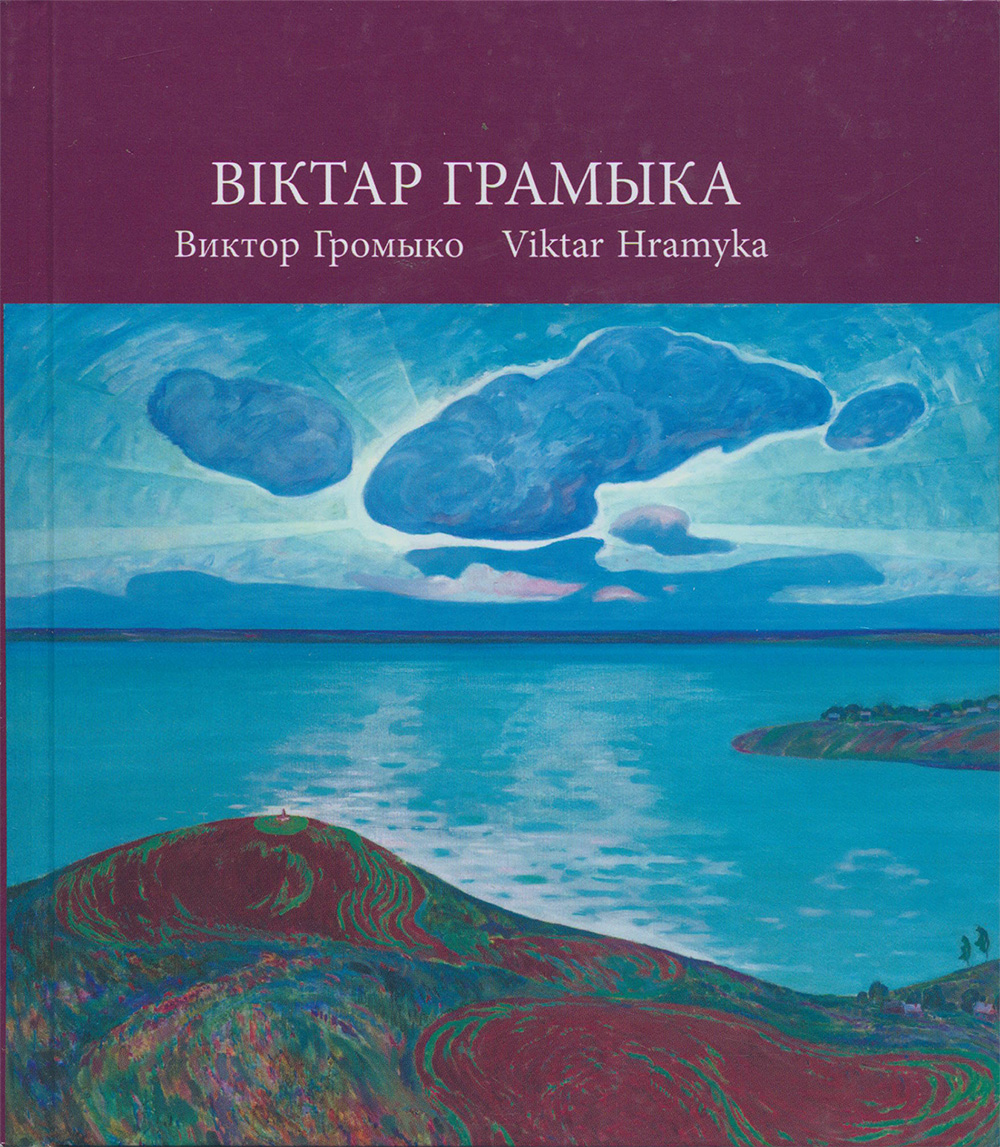
Віктар Грамыка
Выдавец: Беларусь
Памер: 74с.
Мінск 2022
The artist created a furore among the cultural community with his canvas ‘Soldiers’ (1967) at the exhibition dedicated to the 50th anniversary of the October Revolution in 1967. It was his second painting on the memory of the Great Patriotic War after his institute’s thesis ‘Roads of the Avengers’.
19
The subject is simple. Three comradesinarms are standing on the high hill. They remember the killed fellow soldiers. This is a moment of silence. There is a funeral feast by yesterday’s soldiers who are sympathetic and with a pure soul... My God! How many disputes and discussions there were around this canvas! The artist was even accused of‘distortion of reality’! How soldiers and war veterans holding glasses in their hands...with vodka can commemorate someone! From the perspective of ‘smoothness’, which was endowed with many canvases on the war, such reproaches were understandable. It was not supposed to show this... However, a number of official paintings on the war were forgotten long time ago, but the painting ‘Soldiers’ has remained in the painting culture of Belarus to the present.
The artist’s past, war partisan youth and incurable wounds of the war were for him not just memories ‘at the round table. It was an honest mirror of his constant thoughts, feelings and experiences. ‘False mirrors’ were alien to him...
History was never separated from living life for Hramyka. The painter created the images in which a man revealed his true nature in the face of adversity. These images do not consist of emotional glorification or a feat as a personal manifestation, but they are full of pain and troubles, courage and the hardships of the war. In his work as a confession, the painter often returned to understanding the fact and its transformation from a specific dimension into something that constantly lives in time. The partisan theme became the generalized character in which the painter saw, first of all, a free unbroken spirit.
His memory appealed to that holy and unforgettable the young partisan had experienced in the Orsa underground and in the forests of Viciebsk Region. Years later, he depicted these memories in the striking painting ‘Song of My Detachment’ (1978). It is difficult to say what is most impressive here — the troubling nature, penetrated by the last rays of the sun, or the riders following along the river bank in the foreground. Everything is very organic: both plastic, and rhythm, drawing and spatial monumental plans with a detailed design of landscape backgrounds. The genre of the canvas is a ballad painting.
The painter’s philosophical, moral and aesthetic ideal is embodied in his ‘ballad’paintings as‘Ballad of War Youth’(1968), Land (1971), Dedicated to
20
the Women of the Great Patriotic War’ (1972), ‘Polack Land — Partisan Land’ (1975), ‘Apples of the 1941 Harvest’ (1987), ‘Silence over the Old Trenches’ (1995), ‘Memories of the Narac Crossing’ (2009), ‘Dedicated to the Glorious Intelligence Officers of My Regiment’ (2010).
Among them is the painting ‘Over the Prypiac. 1941’ (1970) which after the painting ‘Soldiers’ further strengthened the painter as a bright representative of the ‘severe style’. This was the famous generation of the sixties. The confession painting, the parable painting and the ballad painting... It is about what the 41st year was for our country and people. There are only three figures on the canvas: a fallen Red Army soldier on the sandy shore of Prypiac, next to him is a rifle, a grieving old mother in a black headscarf near his body, and a teenage girl a little further. She holds her hands at her mouth, and as if she is calling somebody for help in desperation. We seem to hear an echo from the girl’s cry: ‘Stand up, enormous country, stand up to a deadly fight...’. There is an intolerable pain in this cry, but also an invisible ray of hope; suffering, but also a human love; great tragedy of death, but also belief in life in spite of death...
Viktar Hramyka is a painter of bright metaphors and complex allegory. He always strove for a multifaceted and rich subtext for his figure paintings and symphonic landscapes. He had the only motto: ‘See the whole Land’. The motto can be attributed entirely to the art of Viktar Hramyka. This Land is the main and fundamental theme in his art: the land scorched by the fire of the war and covered with blood; the land renewed after the Victory; the land and a good moral man on it.
First of all, Viktar Hramyka sings of human feat during the war. The painter perfectly depicts this feat not only in his symbolic and metaphorical canvases, but also in his epic landscapes. They reflect the memory of what he felt during the past war, because his war youth is always in his heart. Over the years, this feeling was not forgotten, but, on the contrary, became strong and filled with revived memories. He picked up the palette with magical colors, or he wrote his memoir called ‘Rainbow over the Road’ (2000) at such moments. What is this book about? About childhood, adolescence and youth, which included the difficult 1920—1930s in Orsa Region, and about the Great Patriotic War, about
21
many months of partisan life mixed with blood and sweat, about heavy losses of human life and victories, about hopes and disappointments. ‘The war is not a firework at all, but just hard work...’. So, the painter’s creative destiny was formed in this fireforge.
In general, the heroic and lyrical theme is one of the key ones in the painter’s work. This can be attributed to his genre and figure painting, and to his landscape, in which Hramyka achieved the heights of excellence. The painter refused the ordinary view of the world, but he reached a kind of‘symphony monumentality’ and a lyrical purity of human feelings.
The synthesis of lyrics and epic quality includes an interesting feature of the painter’s poetic world. There is something permanent and stable in the world — a kind of the orifice of life, a constant flow of daily life, and all the complexity of the worldview, which, as a rule, manifests itself in open dramatic conflicts. Deeply understanding his paintings, it becomes clear that lyrical feelings here are based on more important and stricter principles, which, in the end, turn out to be decisive. So, they organize the entire system of the desired image. It is possible to see some key points in most of the master’s paintings: a strong panoramic reversal of space, the high horizon, an emphasis on certain emotional percussive intonations, smooth musical color rhythms, etc.
Thus, the painter concluded his observations, impressions and feelings in his own space, where there was a plastic focusing of what once seen and experienced whenever. As a result, Hramyka’s new art world took place. This world strictly matched up with reality, and it also had its own internal figure and plastic rules. They allow for a fairly broad and free rethinking of nature in the name of supreme truth of the Image. The love of the Motherland and of the unique beauty of the Belarusian nature is not declarative, but that which comes from the heart. This love fuses with the living memory of the people’s feat on Hramyka’s canvases. He most often preferred the high horizon in his landscapes in order to ‘see the whole land’ and its boundless mountainous expanses from a bird’s eye view. It is possible to see the richness of nature, which so often surprises with bright colors. The uniqueness of the Belarusian landscape harmoniously combines with the richness of emotional intonations, sometimes sublime and
22
deeply dramatic. These are the canvases ‘Cold Day. Braslau Land’ (1963), ‘Red Lands of Polack Region (1970), ‘Belarusian Flax’ (1970; 2002), ‘Symphony of Autumn’ (1974), ‘Hlubielka is the Heart of the Blue Lakes in Belarus’ (1975), ‘Polack Region is a Partisan Land’ (1975), ‘Belarusian Land’ (1977), ‘July Smells of Herbs’ (1990), ‘Silence over the Old Trenches’ (1995) and ‘Late in the Afternoon’ (1996)...
If the rhythm in his epic landscapes is the core of a logical construction, then color is the main way to depict mood and worldview. The painter mastered color and tone thoroughly. This, of course, is not just about technical skill or virtuosity of the brush. Hramyka used the colors of the objective world, and he skillfully filled them with associative images. He provided the color with deep and subtle expressive features.
The painter’s psychological portraits show his excellent realistic talent. Among the expressive portrait images are the portrait of the People’s Writer of Belarus Janka Bryl (1968), ‘Portrait of the Father’ (1977), the portrait of the People’s Artist of Belarus and set designer Jawgien Chamaduraw (1984), ‘Self Portrait’ (1988) and the portrait of the People’s Writer of Belarus Vasil Bykaw (1984), a friend of the artist. The latter portrait is dramatic in terms of depth of feeling.
Viktar Hramyka was also a nice interlocutor with whom one could talk endlessly not only about the main ‘business of life’ — painting culture, but also about the ‘philosophy of being’: from the mysteries of space to the essence of the war prose by his friend Vasil Bykaw, about the unique identity of ancient legends and myths of Orsa land and the irreversibility of Time, which flows in one direction. However, the time of human being, in the artist’s opinion, is not a straight line, because life mysteriously joins up with the beginning at the end of life. Viktar Hramyka lived a long life, and he died on July 10, 2019. The painter left a very rich artistic legacy.
The art of Viktar Hramyka is a phenomenon in the Belarusian national culture, because it appears as an open book of high universal values. He was a romantic realist in his art to the end. As for him, the truth of life was always inseparable from a dream. This is a true national spirit of the people’s artist.
Barys Krepak
Аўтапартрэт у сінім світары. 1966
Автопортрет в сннем свмтере. 1966
Self Portrait in a Blue Sweater. 1966
 КНІГІ ОНЛАЙН