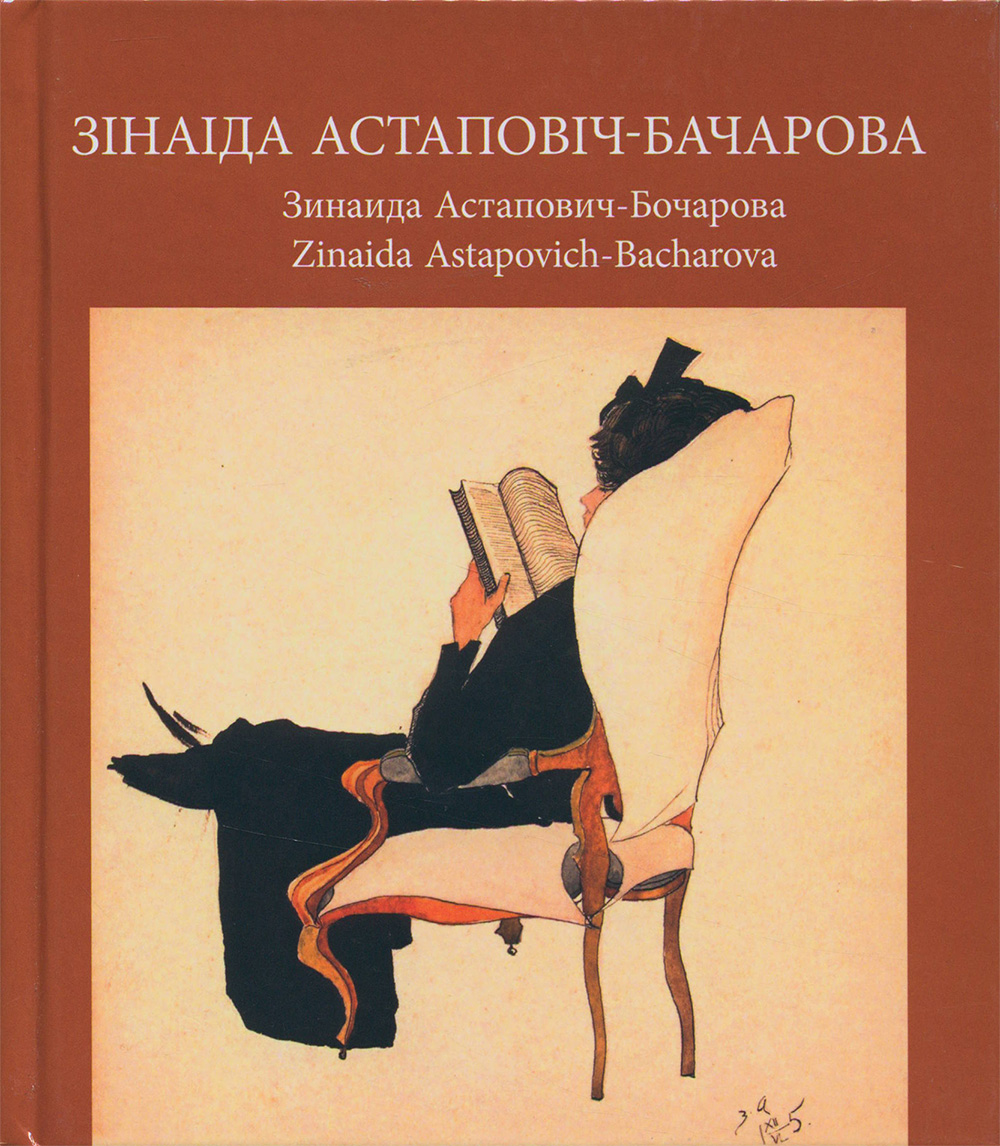
Зінаіда Астаповіч-Бачарова
Выдавец: Беларусь
Памер: 82с.
Мінск 2023
19 Похоронена на вмтебском кладбшце «Мазурлно» рядом с дочерью.
20 Дзесяць стагоддзяў мастацтва Беларусі = Десять веков лскусства Беларусл = Ten Centuries of Art in Belarus: Каталог выстаўкі 27.03—10.07.2014. Мінск, 2014. C. 224.
С/ ^U^inaida AstapovichBacharova1 (1898—1993), the sister of the outstanding Belarusian graphic artist Arkady Astapovich, who died in the first year of the Great Patriotic War, is an example of the now rare phenomenon of ‘unknown artists of the XX century’, more precisely, ‘who wished to remain unknown.
The first exhibition of the artist took place when she was 91 years old2. The joint exposition of the brother and sister’s works in Minsk and Vitebsk in 1989—1990, her posthumous exhibition in 1993 in Vitebsk and by the 100th anniversary in 1998 confirmed that Zinaida Astapovich was not inferior to Arkady in talent.
This album contains only a part of the vast legacy of Zinaida AstapovichBacharova (this is more than 600 surviving works of painting, graphics, illustrations), the most characteristic of her 70year creative path. The artist’s works are kept in the National Art Museum of the Republic of Belarus (more
1 When the artist got married, she took husband’s surname — Bacharova, but in her work she remained Astapovich and until the end of her life she signed her works with them (or initials — Z. A.). To avoid confusion with the work of her brother graphic artist Arkady Astapovich, the compilers of the 1996 catalog decided to call her double surname AstapovichBacharova.
Look: Аркадзь Антонавіч Астаповіч (1896—1941). Зінаіда Антонаўна АстаповічБачарова (1898—1993): да стагоддзя з дня нараджэння: каталог выстаўкі. Мінск, 1996.
2 Усава Н. Аркадзь і Зінаіда // Беларусь. 1989. № 12. С. 22—23; Hers. Першая выстаўка — на 91 годзе // Віцебскі рабочы. 1990. 12 студзеня. С. 4; Аркадзь Антонавіч Астаповіч (1896—1941). Зінаіда Антонаўна АстаповічБачарова (1898—1993): да стагоддзя
з дня нараджэння: каталог выстаўкі. Мінск, 1996.
23
than 50 works), the Vitebsk Regional Museum of Local Lore, the Roerichs Museum in Izvar, numerous private collections abroad, most of them are with her grandchildren in Minsk and Vitebsk, and her greatnephews in Moscow.
Zinaida Astapovich was born in Minsk on September 10 (23), 1898 in the family of Anton Astapovich, a teacher of the mens gymnasium, a native of Navaselki of the Hegumen district of the Minsk province. Already in childhood, they began to draw, first copying reproductions of paintings from magazines, then making sketches from nature. Parents were creative people (father led the choir, mother was a housewifeneedlewoman), supported the children’s passion.
Zinaida always remained in the shadow of her famous brother, researchers inevitably compared her work with the work of Arkady Astapovich3. And this is natural: almost the same age, they grew up together in Minsk and Rechitsa, where their father taught, graduated from the same school, studied with the same drawing teachers at gymnasiums in Grodno, then in 1914 after the death of their father, an inspector of Grodno city public schools, and moving to Petrograd — at school The Society for the Encouragement of the Arts, which was then headed by Nicholas Roerich.
Later, Zinaida liked to emphasize that she was accepted in the first half of 1915 immediately into the fullscale IV class, bypassing the head one (they were accepted to school without exams, based on the drawings presented). Her teachers were neoclassicists with a strong academic reputation V. Naumov and A. Eberfing. But they did not have a greater influence, and not even I. Bilibin4, who led a graphics workshop, but the city of Petrograd itself, whose artistic life, despite the First World War, did not freeze. ‘It was a bright time when we were young, full of hope and energy. We wandered through exhibitions, museums, just about the city on white nights. We lived very modestly at that time on a small pension, which my mother, as a widow, received for my father, but material shortcomings did not bother us at all at that time’5, — recalled Zinaida.
3 Усава H. Аркадзь i Зінаіда // Беларусь. 1989. № 12. C. 22—23.
4 ‘Students brought Bilibin their drawings, he analyzed and criticized them, gave composition assignments’, she recalled // Мастацтва Беларусі. 1990. № 12. C. 32—37.
5 АстаповічБачарова 3. Незгасальная любоў // АстаповічБачарова 3. Мастацтва Беларусі. 1990. № 12. С. 35.
24
Both Arkady and his sister were fascinated by Art Nouveau, its refined line and passeism — the aesthetics of the past. According to the themes, motives and stylistics of the performance, the early works of Zinaida Astapovich can be attributed entirely to the miriskusnic version of Art Nouveau with its languid ‘twilight’ mood of light sadness, the subtle rhythm of curved lines, decorative ornamentation of forms, fluidity of contours and silhouettes.
But already in early Zinaida's works, the future painter is guessed. She loved and felt the color: it is organic in her works — watercolor fits tightly in complex nuances of tone, sharply differing from the transparent detached watercolor undertones of Arkady Astapovich. Zinaida, unlike her brother, was more emotional, ‘restless’. It is not for nothing that in one of his letters to his sister Astapovich called her a ‘butterfly with fiery wings’, as if guessing in her works with a barely restrained cheerfulness of the future temperament that broke free — exuberant, color, major, fascinating. Life ended this period of ‘girlish dreams’ quickly and cruelly, in 1916 Arkady was mobilized into the army, in 1923 his younger brother Anatoly died from an accidental bullet. It was necessary to rely only on yourself and earn a living.
In 1918, after graduating from the school of the Society for the Encouragement of Arts6 (later renamed the AllRussian), Zinaida entered the school of drawing at the Obukhov Factory as a teacher. Hunger and cold in Petrograd soon force her to go to her family in Navaselki, a village near Minsk, where her father once built a house for his parents. Navaselki became her haven for three years. Arkady, a lieutenant of the Red Army, also came to this house in 1922. They teached together at the Navaselki rural sevenyear school and the agricultural college in Maryina Gorka, where Zoya’s younger sister studied.
But their paths do not converge for long. Arkady starts a family, marries his cousin Nina Yakubovich and stays in Belarus, and Zinaida returns to Petro
6 In the certificate issued to her by the Commissariat of Public Education dated December 5, 1918, signed by Commissar P. Naumov, it is indicated that she graduated in three years from the decorative and etude classes of the school of the AllRussian Society for the Encouragement of Arts and received the right to a certificate. From the Personal Archive of A. Smirnova, Minsk.
25
grad in 1923 to continue her education. He tries to enroll in VKHUTEIN — the Higher Art and Technical Institute, the former Academy of Arts, but the questionnaire fails: the daughters of the court adviser are not given scholarships. The old walls help out: in the building of the former school of the Society for the Encouragement of Arts, the Petrograd Art and Industrial College has opened, where she easily enters V. Levitsky and A. Eberling who was already familiar to her.
The second period of creativity begins — the Soviet period, the period of the first creative achievements. During these years, her gift as a draughtsman, portraitist and illustrator unexpectedly manifests itself. ‘SelfPortrait’ (1923), ‘Portrait of N. Yakubovich’ (the middle of the 1920s)7 are painted in oil, with a strikingly strong, almost naturalistic drawing and very careful painting, which was still in the firm rein of realism. No wonder her brother called her ‘my little Menzel’8 in his letters. Tf You did one good job every year, a small gallery of masterpieces would be created until the end of Your days’9, her brother once wrote to her.
Any material, any genre, as before, are given to her easily, without strain — whether a propaganda poster (‘Conquer the air and time’, 1926), with a concise and expressive silhouette of flying planes, illustrations for fairy tales (‘Once upon a time there was an old man with an old woman’, 1922), prose (‘The Story of one love’, 1925), portraitssilhouettes of their friends (‘Portrait of a Friend’, 1925), portraits in charcoal and Italian pencil (‘Portrait of a Woman’, 1926). It seemed that her vocation was graphics.
7 ‘Selfportrait’ and ‘Portrait ofN. Yakubovich’, the cousin and future wife of A. Astapovich, were painted as pairs as a sign of gratitude to Nina Yakubovich, who took her out during typhoid fever. A. Astapovich also liked him very much: ‘.. .Nina’s portrait of your work hangs on my wall and in passing I have a thought: what a wonderful portraitist could come out of you... I look at these two portraits for a long time... ’ // Letter of A. Astapovich to Z. Bacharova dated October 9, 1932. From the I. Nersesova Family Archive, Moscow.
8 Menzel A. von (1815—1905) was a German painter and graphic artist who left behind thousands of realistic drawings.
9 Смірнова A. Д. Жыццё ў згодзе i любові. 3 перапіскі Аркадзя Астаповіча і Зінаіды АстаповічБачаровай. 1915—1941 // Мастацтва. 1998. № 8. С. 16.
26
In 1925, Zinaida made covers for fairy tales in poems by poets V. Erlich and E. Schwartz, the Leningrad magazine published her watercolor ‘Demonstration (1924), the young Samuel Marshak persuaded her to write and illustrate fairy tales herself. But all these rosy prospects, barely dawning, disappear: the Leningrad magazine closes, and books with Zinaidas covers never go to print.
In those years, her brother was her only adviser, teacher, and inspiration. To help her financially, he sends her a small amount of his teachers salary every month. ‘Although our talents are different, but they are equal... If you managed to achieve what you are striving for, it would be 50 % of my life program’10, Arkady Astapovich wrote to her in 1924.
 КНІГІ ОНЛАЙН