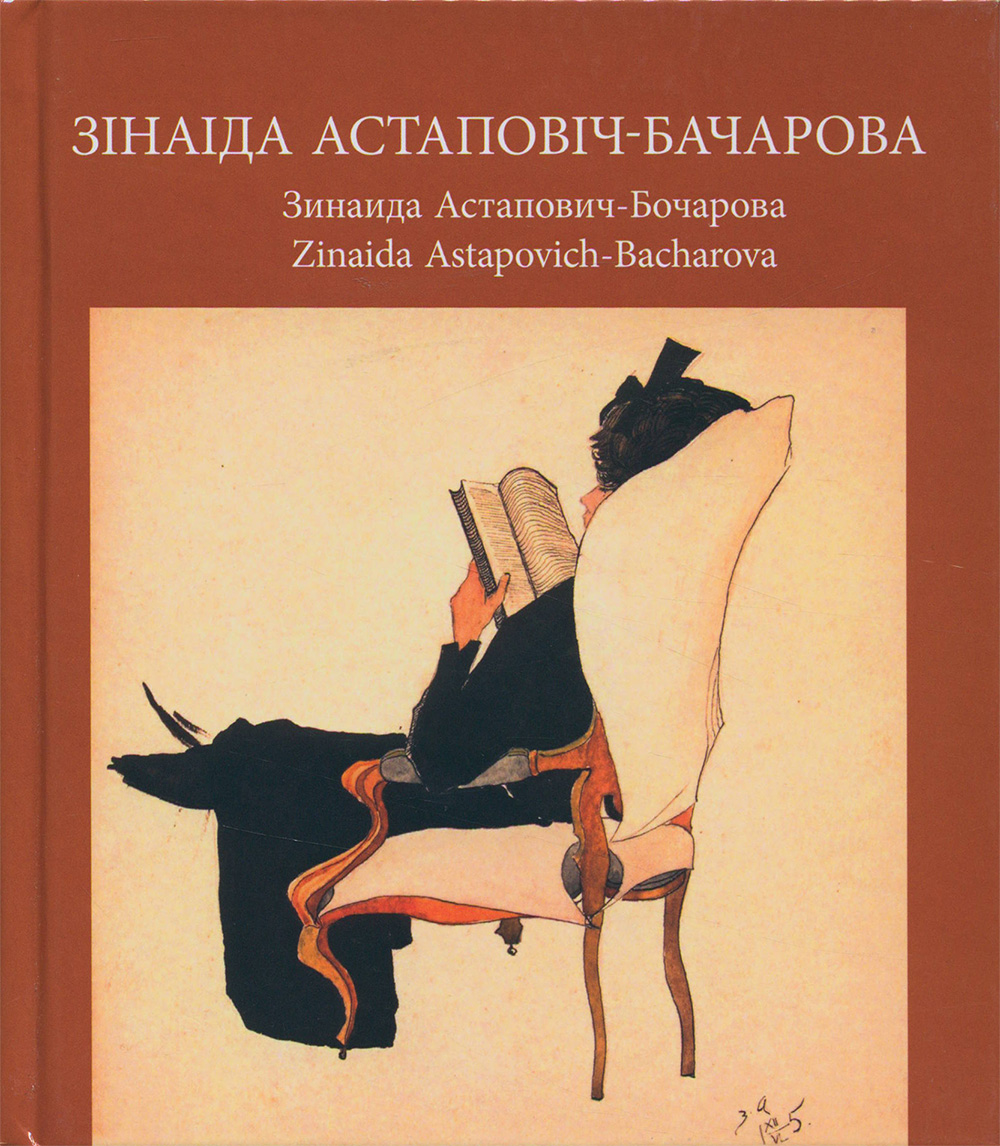
Зінаіда Астаповіч-Бачарова
Выдавец: Беларусь
Памер: 82с.
Мінск 2023
Although Zinaida did not live in the BSSR, the connection with the motherland was not interrupted, thanks to Arkady, she did not fall out of the orbit of Belarusian art.
In 1927, probably through her brother, she received an order from Vaclav Lastovsky, director of the Belarusian State Museum, for a series of drawings of peasant types. Subsequently, they were purchased by museum and demonstrated glued to plywood on special stands. Numerous sketches for this series have been preserved. Powerful, with a rough pattern and bright flashes of color, miniatures have not lost any artistic or historical value to this day. A small pen drawing, possibly a book illustration, ‘On the way to school’ can probably be dated to 1927. The artist solves the theme of the children’s procession in a genre — with all the details of clothing, as a kind of frieze, but this drawing is perceived more broadly and generically — as a path to knowledge.
Orders, of course, stimulated the talent of Zinaida Astapovich, but they were rare, onetime, and it was not in the nature of Zinaida to ‘get’ them11. The ac
10 Смірнова A. Д. Жыццё ў згодзе i любові. 3 перапіскі Аркадзя Астаповіча і Зінаіды АстаповічБачаровай. 1915—1941 //Мастацтва. 1998. № 8. С. 16.
11 ‘In my opinion, you still made a mistake that you didn’t go to publishing houses anymore. So you don’t get anything out there from one or two times, and if an opportunity turns up, by chance, let’s say, you get a job, and then it goes on and on. And I went several times, only I have to say, I didn’t go much...’ // Letter of A. Astapovich to Z. Bacharova dated October 24, 1934. From the I. Nersesova Family Archive, Moscow.
27
tive period of creativity is interrupted in February 1928 by her marriage (not without hesitation and on the advice of her brother, she accepted the offer of a veterinarian Ivan Bacharov) and the birth of her daughter Nina. She leaves Leningrad for a short time, moving to her husbands place of work in the city of Novorzhev, Pskov region. But already in 1930, the family returned to Leningrad, where Zinaida Astapovich, by Bocharov’s husband, taught graphics for 11 years at the Leningrad Veterinary Institute, where her husband, a future doctor of sciences, who became director of the Institute in 1937, worked and studied in graduate school. The daughter was often ill — there was less and less time for creativity. And yet it was in the 1930s that Z. Bocharova begins to seriously engage in painting, especially in the summer months. In Merevo near Luga, where the Bocharovs’ dacha was and the whole family gathered, brother Arkady came to study more than once. Unfortunately, this painting was partially lost during the evacuation to the village of Zaozerye of the Molotov (now Perm) region in 1941—1944.
In 1942—1944 Zinaida teached drawing in Molotov secondary school № 66. The surviving sketches of the 1940s are still traditionally realistic. Color and free broad painting will appear later, in the village of Rybnoye, Ryazan region, where Zinaida, after her divorce from her husband, moved after her daughter Nina’s family in 1955. Here, in a small village, where Nina was invited to the research Institute of Beekeeping, her mother’s gift blossoms, as well as a master of floral still life and a landscape painter; she often paints views from her window and the courtyard at home.
As a wonderful gardener, she sets up her magnificent flower beds at home — growing gerberas, asters, nasturtiums, dahlias. In the afternoon, after putting his little grandchildren to bed, inventing a new fairy tale for them every time, he takes his soul away in still lifes — joyful, excessively lush, and major — in spite of difficult family circumstances, the change of the prosperous and wellprovided way of life in Leningrad that has become habitual.
And yet it was not this painting that became the true legacy, the creative face of Zinaida AstapovichBacharova. She found herself only in Vitebsk, where
28
she lived in her daughter’s12 family for the last 30 years of her life, since 1963. It was here, at the time of her life’s autumn (she was already well over sixty), that her generous coloristic gift suddenly spilled out. This ‘late Vitebsk Renaissance’ produced hundreds of truly original works13.
The places of her constant walks — cozy small courtyards, squares, parks and embankments of old Vitebsk, the surroundings of the country area in Lettsy near Vitebsk — became the real motives of a huge series of magnificent gouache miniatures. Some of them are quite recognizable (the series ‘Vitebsk courtyards’, 1960—1970s), most of them are fictional. ‘She saw even the modest Belarusian landscape as a part of the universe’14, — noted journalist Ilya Kurkov.
These amazing color harmonies were often a reflection of her mood (‘I rejoice’), sometimes an impression of real motives (‘In the Park’), rarely — fullscale sketches (‘Dvina Embankment’). As if hiding under a bushel, the dormant color talent of the artist broke through at once, overnight, giving several hundred hedonistic works performed easily, artistically, inspiringly. Their color orchestration is so rich and exquisite, the techniques are so bold and diverse, and the performance is so masterly that some of these small works can be safely called her masterpieces. In terms of quantity and ingenuity, only no less numerous illustrations to fairy tales and Russian and foreign classics can compete with them, which she has been doing all her life ‘for herself’, reading books literally ‘with a pencil’.
These numerous illustrations (dozens, maybe hundreds of them — strange, bizarre, often grotesque), written in gouache or watercolor on cardboard cake bottoms or painted with colored pencils, she did not appreciate too much, called
12 Smirnova Nina Ivanovna (1928—1988), nee Bacharova, after defending her doctoral dissertation on beekeeping in 1963, was invited to the post of professor at the Vitebsk Veterinary Institute.
13 Усова H. M. Зннанда Антоновна АстаповпчБочарова // Сообіценмя Государственного художественного музея БССР. Выпуск 1. Мннск, 1994. С. 95—100.
14 Курков, 14. Последняя в Беларусм ученнца Рернха // Обозреватель. № 31 (518). 8 августа 2012. С. 14.
29
them ‘faces’, but she could not help but splash out her passion for ‘reviving’ book characters.
Vitebsk is a city of artists, an art and graphic department worked here at the Pedagogical Institute in 1959, wonderful masters taught — graphic artist Grigory Klikushin, a graduate of VKHUTEIN Valentin Dzezhits, her younger contemporaries lived there — painters Pyotr Yavich, Alexander Solovyov... But it never occurred to her to go to the Union of Artists or the Vitebsk Regional Museum of Local Lore to show her works, to arrange an exhibition: delicacy and modesty, selfdemanding, inner dignity, a high bar for evaluating a work of art prevented her.
The creative longevity of Zinaida AstapovichBacharova turned out to be almost equal to life. Her last works date from the second half of the 1980s: a series of pencil sketches with the philosophical title ‘Passing by’ — grotesque, even somewhat caricatured instant observations from the firstfloor window of an old man whose living space has narrowed to the limits of the apartment15.
75 years out of 95 Zinaida Bacharova lived under the Soviet system, but did not, oddly enough, become a ‘Soviet artist’. The miriskusnic inoculation and the strongest creative charge of experiments of the unsurpassed 1920s affected. She, both as a person and as an artist, had a wise acceptance of the flow of life as it is. She simply and sensibly looked at the collisions of fate — that’s why, maybe, the pathos of socialist realism and the conjuncture did not touch her personality, although the changing style of time in her works is very noticeable. The motives of her work remained outside the generally accepted Soviet production — simple, chamber: flowers, children, fairy tales, nature, motherhood, ballet16 native faces. This unclouded creativity, of course, is the result of its tightness, its ‘disconnection from artistic processes and ideological demands of the state.
15 Усова H. M. Зннанда Антоновна АстаповмчБочарова // Сообшення Государственного художественного музея БССР. Выпуск 1. Мннск, 1994. С. 95—100.
16 BDAMLIM. Е 448. The personal fund of Z. AstapovichBacharova has 337 storage units. In addition to documents and letters, these are landscapes; sketches and sketches on the themes of ‘Ballet’, ‘Motherhood’, etc.; portraits and sketches of people; still lifes; book graphics; ornaments, etc.
30
She never perceived her obscurity and creative seclusion as a tragedy: she worked for herself, because ‘when I didn’t draw, it bothered me, it was impossible not to draw’17. The unknown was the price of creative freedom; she paid this price simply and naturally, like everything she did18.
But Zinaida AstapovichBacharova always lived with an inner feeling that sooner or later recognition would come, and calmly, without fuss, she waited for ‘her hour’. And he came. When asked by journalists at the opening day of her first exhibition what Zinaida would have chosen if she had been given a different life, she answered without hesitation: ‘creativity’ AstapovichBacharova died on September 26, 1993 in Vitebsk at the age of 9519, becoming a phenomenon of Belarusian art.
The work of Zinaida AstapovichBacharova fits into the framework of most of the twentieth century. But her works can no longer be ignored in the XXI century — and not only in the cohort of Vitebsk artists of the twentieth century. It is not for nothing that she entered the permanent exhibition of the National Art Museum of the Republic of Belarus, was elected an exhibitor of the grand exhibition ‘Ten Centuries of Art in Belarus’20 (2014) at the National Art Museum of the Republic of Belarus.
Nadzeya Usava
17 Завадская 14. Ee Серебряный век // Беларусь сегодня [electronic resource]. Mode of access: URL: https: //www.sb.by/articles/eyeserebryanyyvek.html. Date of application: 07.04.2018.
 КНІГІ ОНЛАЙН