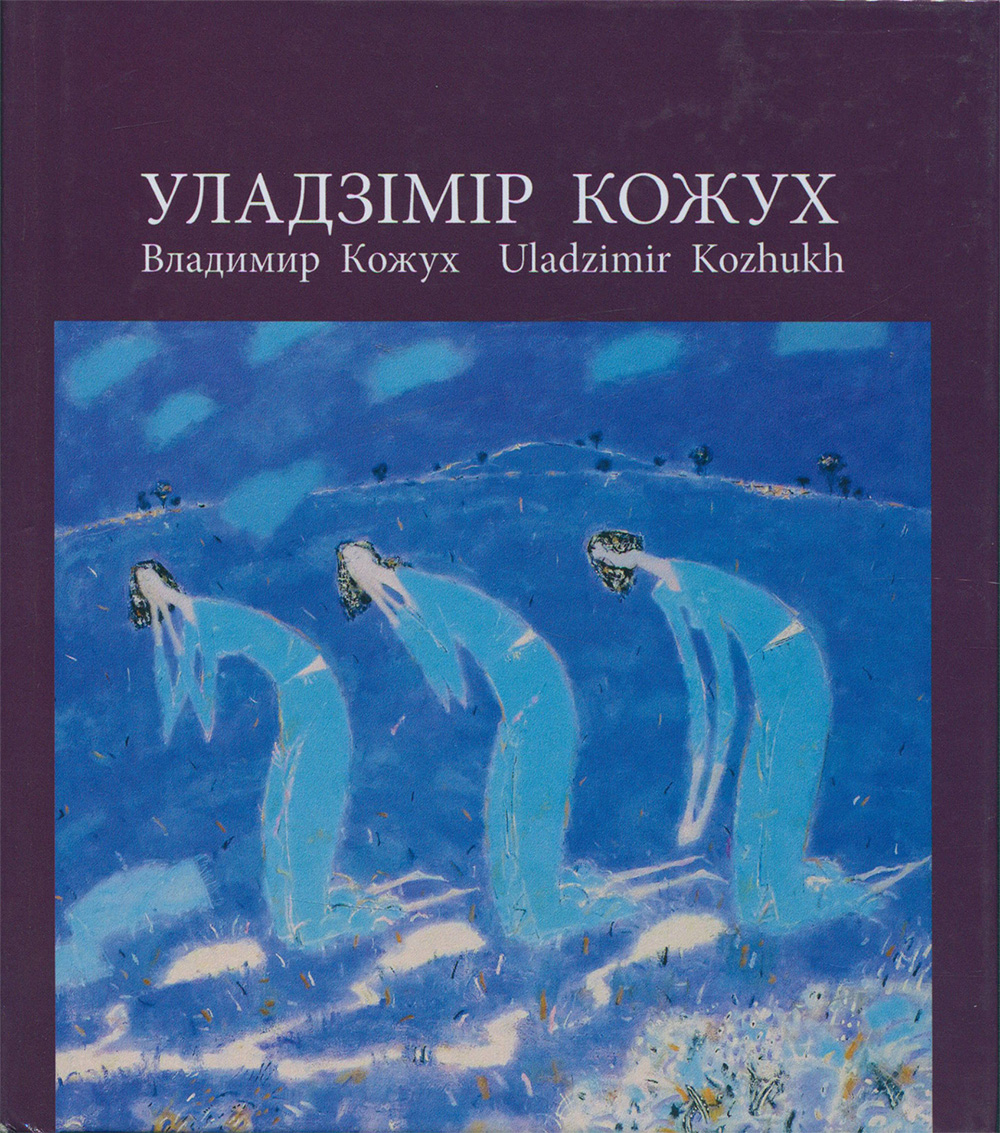
Уладзімір Кожух
Выдавец: Беларусь
Памер: 82с.
Мінск 2018
During this period the artist creates an excellent cycle of artistic paintings including some devoted to the Belarusian landscape with its boundless fields and hills, herds of cattle and river banks, which are familiar since childhood. An allegoric image of a working mother is usually set against their background. The author doesn’t conceive them straightforwardly-they are full of complicated associations and philosophical reasoning, that begin on paganism time. In simple picturesque designs like “Field”, “Native, clear, fair”, “Three fields”, “Pakrou”, “Flower girl” the author fills his canvases with an absolute semantic and colour poetics, as if encrypts nation’s code.
With the course of time Uladzimir Kozhukh’s work gains a great social-artistic and philosophic meaning. The artist successfully realizes his excellent knowledge and skills in a social topic — in a series of artistic paintings and drawings of “Chernobyl album”, which he started in 1986 at the scene together with the group of his colleague-artists. At the “Chernobyl tragedy” exhibition, which was held in Arts Palace in 1987, people were struck by his works — “Goodbye home” (1987), “Nostalgia” (1987), “Security guard” (1987), “Guide” (1987) and especially a painting “Unglued”, in which the artist shows an expressive lifestyle of a man with his helplessness in the face of radiation, that carries unseen poisonous clouds to the man’s eye and makes people leave their home. Uladzimir spent some time in Chernobyl Exclusion Zone, in settled out Belarusian villages embodying the great tragedy of native people which remained in his heart in drawings and drafts.
His painting “Cleanup” (1987) sounds highly symbolic and has an allegorical accord. Two firefighters are set against a light background of church and try to clean a spiritual sanctuary of radiation. Despite its fragmentarity,
24
dynamics, movement and active perspective are felt in this work by means of two contrastive figures in camouflage smocks. They are standing around the image of Holy Mother with Jesus Christ on the stairs above the closed doors. Ocher-red image forms a dominant idea of the painting — it seems that firefighters are trying not only to clean the church of radiation, but also to clean our souls of a great lapse from virtue. In 1991 Uladzimir Kozhukh was awarded the prize of Belarusian Federation of Trade Unions for a cycle of artistic paintings named “A black true story of Chernobyl. A part of his works was exhibited during the 45th UN General Assembly session and had a great international success. Later some works from this cycle were donated to the Brahin Museum of Local Lore.
In 1994 Uladzimir Kozhukh took part in the first international plein-air festival named after M. Shagal. An independent jury awarded him a special prize from joint-stock commercial bank “Belarus”. It was the publication of a personal catalogue of his works and I count myself lucky to announce it in the opening article. It was an acknowledgment of his talent internationally.
Elated by success, the artist works even more diligently in three different genres. It seems that he could work with all kinds of topics. The topic of the past war was especially exciting for him and he tried to reflect it not straightforwardly, showing all the seriousness of Belarusian partisans and their families struggle and life in the forests and bogs during the German occupation, but through the imaginative-psychological completeness of characters and figurative-compositional perfection of the work (“Forest school’, 1985) — from a young teacher with books and a globe to adult men, who put the last shaved floor boards and a boy in a light door opening against the forest and armed partisans...
The topic of Afghanistan also should not go unnoticed. It has gone through the artist’s work. At first organizers didn’t want to take his picturesque canvas “By the Order of the Red Star” (1986—1987) to the exhibition — so great was the wave of tragedy in it and so ingeniously was it resolved by the young artist
25
for that time. He reveals the tragicalness of the situation through a deep psychologism and dynamics of parents figures, who lost their son in a far-away Afghanistan.
In 2015 the artist tries to move to a new level of understanding the topic of past wars, military conflicts, participation of our fraternal Slavic peoples in it and remembrance of victims. In artist’s work “Vanya, Ivanka, Ivan” (2015) he finds an absolutely different artistic vein as opposed to the severe style of his teachers and colleagues — contributes a higher lyrical note to the artistic, tragic solution of the design: three young soldiers at meal with a white towel, loaf of bread and three remembrance glasses, that like brothers forever raised together over the native village landscape.
Many works by Uladzimir Kozhukh are devoted to the topic of national renascence, the topic of Christianity, national holidays that are dear to him since childhood. Not without reason the image of the native Drahichyn church appears in many of his picturesque works. More than 30 picturesque canvases were presented in the art gallery of BSU Theology Institute in 2013. They were created by the artist during different periods, but all they are united by the same topic — “The light of soul”. The series of designs “At Easter”, “At Christmas”, “On Trinity”, “Savior of the Apple Feast Day” are devoted to Eastern Orthodox holidays. Each work impresses not only by a great general spiritual completeness, but also by uniqueness, colour-compositional solution of each of them. The work “Devotion” which was overseen by the artist already in his childhood should be noted from this cycle. It amazes by its warmth and the symphony of kindness: a pregnant woman with eyes closed holds the prayer book in her hands and asks God for good for her family and future child... The figure of Belarusian Madonna looks very emotional and artistically perfect against the background of a dark starry sky in light colours and expressive style.
In the early 1990s Kozhukh asserted himself as a mature artist, artist-innovator, and modernist. Semantics of his artistic paintings originates from Be-
26
larusian antiquity, maternal folk songs and Rushnyks, Belarusian sacred art. The work “Beginnings” (1994), where three women near a fountain symbolize not only fraternal peoples, but also the image of three Madonnas, who went down from the holy icons — is a shining example of authorial ethnomodernism. It concerns also a narrative-topical painting “Yakub Kolas” (triptych 2007), where our poet is illustrated in three guises — not only as a classical poet, but also as a descendant, a citizen of his motherland, who has preserved his historical roots and communication with dear land.
A picturesque melodics of ethnomodernism is characteristic of Uladzi-mir Kozhukh’s canvases, that are devoted to the topic of women and is full of original unique tone. A lyrical line going alongside with astonishing women characters, that admire not only by their beauty, harmony but also fill every work with light poetry of winged sentiments became typical for the author: “Flower girl” (2002), “Like a bird” (1999), “October. Road. Rain” (2011) etc.
Especially enraptures a glamorous, picturesque sense of plastics of the artist in the works, generally devoted to the characters of women in tune with the nature landscape melodics from the series “Flora”: “Careful Flora” (2001), “Pigeon’s milk” (1999), “Girl in white” (1994), “Springlet” (1997), “Flora” (1998), “Flood” (1998), “Ablution. Flora” (2003), “The songs of autumn” (2002), “The songs of spring” (1998), “Flora. South” (1997). Except the characters of hard-working women — “Flower girl”, “Girolies”, “She, that stays in the water , and also a cycle of works with Flora-woman, a special place belongs to the topic of “Artist and Muse”, fair one — the symbol of everything primal and immortal: “Master” (1994), “She, that lies on the hills”(2002), “Eva” (2005), “Pink evening” (1992), “Evening song” (1994).
The works, where the artist delicately, with consummate skill models a woman body, as well as naked, with elongated proportions against the landscape are full of especially delicate figurative-compositional melodics. This fact adds them a highly-artistic aesthetic appeal as to the work of art. It is one
27
more his talented artistic guise, which is invented by the author or creatively interpreted by him from antique culture. Among the generalized female characters we involuntarily find authors comparison with the characters of fairy maidens which are also borrowed from the national carpets and closely connected with Belarusian folklore. There is a wish to particularly note a unique work “Portrait of Alena Kish” (2006) embodying a huge spiritual energetics of both artist’s archetype herself and her work — the carpet, that are organically united compositionally and graphically in the one unit.
Uladzimir Kozhukh, in our opinion, by his work managed to slightly open the mystery of Alena Kish’s artistic heritage and to show the beauty of the artist herself, that nobody could do before him.
The picturesque designs, devoted to contemporary artists, with whom Uladzimir had being on friendly terms for a long time and knew them well should also be noted. “Portrait of Uladzimir Prakaptsou” (2016) and also Open. Maryna and Mikalai Isaenka” (1989). These canvases are filled with warmth and kindness of the author, that he always willingly shared with everyone.
Recently Uladzimir Kozhukh went to considerable lengths, that concerns the creation of a series of outstanding scientists portraits for the presidium of The National Academy of Sciences of Belarus. Many of them had to be reconstructed according to the photos and engravings of different epochs, but despite their representational character, each of them is full of a deep imaginative-psychological meaning and realized at a high art level. In order to reveal their characters, the author had to work a lot with the relevant documents. The portrait of M. A. Savitsky-academician-artist and Uladzimir Kozhukh’s teacher, to whom his talented apprentice was grateful all the creative life for “life institutes” stands out notably. The portrait is made in a warm colour against an ornamental background of Belarusian carpet with a loaf of bread on the table and Second World War weapon, that reminds of the subjects of the famous works by this brilliant artist.
 КНІГІ ОНЛАЙН