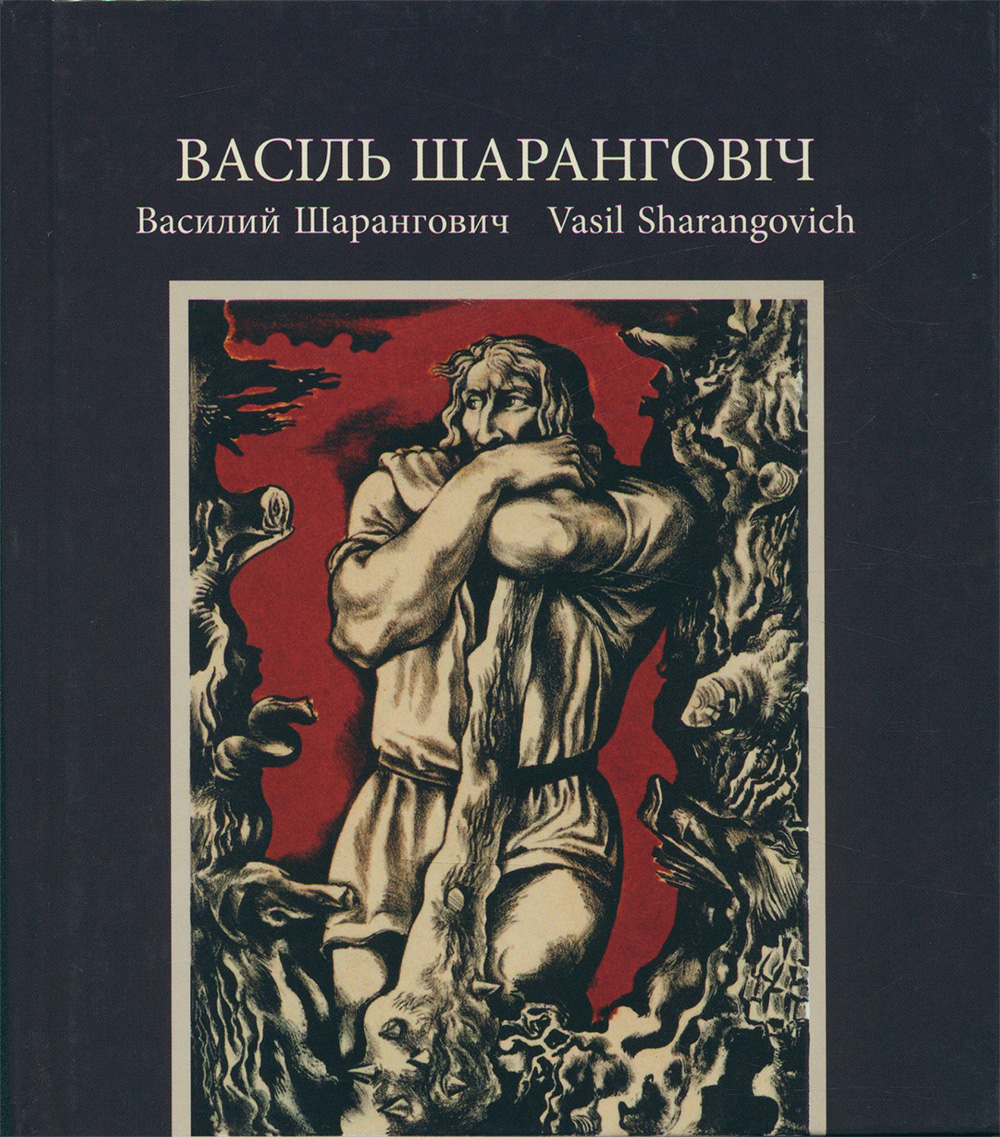
Васіль Шаранговіч
Выдавец: Беларусь
Памер: 74с.
Мінск 2024
When asked when he started drawing, Vasil Sharangovich recalled that it began during the war years, at the end of 1943 or the beginning of 1944. A partisan gifted him a green pencil. The boy, who was about four years old then, saw a pencil for the first time in his life.
Naturally, there was no paper. But in the house’s passage there was a wooden cabinet made by his father. The outside was painted, but the inside of the door remained the light colour of planed wood, so, to the boy, it seemed suitable for drawing. And then, when there was no one in the house, he carefully began to draw on the doors. Little Vasil’s drawing was supposed to depict village men lounging in a bathhouse. He closed the doors, but after a while his “masterpiece” was discovered, for which he received a good thrashing from his father.
In the year 1948, when Vasil was in 3rd grade, his father brought him a box with six coloured pencils and some paper from Myadzel. At that time, schools were already issuing squared or lined notebooks. And this paper was completely clean. What a beauty!.. So, already in childhood, Vasil developed a reverent attitude towards white paper. This special feeling remained with Sharangovich even when he became a renowned graphic artist.
27
Meeting the teacher Genadz Astrousky at the Myadzel secondary school became fateful for Vasil Sharangovich. It was Astrousky who advised the youth to enter the Minsk Art School. And it was quite scary for a village boy of just 15 to decide to take such a step, to plunge into another, totally unfamiliar world of the city...
The art school at that time was located in the Minsk Opera House. Much of what was required in the entrance exams was unfamiliar to Vasil. The results turned out to be low; he did not pass the competition and had to return to school to study in the 9th grade.
The failure did not upset Vasil Sharangovich too much. On the contrary, he became sure that he was in fact able to enter the school; he just needed to work harder. There was an inner inspiration and confidence in his desire to become an artist.
The following year, Vasil applied to the Art School again. This time, the examination committee gave the youth the highest grade for his work. The dream came true —Vasil Sharangovich became a student at the Minsk Art School.
The years of study flew by quickly. Sharangovich recalled: “In the second year, the oil painting course started with still lifes. I’ve already said that before college I made only one work in oil, a copy. After watercolours, it was quite hard to switch to oil painting. For my second or third still life, I used my mothers black and orange bedding as the model for the drapery. The still life was very interesting, and I brought a subframe with a canvas measuring about a meter on the larger side. Well, I really suffered over this still life, having no experience, and with such a large canvas!.. But I never liked anyone else to do my work for me, only myself. I will suffer and worry, but I will achieve my goal. This applied to any sort of work, and even more so to art. But tips and advice — that I eagerly accepted and listened to...”
The time has come for the defense of graduate works at the school. In those days, in order to apply for admission to the institute, a technical school graduate had to have a referral from the Ministry of Education, for which there was a certain quota. The best received the referral, and students with honours decided themselves whether to enter an institute or not. Vasil Sharangovich also had such a benefit. So he decided to enter the Belarusian Theatre and Art Institute, choosing an allnew specialty — graphics. Until then, graphic artists in the USSR
28
were only trained in Leningrad, and the demand for them was enormous, since the field of applied graphics included posters, fonts, leaflets, acerbic caricatures, and book design...
Vasil’s life was completely taken over by his studies at the institute he became interested in etching, lithography, and then linocuts and book illustration. A little later he came to a real understanding of the role of drawing as the main tool of the graphic artist, and it took its rightful place in the artists further work.
In 1962, during his 2nd year, the Belarus publishing house invited Vasil Sharangovich to illustrate “Paths of Smiles”, a children’s book by Ivan Muraveika. From then on, Sharangovich began to work regularly for publishing houses, “Maladost” and “Viasiolka” magazines. During his studies at the institute alone, Vasil Sharangovich created illustrations for 13 books, 3 of which received awards at republican book design competitions. Throughout his entire creative life there were more than 70 of them.
Sharangovich prided himself on the fact that in 1964 he became the first among Belarusian artists to create a set of illustrations for “The Vilna Communards” by Maxim Garetsky. The artist liked the novel; he was impressed by the scale of the historical events reflected, the beautifully conveyed atmosphere of the era, and exploration of thenunknown aspects of the revolutionary struggle in Belarus and Lithuania.
His studies at the institute were coming to an end. Vasil Sharangovich recalled: “The most important thing was the graduate work. During my student years, I became very interested in the work of Yanka Kupala, since his poetry felt so close to me. I began to analyse why my parents and their fellow villagers live like this, why they are always so poor. And their thoughts, reflections and doubts found a real response in the poetry of Yanka Kupala, especially in his poems about the life of peasants”.
New solutions of form: sharp, bold, expressive — were characteristic of Vasil Sharangovich’s student works. The university graduate work was built on contrasts of intense lines and planes. The plastic language was based on a laconic composition free from verbosity; splashes of colour, large strokes emphasised the almost sculptural monumentality, density and integrity of the images.
29
This series and the artists early works in general are characterised by the convergence between linocuts and woodcuts: the author abandoned tonal nuance and shading, overemphasised the juxtaposition of black and white, and brought the composition into the rhythmic system characteristic of woodcuts. Already here the basics of Vasil Sharangovich’s future work were laid down: sharp, dynamic composition, energetic draughtsmanship, expressive rhythm of details. One of the features of his artistic style is the ability to bring a plastic image to the expressiveness of a symbol, which embodies the essence of ideas fundamental for the artist and is able to exist not only in the context of a specific work, but also, to a certain extent, takes on a life of its own.
For this series, which to this day has not lost its artistic and social relevance, the young artist received excellent grades. At the AllUnion Exhibition of Graduate Works, the USSR Academy of Arts the first time in the history of the institute awarded the work with an honourary diploma.
After graduation, Vasil Sharangovich worked for a year as an art editor at the Belarus publishing house. During this period, he illustrated 21 books and sketched out a set of illustrations for a collection of poems by Yanka Kupala. Among Sharangovich’s book designs are: illustrations for a collection of works by Maxim Bagdanovich; “The Nightingale”, a short story by 2mitrok Biadula; a miniature book of poems by Yakub Kolas; “Village Novels” by Mikalai Rakitny; “The Land of Navagrudak, My Native Land...” a collection of ballads by Adam Mickiewicz, Vladimir Ilyich Lenin”, a poem by Vladimir Mayakovsky; Alexei Tolstoys fairytale “The Golden Key”; Uladzimir Karpau’s short story “Niamigas Bloody Shores”. Many of these books received honourary diplomas from allUnion and republican competitions, and the Francysk Skaryna medals.
As a surprise came the commission from the Khudozhestvennaya Literatura publishing house in Moscow to produce illustrations for John Reed’s book “Ten Days That Shook the World”, published as part of the “World Literature” 200volume collection. After the release of the entire series, it turned the all the illustrators were already renowned graphic artists; Vasil Sharangovich was the only beginner among such an honourable company.
Among the important easel works of that period, worthy of mentioning are “The Portrait of Francysk Skaryna”; “The Potter”, a lithograph; “And, Say, Who
30
Goes There?” a monumental lithograph based on the eponymous poem by Yanka Kupala; “The Death of Grazyna” a linocut based on the poem “Grazyna” by Adam Mickiewicz; “The Blockade”, an autolithograph series, “Yakub Kolas in the School in Lyusina”, an engraving; and “The Narach Land”, a largescale linocut series.
The story behind the “Narach” series is rather curious. Initially, the artist was commissioned by the Union of Artists of the USSR. Vasil Sharangovich worked on the linocuts for a long time, making drawings, sketches, and studies in his native places; he visited Narach fishermen at dawn, when they were returning from night fishing. The artist wanted to embody the grandeur, monumentality and beauty of the nature of the Myadzel region, the traditional song festival on the coast of Lake Narach, and to create portraits of the hardworking fishermen. The large scale of the engravings required not only ultraprecision of technique, but also confident use of the chisel; it took a lot of time and significant physical effort.
Vasil Sharangovich recalled: “Having made an incredible effort, since I had never created engravings of this scale before, I finished the work and made the first test prints. When I saw the result, I was horrified. Nothing corresponded to my inner vision, to the images I dreamed of in the depths of my soul. For the uninitiated, I will explain that engravings are cut almost blindly; the artist relies only on his feeling, experience, and subtle sense of the material, the firmness and precision of his hand... I am by nature an ambidextrous person. I do some things with my right hand, some with my left. The most difficult physical work is done only with the left hand; I write and draw with the right. But it turns out I cut engravings with my left...
 КНІГІ ОНЛАЙН