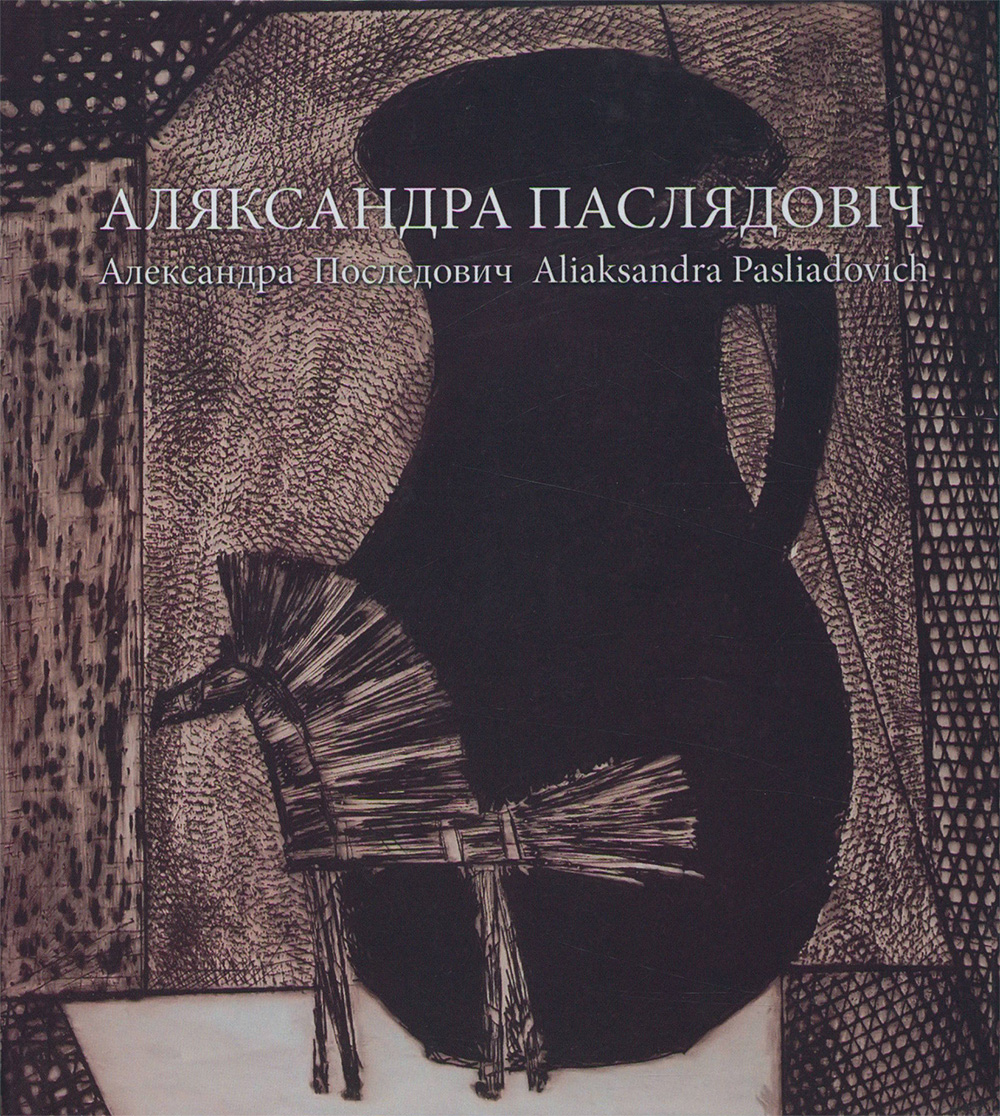
Аляксандра Паслядовіч
Выдавец: Беларусь
Памер: 98с.
Мінск 2021
Aliaksandra Pasliadovich was born into the family of a railway worker in Minsk on April 23, 1918. Being a schoolgirl she studied in the studio of famous painter Valiantsin Volkau. In 1938, she entered the Painting Department of the Viciebsk Art College, the only educational institution of the BSSR at that time. Raisa Kudrevich, the famous Belarusian artist, Aliaksandra’s close friend and classmate, shares her memories of the prewar years: ‘The war caught us in Viciebsk. We grabbed documents, photos and some other things. We got to Penza with different adventures. From there, we were carried on a cart to Kontsavka Village of the Penza District (the Kuibyshev Region), where we began working on the collective farm, which was located on the high bank of the Volga. Once, we made a turf note on the other bank: ‘Girls from Minsk live here’, hoping that someone from steamers and barges passing by would pay attention and respond.
1 Шматаў B. Ф. Сучасная беларуская графіка. — Мінск: Навука і тэхніка, 1979. — С. 37.
31
But we hoped in vain’2. After that, the artist had to be evacuated first to Kazan and Ufa, where she worked at the car plant, then as a tour guide in the museum. Later, Aliaksandra successfully passed her exams and was admitted to the Leningrad Institute of Painting, Sculpture and Architecture, which was evacuated to Samarkand. In 1944 students and teachers returned to Leningrad and began to restore the destroyed institute. In the first years, Aliaksandra Pasliadovich was engaged in painting, but she changed over to the Graphics Department in her fourth year. ‘Did I regret it?’ — She recalled. — Never. Sometimes I felt that I was drawn to color. This must be why I was keen on color lithography’3.
Among the teachers of the USSR Academy of Arts (she studied under Vladimir Konashevich and Gennady Epifanov) was artist Konstantin Rudakov, about whom her memoirs have been kept: ‘He was a gentle and kind teacher, but demanding and sometimes he could play a joke on someone. Then, he took a sheet of paper, paints and palette, so we watched and waited to whom the masterly painted watercolor would be presented’4. After she had successfully defended her graduation work — the design of the book ‘Courage’ by Vera Ketlinskaya, Aliaksandra Pasliadovich began her career in Leningrad. Since 1953, she had been actively working for the publishing houses Molodaya Gvardiya, Lenizdat, Detgiz, and Gosizdat. She was admitted to the Union of Artists of Leningrad in 1954. In 1956, with the help of her friend Raisa Kudrevich and her friend’s husband Adolf Huhiel, the artist returned to Minsk (her parents lived in Vilnius at that time), where she stayed to live. One of her first works in Minsk was illustrations for the poem ‘Simon the Musician’ by Jakub Kolas. The style of these early works is traditional — a detailed and slow narrative that accurately reproduces the poem events. The artist fills the image with psychologism, so
2 Данекіна B. «Аб табе я ўспамінаў i думаў больш чым аб родных і самых блізкіх сябрах» (Пісьмы У. Г. Брыгневіча да A. А. Паслядовіч) // Аўтограф. Альманах. Вып. 1. — 2020. — С. 227.
3 Воронова О. П. Александра Последовнч. Альбом. — М.: Советскнй художнмк, 1984. — С. 4.
4 From the archival records of Aliaksandra Pasliadovich.
32
the central figure of the boy is separated from other characters. He is detached, focused and dreamy.
The illustrations of 1962 for Jakub Kolas’s poem ‘Fishermans Hut’ (together with Viktar Sakhnienka) are based on linocut method. The author uses some expressive features of linarite and its ability to make bright contrast of lightanddark planes. As a result, images appear realistic, but at the same time almost abstracted in their rhythmic plasticity of dynamically placed black and white spots, accurately depicting the light palette of winter landscapes, their coldness and emptiness. Two years later, the artist designed the poem ‘Katerina by Taras Shevchenko. Afterwards, the artist less often turned to book illustrations. She was mostly engaged in easel graphics. The artist actively participated in AllUnion and international exhibitions (one of the first exhibitions at which Aliaksandra Pasliadovich’s works were displayed — ‘Spring Exhibition of Works by Leningrad Artists, Leningrad). The early works of 1958—1961 made in pastel method are ‘Spring’, ‘Summer’, ‘Spring’ (‘Spring Flowers’) and ‘Spring Day’. They are related to the Soviet artistic tradition. The artist chooses emotional ‘Levitan’s’ motives of spring nature as a depiction of youth and its romantic mood. The twisting trunks of bushes painted with precise small strokes present some uncertainty in the graphic sheet ‘Spring’. The graphic artist fondly poeticized young heroines’ fine and thinking faces. They look nothing like peasant women, but similar to urban students. The artist places the image of a girl (‘Spring’ (‘Spring Flowers’)) in the life of nature and people. The girl is static. Some genre and cinematic ‘fragments’ of the background (the girl riding a bicycle in the ‘Spring’) enhance the effect of the ‘stopped moment’. The artist depicts her worries, doubts and thoughts. The colour is subtle ‘impressionistic’ tints and interesting bright color accents — a lilac shawl and a snow white blouse in combination with gray and olive. This can be safely attributed to the author’s finds.
Afterwards, the artist made a series of portraits. Having developed the theme of youth, she created an incredibly subtle image of the girl in the graphic sheet ‘Verochka. The charm of her heroine is seen in the title of the work, light and
33
quick painting, and grace of color. The monochrome work has the only coloristic accent that is a pastelblue bow. It emphasizes her childhood despite her serious face.
The portraits by Aliaksandra Pasliadovich are special with the typification of images. These ‘stories’ about typical heroes of their time sound lyrically. The graphic sheet ‘Portrait of Vasily Nikolaychik, Foreman’ is made in pastel method. The artist depicts the foreman in profile and against the snowcovered village landscape. The portrait has some bright details which are a pattern of the scarf and flush on his cheeks. His brooding eyes look into the distance that is a symbolic future. This is an artistic device usual for the Soviet portrait genre to elevate the lead character. ‘The Portrait of Mariya Kasovets, Collective Farm Bookkeeper’ is more natural in the image interpretation. The artist tried to depict something individual in the woman’s face.
The artist presents the characters, first of all, as part of the social whole emphasizing their profession. Using simple details, she allows directness of speech usual for the poster art. She depicts a herd of cows, for example, in the ‘Portrait of Ganna Krasko, Milkmaid’, an industrial site and workers in the ‘Portrait of the Polack Refinery Worker’. The picture contains such art methods as the lack of depth of field, ‘frame’ of the composition (the portrait of Ganna Krasko), the large figure against smaller details, stylistic formalization, convention, symbolism and generalization, which becomes central for the author’s poetics of Aliaksandra Pasliadovich. It would be developed in her printed graphics.
During the thaw period, Soviet artists had the opportunity to travel outside the Soviet Union and visit not only the countries of the Soviet camp. In the 1960s and 70s, Aliaksandra Pasliadovich actively traveled to Bulgaria, Transcarpathia, Italy, France, etc. From each trip she brought sketches, drawings and finished works full of her impressions of the places she saw. The artist tried to ‘catch’ barely visible towers of Bakhchisarai in a haze, outlines of Venice in the rain, colourful houses and cobbled Bulgarian streets. She had personal experience of the architecture, nature and people of these places. She wrote her small but detailed essay on Bulgaria. It was published in the ‘Literature and Art’ News
34
paper, where she also described the development of modern graphics. The artist analyzed the work of the authors she saw.
In 1972, the artist came to France to know more about the world museum classics. Her notebook contains sketches of famous Paris monuments made with a ballpoint pen and notes about works of art: ‘Brancusi, very integral, plastically extensive, the head as an egg. Or: *.. .the whole Paris is made bright’5.
Working trips around the country and visiting of the Polack Refinery and Salihorsk provided the basis for the artist’s graphics ‘Salihorsk. Mines’, ‘Night Shift (Salihorsk Potash Plant)’, ‘Night Shift’ and ‘Shakhtyorspetsstroy’. They present one of the central and demanded themes in the Soviet art that is industrial. The artist’s attention is drawn not only by the objects — simple geometric shapes of the Salihorsk mine building, majestically rising like a medieval tower or rock, but first of all people as part of a rhythmically organized movement around. She makes views of Salihorsk in several versions, in different techniques and perspectives. The artist enlarges the workers in the foreground or focuses on the architecture. But, the human who is thought of as part of a large social mechanism is always depicted in motion and in the course of the works. Or — large, in the foreground, with close attention to the face details (‘Portrait of the Oil Refinery Worker’).
Aliaksandra Pasliadovich visited the Belarusian Paliessie in 1961. She often came there. The places seen by her, folk art culture and folklore were grounded as themes, images and subjects in her art for a long time. ‘Pasliadovich admires carved window surrounds, items by local potters and weavers, straw braiders and embroiderers. She enthusiastically sketches Paliessie inhabitants, household items and costumes’6, — Volga Voranava writes.
The artist does not depict the nature in detail in her Paliessie paintings, but she seeks its visual and plastic analogue. She emphasizes the expressive contrast of lines in her graphics ‘Paliessie’ (1960): rigid verticals of bare trees meet the
 КНІГІ ОНЛАЙН