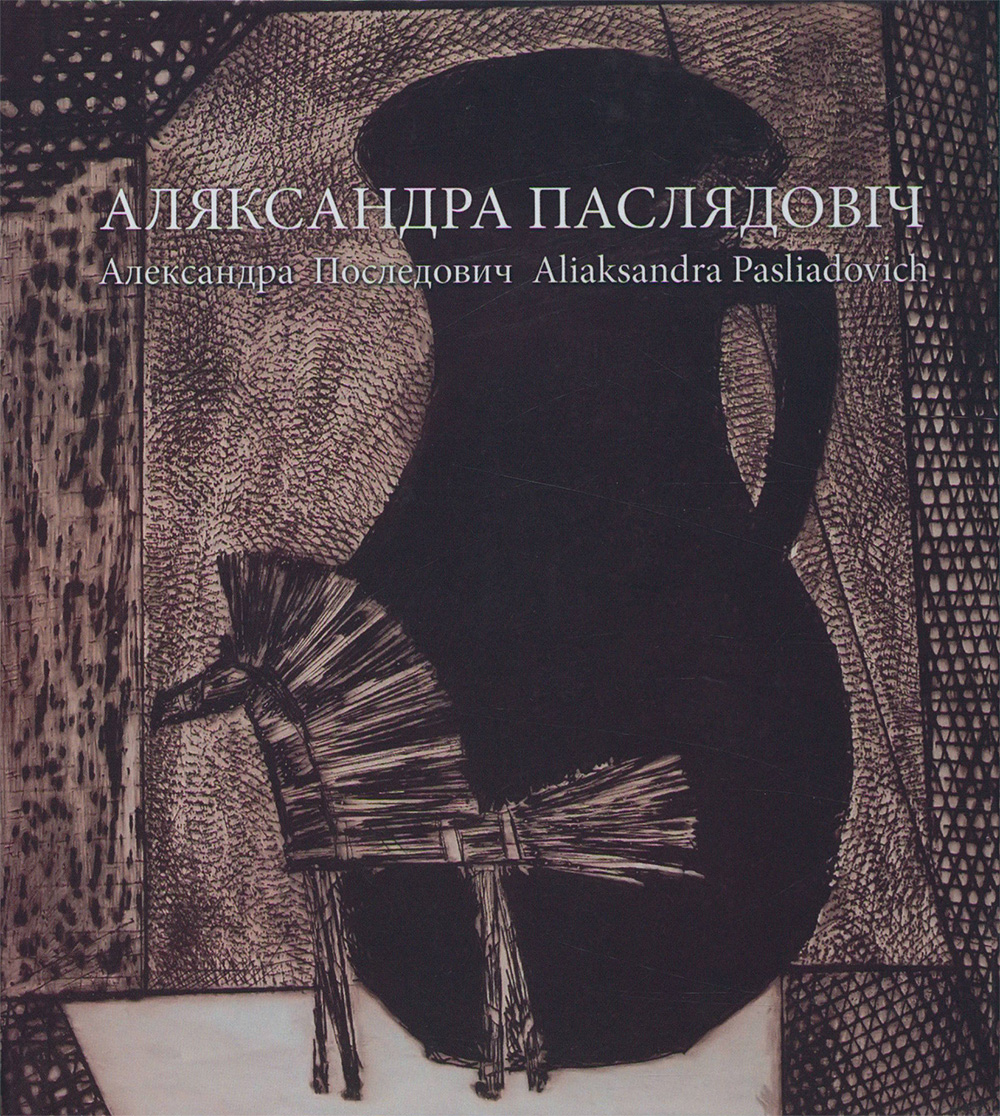
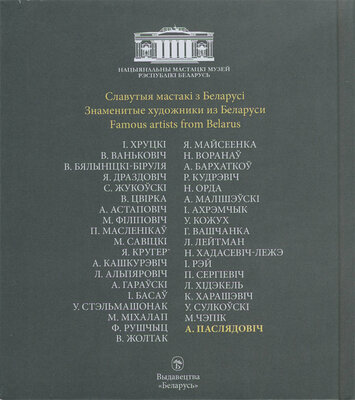
Аляксандра Паслядовіч
Выдавец: Беларусь
Памер: 98с.
Мінск 2021
5 From the archival records of Aliaksandra Pasliadovich.
6 Воронова O. П. Александра Последовмч. — C. 10.
35
diagonal of the river. The geometry of the outlines of the river’s end, or, most likely, of the channel against the crane tower on the horizon carefully depicts the landscape cultivated’ by the human. The author’s coloristic solution is also based on contrast, however, the river and the sky are an unexpectedly expressive azure and emerald, slightly intensified, clearly standing out against black and white, which organizes the color space of the work. Probably, according to the author’s idea, it is a kind of coloristic picture of Paliessie including the work ‘Paliessie Women’.
‘Associate oneself with the common people’, in the words of Aliaksandra Pasliadovich, — traveling to Belarusian places and studying customs, culture, and folk traditions were associated not only with her creative activities, but in general with the art of that period on the national identity of the peoples of the USSR in accordance with the Soviet ideological and aesthetic standards. The national theme is central in the work of Aliaksandra Pasliadovich. Its stylistic evolution is from realistic interpretations to decorative, symbolic and metaphorical solutions, from simple sketches from life to her author’s method of dealing with the form which has features of figurativeness and detail, but at the same time it is extremely generalized. She tries different engraving techniques such as lithography, linocut, etching and dry point. She actively uses color, making it as a mainstay for her visual system, which became a discovery for the Belarusian graphics. The artist develops a number of motives such as craft, folklore, tradition and its continuity, but the center of attention is a Belarusian woman. She emphasizes the young girl’s (‘Belarusian’) liveliness and energy, and at the same time inner strength (of a woman of the house in which the artist lived), the beauty of her peasant red clothes. So, the artist is gradually coming up for the classic female image as a sign. The series and cycles of works of the late 60 — 70s ‘Based on Folk Songs’, ‘Craftspeople’, ‘Antonovka Apples’, ‘People of the Collective Farm Village’ and others open a new chapter in the artist’s work.
The cycle ‘Based on Folk Songs’ consists of 4 graphic series, and it is something special among other works on the same theme. An attempt to find a visual
36
equivalent to the sound of folk melos was depicted in a particularly free and flowing line, which, like a song, leads and awakens other form features. Fluently outlined rounded contours, pictorial naivety and ‘retelling’ of the song in detail, while textured and ‘grainy patchy background of the prints similar to a crumbling relief or chalk drawing say about the ancient origin of song folklore, its cyclical, but at the same time spontaneous nature, melody and fabulous images. The main character is a woman represented as a young beauty looking for a flower of happiness or as a martially riding a horse.
The visual language of Aliaksandra Pasliadovich in the works of that period is based on the synthesis of plastic methods of the Italian renaissance art, the Belarusian icon painting, popular prints, posters and modern Soviet graphic design. This language is quite remarkable in the work ‘Leader’ (1968). While experimenting, the artist uses several color options for the background and lines. The image of a woman is extremely generalized and emphatically symbolic like folk culture and its structural elements of ornament, and recurrent folklore motifs. Studying the signlike components of peasant art, the Soviet authors develop a spectrum of motives that have become visual cliches today. For example, this is the image of a cornflower, which Aliaksandra Pasliadovich placed against the background of this work. The cornflower is a wellknown element of Belarusian culture. In addition, as an artist and a researcher, she seems to spread the color palette of traditional folk art, making color to be significant, symbolic and graphically conventional. The sources of the Soviet modernity are clearly represented in the woman’s confident posture demonstrating power and greatness, and in poster rhetoric. This interpretation is similar to the works by American pop art artists of the same time.
Simplicity and informational content, similarity to the art of signboard provide the visual solution chosen by the artist in the graphic series ‘Craftspeople’. She was engaged in traditional crafts and its ‘fruit’. Straw products and pottery seem to be precious in masters’ hands. The motives as a jug and a ‘straw horse’ became central in the works by the artist. The artistic solution looks especially
37
expressive in the graphic sheet ‘Weavers’. The conventionality and generalization of forms similar to the geometric style of Suprematism works are combined with scenic lines of aprons folds, hard handed women, floral patterns, lightanddark picture of faces, bright colouring and narration. Everything depicts the beauty and ‘materiality’ of the fabric created by the craftswomen.
The graphic work ‘Antonovka Apples’ is especially picturesque when there is no color. The classic motif of ‘harvesting’ dates back to the art of the Italian renaissance where there is a circular’ compositional formula (motion in circle begins with a basket of apples in the hands of the central woman, through the stairs and bowbacked another one to the apple box, and it ends with the figure of the third woman). The motif is enriched with avantgarde techniques — enhanced blackandwhite volume modeling.
Working in different styles and methods, Aliaksandra Pasliadovich develops the ‘national’ theme of all kinds. She is gradually moving towards its symbolic and metaphorical interpretation in a series of stilllife paintings of the second half of the 70 — 80s — ‘Rural Still Life’, ‘Rural Still Life’ (with chanterelles), ‘Sheaf Still Life’ and ‘Small Straw Horse’.
She chooses and varies the folk motif of the jug, first filled with milk, then empty, balancing its open symbolism with a branch of dry poppy steeped in folkloristic mysticism. The author ornamentally depicts a butterfly like in Dutch floral stilllife paintings. The butterfly harmonizes the color and compositional style of volumes, Tightens’ the jug weight and gives a sentimental touch. The straw horse looks like a poignant and an anxious character in the work ‘Small Straw Horse’. She successfully places it on a white plane against the massive black jug. The horse seems especially delicate. This series of stilllife paintings united by motives, subjects and techniques illustrates the author’s desire to emphasize ornamental features of wood, golden straw and clay associated with folk culture, and she makes them aesthetic. The artist masterfully varies strokes, combines flat forms and depth of field, distributes light and shadow, and plays with lines. The image found by the artist in the ‘Still Life with Chanterelles’ is especially
38
expressive. Contrasting with a rectangular chair, the winding shapes of chanterelles seem particularly refined and sound like a refrain in the soaring thin lines of a bouquet of dried herbs.
In the late phase of Aliaksandra Pasliadovich’s art, her manner, themes and style change, so some expressiveness begins to appear in them. The female image is visibly dramatized in a series of charcoal works ‘Portrait of Woman No. 1’ and ‘Portrait of Woman No. 2’. Overdrawn shadow accents on the face serve as a symbolic mask, and also there is a steep turn of the figure. The fishing net motif seems to be equally expressive for the artist. She varies it in her stilllife paintings of recent years (‘Anchors’, ‘Fish and Shells’ and ‘Fish and Nets’). It is attractive for its decorativeness and semantic diversity (as the image of a modernist lattice).
The artist’s most recent works include the ‘Nude’ series that is a completely unusual motive for her art. It represents the constant search for new themes, images and solutions.
The artistic heritage of Aliaksandra Pasliadovich is widely represented in various museum collections. The collection of the National Art Museum of the Republic of Belarus contains more than 240 of her works. The master’s art is manysided, and it combines professionalism, traditions and a sense of modernity, style and elegance of execution.
Katsiaryna Kaliankievich
Вясна (Вясновыя кветкі). 1960
Весна (Весеннпе цветы). 1960
Spring (Spring Flowers). 1960
41
42
Вясна. 1961
Весна. 1961
Spring. 1961

43
Зімніэцюд. 1958
Зммннй этюд. 1958
Winter Sketch. 1958
44
іййТ?
Хлопчык. 1957
Мальчкк. 1957
Воу. 1957
45
Ноччу. Ілюстрацыя да паэмы Якуба Коласа «Сымонмузыка». 1957 Ночью. йллюстрацня к поэме Якуба Коласа «Сымонмузыка». 1957 At Night. Illustration for poem ‘Symon the Musician by Jakub Kolas. 1957
46
Восенню. Ілюстрацыя да паэмы Якуба Коласа «Сымонмузыка». 1957
Осенью. Мллюстрацня к поэме Якуба Коласа «Сымонмузыка». 1957
In Autumn. Illustration for poem ‘Symon the Musician’ by Jakub Kolas. 1957
47
Ілюстрацыя да паэмы
Якуба Коласа «Рыбакова хата». 1962
Яллюстрацня к поэме
Якуба Коласа «Рыбакова хата». 1962
Illustration for poem ‘Fishermans Hut’ by Jakub Kolas. 1962
48
Ілюстрацыя да паэмы Якуба Коласа «Рыбакова хата». 1962 Нллюстрацмя к поэме Якуба Коласа «Рыбакова хата».
1962 Illustration for poem ‘Fisherman’s Hut’ by Jakub Kolas. 1962
49
Вясна. 1958
Весна. 1958
Spring. 1958
50
Верачка. 1958
Верочка. 1958
Verachka. 1958
Закарпацце. Горад Рахаў. 1961
Закарпатье. Город Рахов. 1961
Zakarpattia. Rakhiv. 1961
52
Гурзуф. 1960
Гурзуф. 1960
Gurzuf. 1960
53
Беларуска. 1961
Белоруска. 1961
Belarusian. 1961

54
Лета. 1958
Лето. 1958
Summer. 1958
55
Партрэт рахункавода калгаса Марыі Касавец. 1960
Портрет счетовода колхоза Мармм Косовец. 1960
Portrait of Mariya Kasavets, Collective Farm Accountant. 1960
56
Вясновы дзень. 1962
Весеннмй день. 1962
 КНІГІ ОНЛАЙН