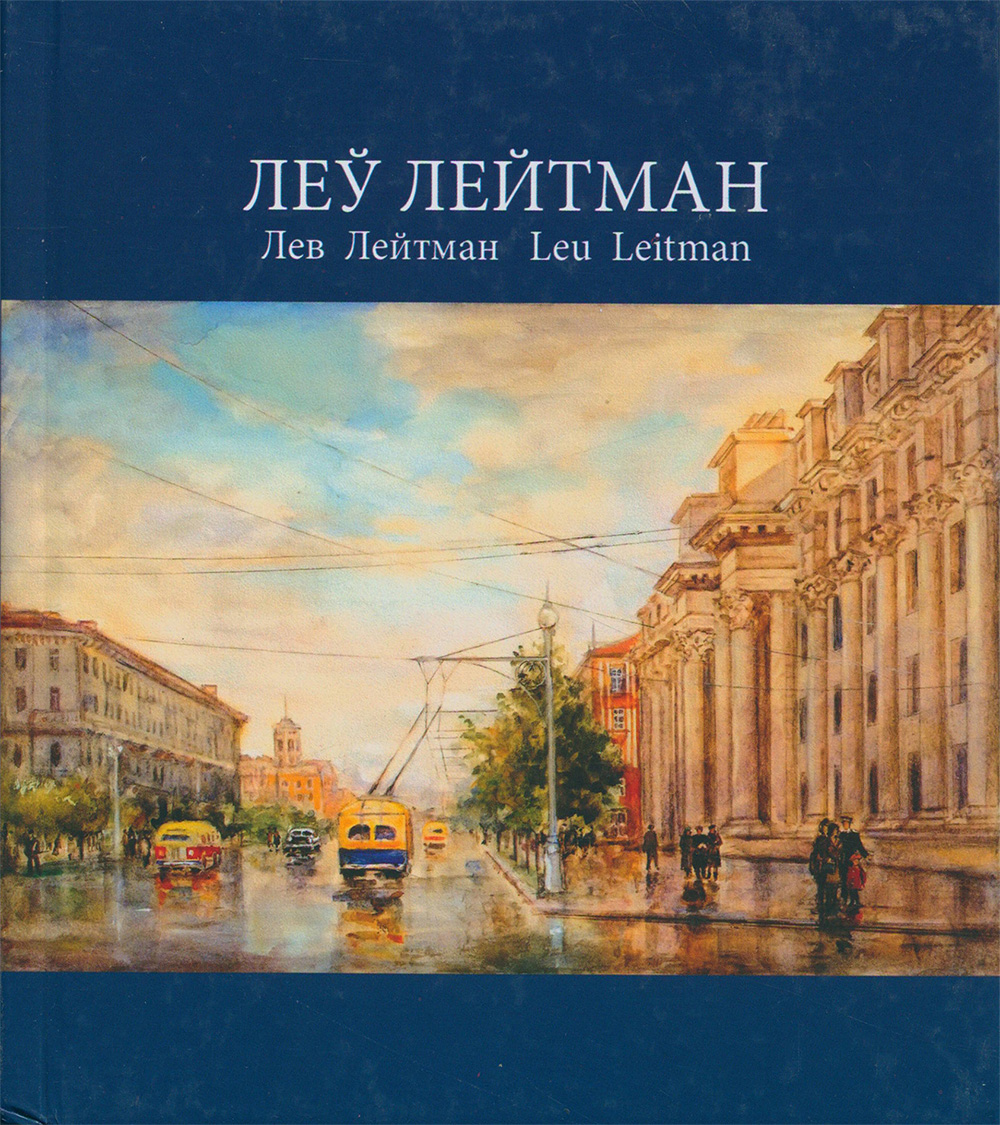
Леў Лейтман
Выдавец: Беларусь
Памер: 82с.
Мінск 2019
’ The information is given according to one of the autobiography options (The Belarusian State ArchivesMuseum of Literature and Art. Leu Leitman, f. 91, l.f. 1, it. 93, sh. 1).
10 Ibid.
33
Art College played an instrumental role for Leu Leitman as a teacher, where he taught drawing, painting and composition since 1931. He was the head of the teaching department since 1936, and in early 1941 he chaired the college. Leu Leitman worked hand in hand with the leading artists of the time: Yudel Pen, Abram Brazer, Salamon Yudovin, Mikhail Kerzin, Valiantsin Volkau, Ivan Akhremchyk, Uladzimir Khrustaliou, Mikalai Mikhalap. It was a team of congenial people. During this period, Leitman was repeatedly delegated to Moscow and Leningrad to allUnion meetings on art education and culture. He participated in the anniversary session of the AllRussian Academy of Arts. Unfortunately, the artists paintings of the Viciebsk period are few, including “Bridge” (1934), “Landscape” (1934), “Rainy Day (The Dzvina River. Viciebsk)” (1934), “Evening” (1930s). They are full of gentle sadness and sincere admiration of Viciebsk, the city over the Dzvina River.
At the same time, the 1930s was a period of active exhibition activity for Leu Leitman both in his own country and abroad. Due to his participation in Soviet and international exhibitions, Leu Leitman became one of the brightest artists of the country. The painters works were successfully exhibited in Los Angeles (exlibris exhibition, 1929), at the AllBelarusian exhibition in Minsk (1930, 1932), at the exhibition of Belarusian art in Moscow (1935). At the AllUnion art exhibition “Socialism Industry” in Moscow (1939), Leu Leitman was represented by the following works on “Woman in Manufacturing” made in 1937: “Linking Machine Operators at the Sewing Shop”, “Sewing and Linking Shop”, “Linking Machine Operators”, “The Portrait of Shpakouskaia, a Stakhanovite Worker” and others. These sheets expressed the idea of the primacy of active people in industries, demonstrated their attachment to the cause and enthusiasm. By the invitation of the AllUnion Society for Cultural Relations with Abroad, Leu Leitman took part in the traveling exhibition of Soviet artists in London, Brussels and New York in 1938—1940. In 1940 Leitman became a member of the Union of Artists of the Belarusian SSR, and he was admitted to the Kremlin among other participants during the decade of Belarusian art.
34
For the series of works “Life and Study of the Red Army” exhibited at the AllBelarusian Exhibition of Fine Arts “Lenin and Stalin are the Founders of the BSSR” in Minsk (1940), the artist was awarded the Certificate of Honor of the Supreme Council of the BSSR. Unfortunately, most of the sheets in this series, created from nature in Mazuryn near Viciebsk, destroyed during the war.
Leu Leitman belongs to a galaxy of masters, whose generation, together with the Soviet people, suffered of severities and horrors of the Great Patriotic War, which made an indelible mark on the people’s memory and artists’ world views. They became to see the great sense and beauty for simple things in the field. Years of battle and irretrievable losses laid bare feelings of affection for the masters of art to their native land, and the war revealed the price of life that it was not easy to defend.
Leu Leitman was the director of the Viciebsk Art College when the war began. “It was difficult to leave pedagogical activities. After all, I have been continuously teaching painting and composition since 1918.1 worked in the art college, in the Viciebsk Regional House of Folk Art. For more than 11 years, I mastered art studios for workers,”11 the artist told in one of his interviews. During the war, Leu Leitman served in departments of the Military Construction Directorate of the Western Front, where he worked in the political department. He was an agitational leader. During the first ten months of service in the Red Army, Leu Leitman issued more than 75 frontline newspapers and war sheets. During the war, the artist took part in the exhibition “The Works of Moscow Artists during the Great Patriotic War” (Moscow, 1942) and the AllUnion Exhibition of Painting, Graphics, Sculpture and Architecture “The Great Patriotic War” (Moscow, 1942—1943). As a participant in the war, Leu Leitman was awarded the medals “For the Defense of Moscow”, “For the Victory over Germany in the Great Patriotic War of 1941—1945”, “For Valiant Labor in the Great Patriotic War of 1941—1945”.
11 The Belarusian State ArchivesMuseum of Literature and Art. Leu Leitman, f. 91, l.f. 1, it. 109, sh. 3.
35
At frontline construction projects, in places of recent battles and territories liberated by the Red Army from Nazi invaders, Leu Letman made a number of sketches and studies in watercolour, gouache and pencil. There are no battle scenes in these drawings by the artist. He focuses on military everyday life. The master depicted the heroic labour of builders working to defend their homeland, landscapes, destroyed buildings, surviving constructions, and soldiers with guns, numerous trophies such as wrecked tanks and weapons of the enemy (“In the Area of Volokolamsk”, 1943; “Sereda Village”, 1943—1944; “At the (Defensive) Boundary” 1943; “The First PostWar Winter at the Exhibition of Captured Weapons”, 1945). The depicted world is realistic, full of anxiety. The artworks are issential with lyrical softness, transparency of texture, harmonious colour. Most of the artist’s heritage was lost during the Great Patriotic War.
After the war, Leu Lehman returned to his homeland. He played a significant role in the foundation of the Minsk Art College, opened in the dilapidated capital of the BSSR in 1947, where he worked until 1958. At that time, it was the only educational institution in the country that trained artists. It was the college that was destined to play a key role in the postwar revival and the formation of the national art school and its pedagogical system. Leu Leitman was engaged in the selection of personnel, as he already had the corresponding experience. Valiantsin Volkau, Uladzimir Khrustaliou, Ivan Akhremchyk, Pavel Maslenikau, Matvei Belianitski, Nadzeia Galouchanka, Khaim Liushyts, Kanstantsin Kasmachou were invited to work at the art college.
Leu Leitman was engaged in educational process, its organization and teaching methods at the college. The education board of the college began to work under his leadership. Leu Leitman recommended his students to use formula and creatively different colour pairings. He taught to paint expressively and vividly, advised to take notice of life, paid much attention to composition and colouristics.
Leu Leitman was a delicate and a tactful, a brainy and a cheerful, a decent and in love with art painter. He was interested in young artists’ creative activities. 36
The master greatly influenced on his students, and they loved and cherished him for the evaluation of their work. A lot of students became famous Belarusian artists, among them — Mikhail Savitski, Maj Dantsyg, Viktar Gramyka, Viktar Pratasenia, Arlen Kashkurevich, Viktar Viarsotski. They all remembered, “how Leu Leitman dressed in a soldier’s overcoat brought firewood in a backpack to warm the cold studio and enable them to work under normal conditions in the difficult postwar time,”12 wrote artist and teacher of the Minsk Art College Iryna Glazava in her article “Memory of the Teacher”.
Leu Leitman’s students and colleagues said he was a wonderful teacher, a highminded and a fair person who spoke to people as an equal, explained kindly and sincerely. He had a clear mind and an understanding heart. Arlen Kashkurevich13 told about his teacher in this way: “With great warmth I recall one of my first teachers Leu Leitman. He was small in stature, with a curly gray hair and a sharp nose. He respected all students. His daughter, Fryna14, taught the art history. She was an intelligent and highly educated teacher.”15 Leanid Shchamialiou16 still recalls: “We were taught by outstanding teachers. One of them was Leu Leitman, who taught in junior courses. He was interested in some discoveries in the students’ works.”17 Georgy Paplauski18 spoke about the
12 Ірына Глазава. Памяць пра настаўніка // Літаратура і мастацтва. Мінск. 12 сакавіка 1976 (БДАМЛМ. Лейтман Л.М. Ф. 82. Воп. 2. Адз. зах. 58. Арк. 82).
13 Arlen Kashkurevich (1929—2013), the Belarusian graphics painter, the People’s Artist of the Belarusian SSR, the Honoured Artist of the BSSR, the Laureate of the State Prize of the BSSR, the Professor.
14 Fryna Leitman (1921—1985), the Belarusian art expert, the teacher, the daughter of the Honoured Artist of the Belarusian SSR, the graphics painter Leu Leitman.
15 Шлях y мастацтва / уклад. B.I. Ясюк. Мінск, 2017. С. 24.
16 Leanid Shchamialiou (1923), the Belarusian painter, the Peoples Artist of the Belarusian SSR, the Honoured Artist of the BSSR, the Laureate of the State Prize of the BSSR, the Holder of the Order of Francysk Skaryna.
17 Шлях y мастацтва. C. 28
18 Georgy Paplauski (1931—2017), the Belarusian graphics painter, the Peoples Artist of Belarus, the Honoured Artist of the Belarusian SSR, the Academician of the National Academy of Sciences of Belarus and the Russian Academy of Arts.
37
excellent sense of humor of his teacher: “The first teacher, Leu Leitman, was a brainy person with a good sense of humor. He wrote poems and notes for the college wall newspaper. He had a favorite pun: ‘Who is the leading artist?’, he asked the students. ‘The leading artist is the artist who knows how to behave’.”19 “If you recall the teachers of the college, then the warmest impressions I have had about Leu Leitman. He was a wonderful teacher and man. I remember how he conducted summer intern. His classes were scheduled in the late afternoon. I took a sketchbook, at dawn I went to Drazdy and brought a finished sketch to the beginning of classes”20, says Vasil Sumarau21 about his teacher today.
 КНІГІ ОНЛАЙН