Леў Лейтман
Выдавец: Беларусь
Памер: 82с.
Мінск 2019
In the postwar years, Leu Leitman combined pedagogical activity with creative activity. During this period, he was engaged in an industrial topic, speaking to the audience as a singer, an eyewitness to life, work, and the feat of the heroes of his time — builders, workers of Minsk and Gomel factories and plants. The works devoted to the restoration of their native land tell about the hard work of the Soviet people on the revival of the industry of Belarus destroyed by the fascists: “Construction of the Main Building of the Automobile Plant” (1947), “Construction of the Automobile Plant” (1949), “At the Vertical Lathe” (1960). These watercolour drawings depict the intense rhythm of grand construction.
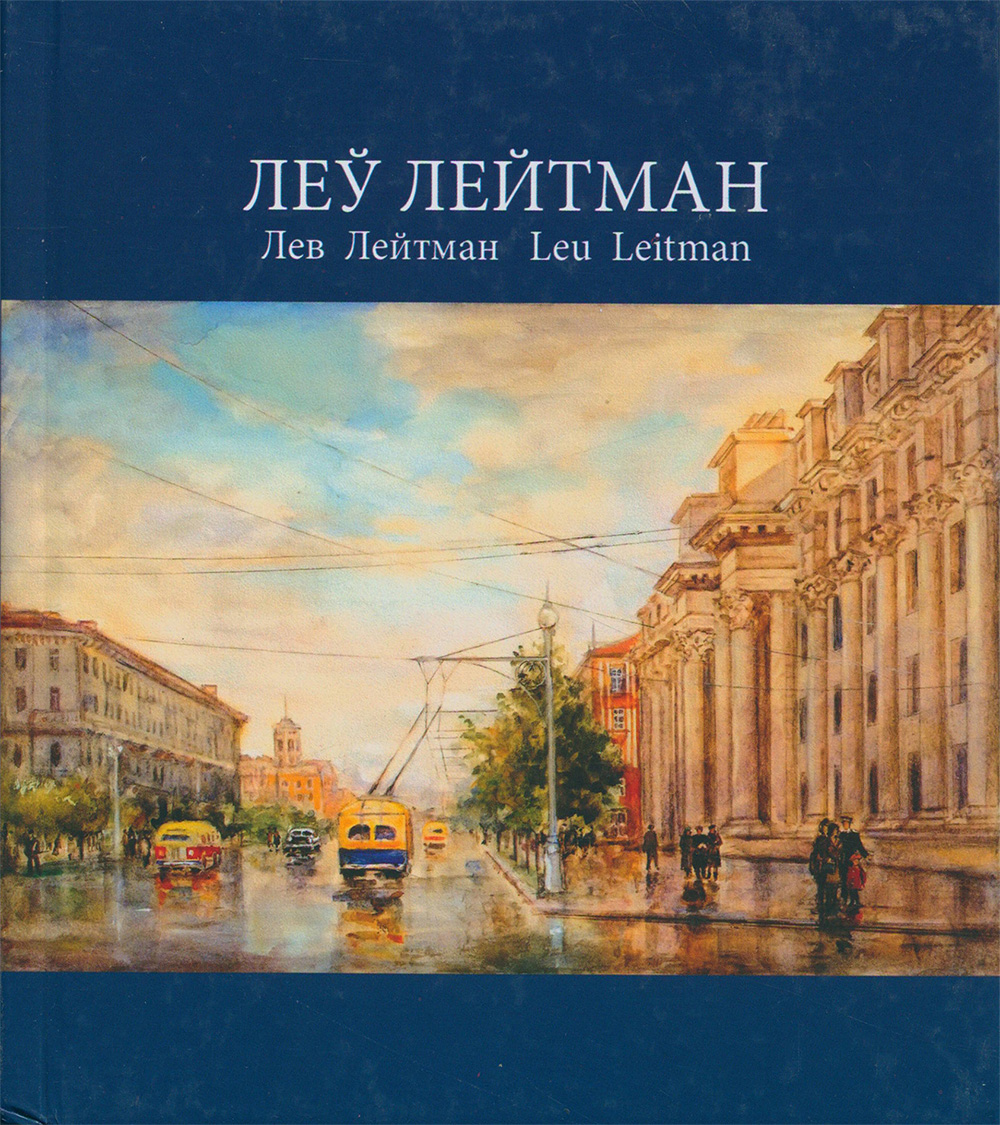
Some external signs of the postwar period such as tower cranes, highvoltage transmission towers, paved roads are present in a number of Leitman’s watercolour drawings dedicated to Minsk and its inhabitants, as well as to the outskirts of the city. In landscapes painted from a height, from the studio window, Leu Leitman looks at the city with love, trepidation and admiration. The city is fierybright, noisy, festive, then peaceful, sleepy, melting in the darkness. He
19 Шлях y мастацтва. C. 29
20 Ibid, p. 34.
21 Vasil Sumarau (1938), the Belarusian painter, the Honoured Artist of the Belarusian SSR, the Bronze medalist at the Exhibition of Achievements of National Economy of the Union of Soviet Socialist Republics. He was the head of the childrens public art studio at the Palace of Culture of Textile Workers in Minsk in 1965—1985.
38
admires the beauty of the capital, its wide highways, architectural ensembles, sports facilities, busy avenues, quiet corners. They are “Praspekt named after Iosif Stalin (Stalin Avenue)” (1952), “The Main Entrance to the ‘Dynama Stadium” (1952), “The Central Post Office” (1954), “Near Yanka Kupala Poplar” (1957), “In the Park” (1957), “From the Studio Window” (1965, 1966), “Minsk. Winter” (1970) and many others.
It was also important for Leu Leitman to present and embody the image of a contemporary, as people make the unique history of the city, form its special historical image. The artist painted wonderful portraits of his contemporaries, marked by a keen sense of time and authenticity. The masters characters are depicted in moments of inspired labor, in close connection with the work and volitional aspiration. These details are embodied in the following works “The Portrait of Maltseva, the MillingMachine Operator” (1945 (?) 1960 (?)), “Varnishers. The Minsk Radio Plant” (1947), “Youth Team of the Tractor Plant at Work” (1950), “On Guard for Peace. Dubrouskaia, the Best Driller of the Bicycle Plant” (1950), “The Portrait of Filipau, a Bricklayer and Innovator (The Best Bricklayer of New Buildings in Minsk with His Assistant Shalakhanava)” (1951), “The Portrait of Alina Lasitskaia, a Watch Assembler of the Minsk Watch Plant” (1961), “The Portrait of a Worker” (1969).
When making portraits, the artist was interested not only in reflecting the individuality of a person, the uniqueness of his appearance, the external similarity of the image with the model, he also looked for something universally significant and distinctive: nobility, honesty, labor activity, will and intellect. The characters of the portraits by Leu Leitman are almost always shown waistdeep or kneelength, given in closeup, their figures are inscribed on a sheet. The background in the portraits is either completely absent and is determined by the colour of the graphic sheet itself — white, black, brown, or conventionally indicated by colour planes — bluegreen, ashgray. Among them there are calm and peaceful faces (“The Portrait of Zinaida Shalyka, a Milkmaid”, 1962), serious and thoughtful (“The Portrait of Tsimafei Aleksandrenka, a Sergeant,
39
Veteran of the Frontier Post”, 1964; “Builder”, 1970), brighteyed and cheerful (“The Portrait of Tsviatkova, a Knitter of the Homiel Factory named after March 8”, 1961).
Leu Leitman’s charming and attractive female images embody the aesthetic ideal of the Soviet womanworker — stout, full of health, with a bright blush on her cheeks, energetic and fervent, modest and full of proud dignity. Her mind is combined with determination and strength of character. These are his “The Portrait of Tsviatkova, a Knitter of the Homiel Factory named after March 8” (1961), “The Portrait of Alina Lasitskaia, a Watch Assembler of the Minsk Watch Plant” (1961), “The Portrait of Nina Berastsevich, a Schoolgirl Looking after Calves” (1962).
When making some still life paintings (“Flowers”, 1943; “Still Life. Lilies”, 1964; “Flowers against a Window Background”, 1965; “Dressing Table”, 1969; “Flowers”, 1970; “Flowers on the Window”, 1972), Leu Lehman used vases of various configurations and colour palettes in interior decoration. Fresh flowers remained unchanged and certainly in the score of shades of red. They served the artist as a kind of tuning fork, performed a standard colour chord, according to which he built colour, wrote “colour music” of their watercolour works. The artist painted shortlived, but bright floral splendor with wide and bold strokes.
Leu Lehman improved his skills working hard. Having lived all his life in Belarus, he knew and loved her charming nature. Belarusian landscapes enter largely into the artists art. There is a special charm, poetization and intimacy of the painter’s point of view so peculiar to his talent.
Turning to nature as an exalted image, Leu Lehman depicted a humans tendency to dialogue with it to search spiritual understanding. Speaking to the nature gave rise to many emotions, which Leu Lehman sought to present in his works. He portrayed specific places in Viciebsk, Minsk, Moscow Region (“Rainy Day (The Dzvina River. Viciebsk)”, 1934; “Winter Landscape (Winter)”, 1943— 1944; “OrekhovoZuyevo”, 1943—1944; “The Klyazma River”, 1943; “Province”, 1945; “Minsk. Winter”, 1970).
40
The masters delicate lyrical pictures are striking such as “Birches” (1945), “April” (1957), “Wind” (1966), “Silence” (1968). They have a lot of warmth, purity and soulfulness. The names of the paintings are short and clear. They are consonant with Isaac Levitans thoughts: “The simplest and most sincere motive is worthy to be painted. It can turn into the great artwork if the artist loves it and tells of it heartily.”22
Leu Leitman’s landscapes, as well as his works in other genres, are small in size. Their impressionistic style is due to the artist’s activity in plein airs, which gave him the opportunity to admire colour details, which he strived to embody in his pictures. There is silence, light purity, peace in the landscapes. Leu Leitman masterfully paints trees, covered with autumn colours, and barely blooming foliage in spring. The true charm of the green, a sense of peace, coziness and harmony in nature were conveyed by the artist in such works as “At the Svislac River” (1956) and “Pond in Palanga” (1957). In these works, trees with huge spreading branches are buried in greenery and “admire” their reflection in the mirror of water against the blue sky, the border between the water surface and the coastline is almost blurred. “Near Yanka Kupala Poplar” (1957) is made with light bluishgreen tones in the method of gouache. It depicts the charm of a summer day, the joy of relaxing in the shade of trees in the park. The clear blue air, flowing above the ground and covering the green foliage with a slight haze, enhances the impression of the depth of space. Its lyrism is presented in “Red Roofs (Kaluga)” (1942—1943), “Gloomy Day” (1944), where frozen tree branches visible through spring air and gray constructions logs penetrate the specifics of the winter landscape image. For watercolour painting “Night Is Falling” (1949), the artist chose a special state of nature — presunset time, when shades and halftones are barely perceptible in the condensing twilight, and the bright spots of the main — blue colour are especially sonorous. The
22 Левнтан M.M. Пнсьма. Документы. Воспомшання / под ред. А. ФедороваДавыдова. М„ 1956. С. 232.
41
strokes laid next to each other overlap in places. The interaction of colours is complicated. Blue and purple tones come in contact with the ashen one and as if begin to smolder. Gamma is getting colder.
The motifs found in nature and associations associated with them were of great importance to Leu Leitman. In his watercolours, the artist sought to accurately capture the feeling that gripped him in the open air, the excitement that prompted him to take up his brush, the delight that he experienced when he met with nature.
Leu Leitman took an active part in the work of the Union of Artists of the BSSR. He was the chairman of the graphics section, a member of the revision committee, he organized the watercolour section and three national watercolour exhibitions. The artists selfless service to art received a welldeserved mark: in 1967 he was awarded the title of the Honored Artist of the BSSR.
The collection of the National Art Museum of the Republic of Belarus presents all the facets of Leu Leitmans creative heritage — a soulful lyricist who knew how to feel deeply and poetically subtly convey the subtle nuances of wildlife, the bustling life of a centuriesold, reviving from the ashes and ruins of the city and its inhabitants; the creator of portraits that are distinguished by a realistic vision of the world, accuracy and clarity of plastic figures; the author of narrative paintings on the theme of glorifying a human who benefits society by his work, who knows how to enjoy leisure, to enjoy life; the master of colourful still life paintings. The collection of Leu Leitmans pictures in the museum is one of the most significant in our country (140 graphic works and one painting) along with the funds of the Belarusian State ArchivesMuseum of Literature and Art. The master’s paintings are also in the collection of the Belarusian State Museum of the History of the Great Patriotic War, the Viciebsk Regional Museum of Local History, in the funds of the Belarusian Union of Artists, and in private collections in Belarus and abroad.
 КНІГІ ОНЛАЙН