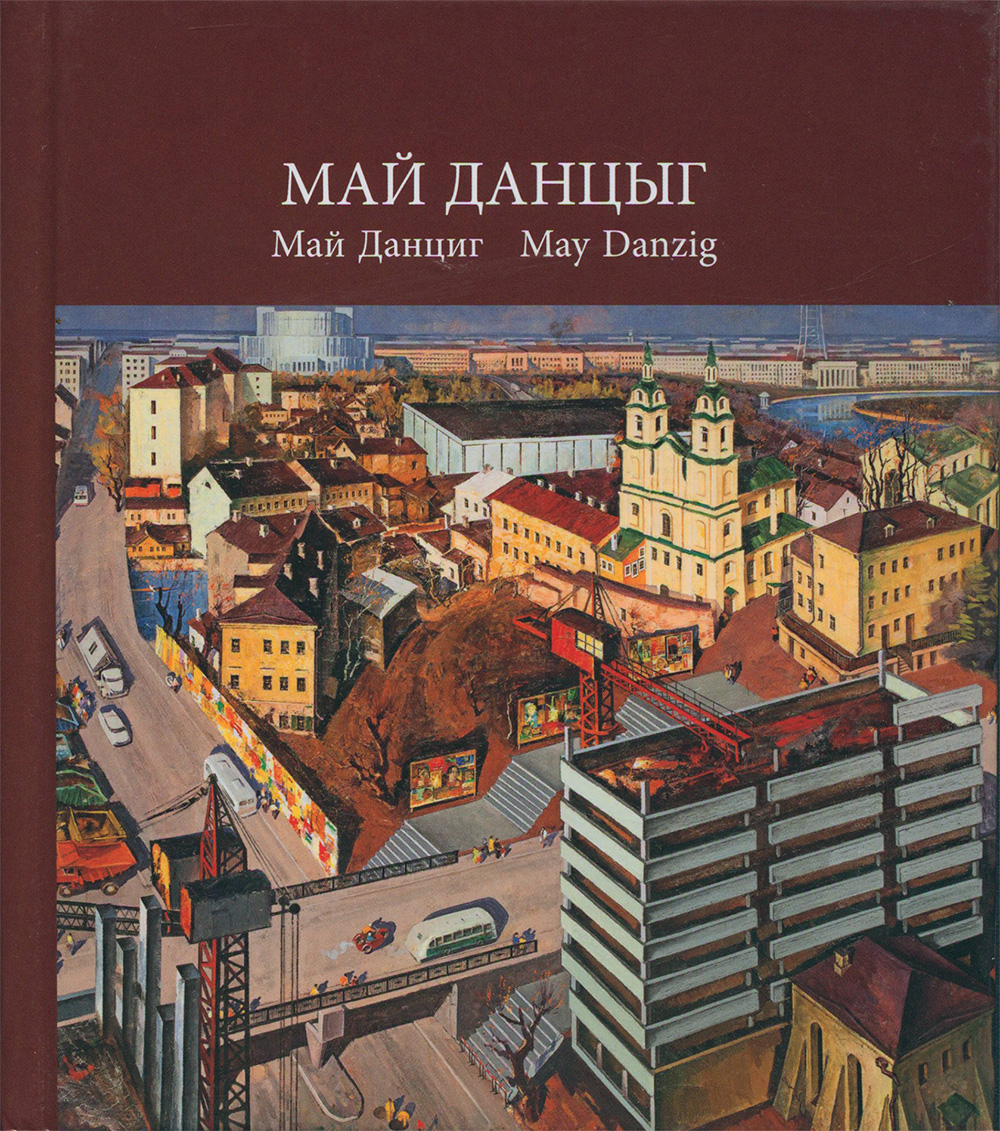
Май Данцыг
Выдавец: Беларусь
Памер: 74с.
Мінск 2023
Мне посчастллвллось влдеть сволмл глазамл, как в творческой мастерской по уллце Некрасова, на террлторлл Млнского художествен-но-промышленного комблната, рождаллсь этл новаторскле жлвоплс-ные памятнлкл народному подвлгу белорусов. Я тогда очень удлвлялся, как Май Вольфовлч работал вообіце без всяклх этюдов л эсклзов, плсал прямо на полотне. Он говорлл, что у него все уже выстроено до деталей в голове... Так ллл лначе, но, по сутл, этл картлны сталл настояіцлм глм-ном геролзму, жлзнл, добру л гуманлзму.
«О Веллкой Отечественной войне» (1968) — одно лз лучшлх про-граммных полотен Мая Данцлга, в котором он выразлл мыслл л чувства современнлка про его долг перед прошлым л ответственность перед буду-іцлм. Стол, плшуіцая машлнка с члстым ллстом бумагн, полная окурков пепельннца, наручные часы, раскрытая пачка слгарет, гнльза от артнлле-рнйского снаряда с веточкой красной ряблны, смятые лспмсанные лнсты бумагн на полу... За большнм окном белеют заснеженные крышм домов м какмх-то строенлй... Все это рассказывает о главном герое картнны —
19
неспокойном человеке, журналнсте нлн пнсателе, которого мы сейчас не внднм. Он словно отошел куда-то на мннуту, однако мы многое по-ннмаем про него: ему действмтельно есть что вспомннть н рассказать лю-дям. Вндммо, ему очень больно на сердце от непростых воспомннаннй о прошлом, про погнбшнх однополчан, про «свою войну»...
Однажды Май Вольфовмч процмтнровал мне чудесную фразу зна-менмтого кннорежнссера Андрея Тарковского, которого очень уважал: «Мы распяты в одной плоскостл, а мнр — многомерен. Мы это чувствуем м страдаем от невозможностн познать нстнну... А знать не нужно! Нуж-но любнть. Н вернть. Вера — это знанне прн помошн любвн...» На мой взгляд, так н жнл Май Данцлг — художнлк, которому «прн помоіцн люб-вн» была открыта особенная красота. Поэтому в его творчестве так мно-го художественной правды, которая заворажнвает зрнтеля. Данцнга не-возможно нн с кем сравннть нлн спутать. Он однн такой — с особенным «голосом», особенным мышленнем, эмоцлональной н ннтеллектуальной энергетмкой...
Борйс Крепак
eople’s Artist of Belarus, Honored Artist of Belarus May Danzig... Holder of the Belarusian Order of Honor and the Order of Francis Skaryna. A brilliant painter, professor, an outstanding teacher, from under whose wing several generations of artists came out; a sociable person, conscientious and principled, for whom high creativity from his youth became the main meaning of life. And there is nothing surprising here: of the 87 years he lived, more than 60 he worked in art.
This man was a unique personality, unlike anyone else. His large exhibition dedicated to the 85th anniversary of his birth and the last one in his lifetime, which was held in 2015 at the National Art Museum of the Republic of Belarus, became a real holiday for Minsk residents and guests of the capital. It featured more than 250 artworks, starting with student works of the 1950s and ending with grandiose canvases of recent times.
One can only wonder how May Danzig, at such a venerable age, managed to create large monumental works, the likes of which no one has painted in modern fine art for a long time. Among all Belarusian painters, even today, six years after his death, May Wolfovich remains the only artist in Belarus who considered the genre of a subject-themed painting fundamental and even socially important in the space of all other types and genres of visual culture. Danzig’s work is characterized by vivid metaphoricity, complex allegoricity and a desire for a multifaceted meaningful subtext. Therefore, his best figurative canvases about war and peace, as well as large-scale urban works on
21
the theme of post-war and new Minsk, deservedly entered the golden fund of Belarusian fine art.
The diverse heritage of May Danzig includes genre things about today, and strong compositional portraits of Belarusian and Russian cultural figures, and small mood urban landscapes, and ambiguous philosophical still-lifes, and hundreds of drawings in pencil, pastel, tempera.
This was Danzig — active, restless, encyclopedically educated, starting with his early works and including his brilliant student studies made during the 1957 World Festival of Youth and Students. But the first real recognition of Danzig as a painter came already in Belarus, when his thematic paintings, industrial landscapes, full-scale portraits of miners, oil workers, builders from the “Soligorsky cycle” appeared at republican and all-Union exhibitions, among them of which it is especially possible to single out the significant compositions “The land of Soligorskaya is buzzing” (1960), “I know the city will be... Soligorsk” (1961), “Novoseltsy” (1962) and “In the factory canteen” (1963). It was with these works that Danzig began, who a few years later, after receiving the Lenin Komsomol Prize of Belarus (1968), was already at the forefront of that galaxy of Belarusian Soviet painters, representatives of the so-called “harsh style”, for whom the unadorned truth of life was the alpha and omega of creativity.
May Danzig is from that romantic, legendary generation of the “sixties” who boldly “turned over” Soviet art, discarding seemingly indestructible official canons. Yes, he is from the “sixties”, and at the same time — by himself, original and unique. Freedom and breadth of figurative generalizations, co-loristic rebelliousness, juicy and bright colors, grandeur of plots and deep spiritual and moral understanding of them, metaphor as a motor of form — these are the main features of his figurative and expressive concept.
From 1958 until the end of his life, fate connected May Wolfovich with pedagogical activity at the Belarusian Theater and Art Institute (now the Bela-
22
rusian State Academy of Arts). This did not prevent him from doing his favorite creative work in his workshop almost every day. Or maybe, on the contrary, since he needed constant and direct communication with young people, with their joys and failures, with their work, like air. Yes, the artist had no unusual diligence and strong energy...
.. .May Danzig was born on April 27, 1930 in Minsk in the Nemiga district. Before the war, he managed to graduate from five classes of secondary school No. 12 and three classes of music, where, having absolute hearing, he played the violin. He studied the basics of drawing from his father, an athlete-teacher and an amateur artist.
And here — a terrible war. On the morning of June 24, 1941, the first massive bombing of the city began, and within a few hours the center turned into ruins. On June 27, the Danzig family — parents with their son and daughter — miraculously managed to escape from the dilapidated Minsk to the freight station and with difficulty squeeze into the last-echelon train car with Red Army soldiers wounded in the very first battles. And the very next day the fascists entered the capital...
In Ulyanovsk, where the family was evacuated, life was not sweet: cold, hunger, domestic disorder. And although the parents worked, there was not enough food at all. However, at the age of twelve, Marik (as relatives and friends called Danzig) received his first fee there — a loaf of bread — for painting a tin sign “Stall No. 3” on a bread store with oil paints. He also drew slogans and wall newspapers, and for this he received something from customers from clothes and products.
And when, in early July 1944, the Danzig family heard on Levitan’s radio that Minsk had been liberated, they immediately returned to their homeland. Fortunately, the parent’s two-story brick house survived. Life was getting better, but the violin was now forgotten — the desire to draw won. At first, the teenager continued his studies at the 42nd school (by the way, he studied with
23
the future Nobel Prize-winning Zhores Alferov) and at the same time attended the children’s art studio of Sergei Katkov at the Palace of Pioneers and Schoolchildren. Then he studied for six months at an architectural college. And when the art school opened in the fall of 1947, 17-year-old May immediately enrolled there without any problems. His cherished childhood dream came true...
In the post-war years, this school was the only educational institution in Belarus in the field of fine arts, where many future outstanding painters, graphic artists and sculptors received their first education, some of whom were later awarded the titles of People’s or Honored Artist of Belarus. For example, Danzig studied together with Viktor Gromyko, Leonid Shchemelev, Mikhail Savitsky, Georgy Poplavsky, Arlen Kashkurevich and other masters whose names are known far beyond the borders of our country.
After art school (1952) - the legendary Moscow State Art Institute named after V. I. Surikov. Excellent teachers — Pyotr Pokorzhevsky, Viktor Tsyplakov, Fyodor Reshetnikov, Mikhail Kurilko... He lived in a boarding school on the famous Trifonovka — the area of settlement of students of creative institutions. The bedmates are future celebrities: Tahir Salakhov, Ernst Neizvestny and Belarusian Ivan Stasevich. A little further down the corridor, there is another Belarusian in the room — senior student Mikhail Savitsky.
Danzig studied with inspiration. For excellent achievements, he received an increased scolarship — very good support in the far from well-fed life of students. In addition to compulsory lessons, he ran around exhibitions on his own, studied in museums and libraries everything that particularly attracted him in contemporary art: from Giotto, Titian, Raphael, Rubens, Surbaran to Delacroix, Surikov, Gutuz, Dayneko, The Jack of Diamonds, Impressionists and early Picasso. In this very heterogeneous, colorful “palette” of names, the guy was looking for himself, his figurative and pictorial system, his personal creative “ideology”. Already his graduation painting “Towards Life” made
24
such a deep impression on the members of the examination committee with the freshness of mood, romantic elation that even now, after 65 years, this canvas looks like a bright hymn to life, youth, and a dream.
 КНІГІ ОНЛАЙН