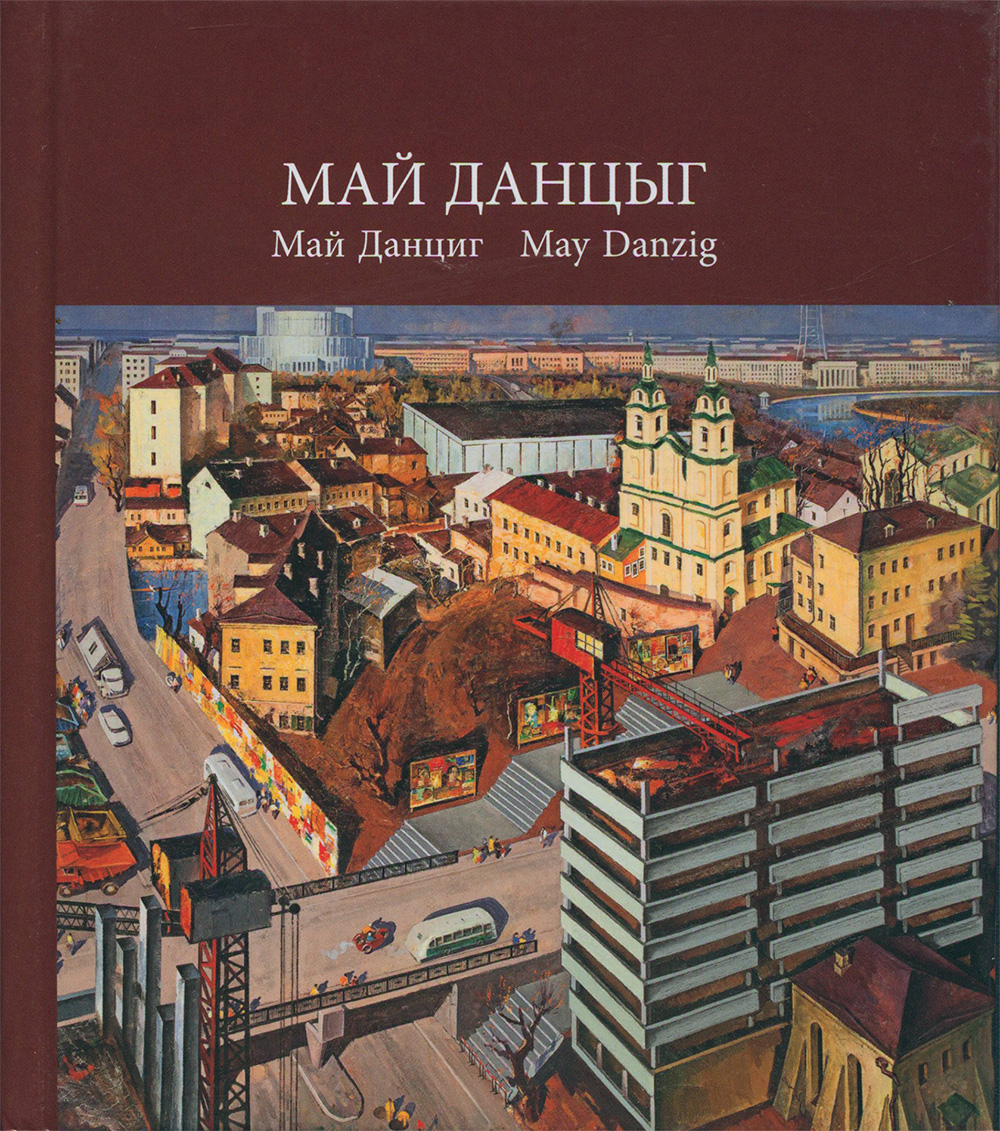
Май Данцыг
Выдавец: Беларусь
Памер: 74с.
Мінск 2023
Since then, Danzig has worked in the studio and in the open air almost without days off and holidays, and freely moved from one genre of easel painting to another. And in collaboration with Boris Nepomnyashchy, he even made several monumental and decorative mosaic panels — in the lobby of the Minsk Partizan cinema (now the Cinema House) and in the Yubileynaya Hotel.
Usually art historians refer Danzig to realists. But the artist himself believed that his realism should not be perceived one-sidedly, like the wanderers, as was customary in the era of socialist realism, and that the classical school is completely inseparable from the so-called “realism without shores . Since the boundaries of such realism are actually wide, because, according to the artist, it allows the creators to express themselves more deeply and comprehensively than the framework of textbook, banal realism allowed. You just need to distinguish its external manifestations and essence.
Realists can also include themselves as just a bad artist who conveys the external similarity of nature, but at the same time does not look into the essence of phenomena, does not reveal the depth of images, the sharpness of characters. Therefore, Danzig’s sympathies have always been on the side of lively, expressive, emotional realism. Even expressive, even romantic, because art should be superactive. In this series there is also a large cycle of acutely psychological portraits of outstanding Belarusian and Russian figures of literature and art, made in the 1980s. The full-scale portraits of Vasil Bykov, Ales Adamovich, Anatoly Anikeychik, Georgy Tovstonogov, Bulat Okudzhava, Semyon Geichenka, Viktor Avilov as Hamlet, Elem Klimov, Daniil Granin are a kind of “gallery of mirrors” in the variety of types and faces that give a vivid description of that unforgettable post-thaw era of “storm and pressure” in which despite we lived and worked for nothing...
25
The first monograph about the life and work of May Danzig was published by the publishing house “Belarus” in 1976. In it I tried to tell about the so-called romantic realism multiplied by expressionism, which the artist began to adhere to from the early stage of his creative biography to the end of his life. Although this romanticism in figurative and compositional details manifested itself in different ways in different periods, at the same time it retained the expressive pictorial and plastic style characteristic of Danzig from his youth. I have always liked this style, as it was based on the author’s own way of thinking, on a good attitude towards people, on the moral and ethical foundations of light perception, on the contrast of the concepts of good and evil, love and hate, humanism and anti-humanity.
All these biblical categories for Danzig were never abstract and were perceived by him naturally in the process of personal life experience. May Wolfo-vich has always understood that in a complex creative process, the position of the artist, his attitude to what he depicts, has a decisive role. His art is the fruit of his many years of reflection during insomnia, not always joyful life collisions, social cataclysms or inspired by memories of the difficult fate of people close to him and at the same time — a sincere love for everything wonderful and bright that surrounded him in life, especially the unspoken crazy love for Minsk.
Danzig’s first work about his hometown called “Minsk. The ashes of Nemi-ga” appeared around 1955. The last one is in half a century: a study of night Minsk (this is a replica of a painting from the 1970s). And between these dates there were an incredible number of canvases and drawings about our hero city — ancient and modern, a city destroyed by war, bloody and a city reborn, renovated; a chamber city, intimate and an epic, majestic city; the city of unique monumental poetry and the city of eternal youth, illuminated by the flame of the Eternal Flame, which is near the obelisk monument on Victory Square... Among the main paintings dedicated to Minsk by Danzig are “My
26
Minsk” (1967), “My City, ancient, young” (1972), “Song about Minsk” (1975). The last of them is a work, in my opinion, in the entire pictorial chronicle of Belarus, the best generically monumental portrait is the image of our capital, embodied by the brush of Danzig...
One of the main themes in the artist’s work is the theme of the Great Patriotic War. In my opinion, the “war” for the artist was only an occasion for a conversation about what a person is in the modern world, what is the meaning of his destiny on our sinful earth and what is his historical memory. Reflections on the laws, mysteries and paradoxes of time are an integral sign of the figurative and philosophical thinking of the creator. We are not always aware of how often painters, our contemporaries, turn to subjects that are associated with the traditional idea of “the omnipotence of time”, our contemporaries, to subjects that are associated with the traditional idea of “time”. So Danzig possessed the ability to transmit time as something unusual, which stretches endlessly or is almost stopped, as well as to notice signs of frozen time where others see the pulsation of life....
It is the experience of time that Danzig’s pictorial poems and short stories are filled with. This theme of the artist is connected with the Great Patriotic War, and in a large degree is closely intertwined with the theme of memory, which for May Danzig the artist has always been in his work, probably the most vulnerable in its nakedness, openness and insecurity. And therefore, if you look closely at his iconic works, for example, in the paintings “Partisan Ballad” (1969), “Kupala Lines” (1972), “Heritage” (1973), “Legend of Belarus” (1974), “Minsk. Spring. 1944” (1975), “Victory” (1984), “And the saved world remembers...” (1985—1995), “Maly Trostenets. Blagoveshchina tract. A monument has been erected here by the memory of people” (2015), you can think about the past and today, about the temporary and long-lasting, about the fate of man and the fate of art in the flow of time, about the roll call of epochs, starting from “before the war” and ending with “after the war”...
27
In this way, the artist approached, so to speak, the parable “formula” of the figurative-philosophical allegory about the basic properties of being...
“With his war”, Danzig “broke into” this sacred topic for our country in the mid 1960s. It was then that the time came for the artist to comprehend the guerrilla theme from more distant time distances. And try to realize it in a philosophical, more focused, emotional way, since at that time it was clearly not enough to reflect only genre-narrative episodes of a military epic. This is how the grandiose canvases “Belarus is a Partisan Mother” (1967) and “Partisan Wedding” (1968) appeared, which made a real sensation in the cultural society of Belarus and Russia.
I was lucky enough to see with my own eyes how these innovative picturesque monuments to the national feat of Belarusians were born in the creative workshop on Nekrasova Street, on the territory of the Minsk Art and Industrial Combine. At that time I was very surprised how May Wolfovich worked without any sketches and sketches at all, he wrote directly on the canvas. He said that everything was already built up to the details in his head... One way or another, but, in fact, these paintings have become a real hymn to heroism, life, goodness and humanism.
About the Great Patriotic War” (1968) is one of the best program canvases of May Danzig, in which he expressed the thoughts and feelings of a contemporary about his duty to the past and responsibility to the future. A desk, a typewriter with a blank sheet of paper, an ashtray full of cigarette butts, a wristwatch, an open pack of cigarettes, an artillery shell casing with a sprig of red mountain ash, crumpled decommissioned sheets of paper on the floor. All this tells about the main character of the picture — a restless person a journalist or a writer, whom we do not see now, he has gone somewhere for a minute; however, we understand a lot about him: the hero actually has something to remember and tell people. Apparently, it hurts his heart very much from the difficult memories of the past, about the dead fellow soldiers, about
28
“his war”... And behind the big window, the snow-covered roofs of houses and some outbuildings are white...
Once May Wolfovich quoted to me a wonderful phrase of the famous film director Andrei Tarkovsky, whom he greatly respected: “We are crucified in one plane, and the world is multidimensional. We feel this and suffer from the inability to know the truth... And you don’t need to know! It is necessary to love. And believe. Faith is knowledge with the help of love...” In my opinion, this is how May Danzig lived, an artist to whom “with the help of love” a special beauty was discovered. There is so much artistic truth in his work that fascinates the viewer. Danzig cannot be compared or confused with anyone. He is the only one — with a special “voice”, special thinking, emotional and intellectual energy...
Boris Krepak
Навасёлы. 1962
Новоселы. 1962
New settlers. 1962
31
На бульвары. 1957
Ha бульваре.
1957
On the boulevard.
1957
32
Вясна. 1960
Весна. 1960
Spring. 1960
33
Растуць новыя кварталы. 1960
Растут новые кварталы. 1960
New neighborhoods are growing. 1960
34
Насустрач жыццю. 1958
Навстречу жнзнн. 1958
Towards life. 1958
35
У працоўнай сталовай. 1963
В рабочей столовой. 1963
In the work canteen. 1963
36
Графічны аркуш «Галава шахцёра». 1960
Графмческнй лпст «Голова шахтера». 1960
Graphic sheet “Miner's head”. 1960
38
Графічны аркуш «Шахцёрка». 1960
Графнческнй лнст «Шахтерка». 1960
Graphic sheet “Shakhterka”. 1960
39
Сталявар.1956
Сталевар. 1956
Steelworker. 1956
40
Гудзе зямля Салігорская. 1960
Гуднт земля Солнгорская. 1960 The land of Soligorskaya is buzzing. 1960
 КНІГІ ОНЛАЙН