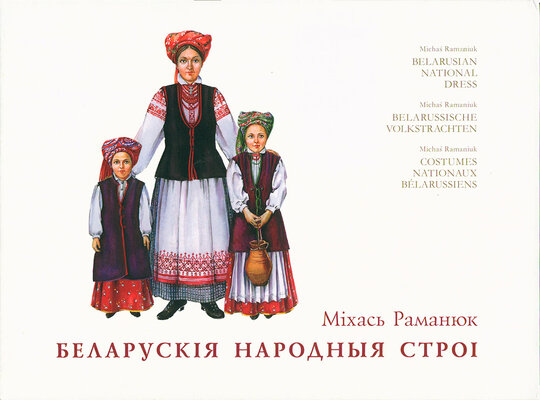
Беларускія народныя строі
Міхась Раманюк
Памер: 80с.
Мінск 2014
     Менавіта жаночы строй вызначае адметнасьць нацыянальнага адзеньня беларусаў увогуле.

     На тэрыторыі ўсёй краіны ў канцы 19 — пачатку 20 ст. y летнім жаночым адзеньні быў распаўсюджаны убор, y склад якога ўваходзілі: кашуля, спадніца, фартух, гарсэт, ваўняны пояс.
     Жаночая кашуля кроілася з прастакутных кавалкаў ільняной тканіны. Аздаблялі кашулю чырвона-чорным колерам і строгім геамэтрычным або расьлінным арнамэнтам, карункамі ці белым рэльефным шыцьцём. Найбольшая ўвага зьвярталася на ўпрыгожаньне рукавоў, што зьвязана зь верай y магічную сілу чырвонага рамбічнага арнамэнту, які нібыта засьцерагаў рукі ад злых духаў і надаваў ім моц y працы. Разнастайным было паясное адзеньне жанчыны: многія віды спадніц (андарак, саян, палатнянік, летнік, бурка), a таксама панёвы, фартухі. Малюнак спадніцы і панёвы — клетка, падоўжныя або папярочныя палосы ў чырвоным, сіне-зялёным ці срабрыста-белым калярыце. Кампазыцыйна-арнамэнтальнае вырашэньне фартуха адпавядала кашулі і гарманізавала зь ёю; апрача таго, фартух упрыгожваўся карункамі і быў прыкметнай часткай строю. У жаночае, асабліва сьвяточнае ўбраньне ўваходзіў і гарсэт (кабат) y выглядзе безрукаўкі, якая шчыльна аблягала стан і рабіла паставу зграбнай. Пояс быў рознакаляровым (найчасьцей чырвона-зялёна-белым) з абавязковымі кутасамі ці махрамі на канцах. Дапаўняўся жаночы строй вялікай колькасьцю караляў з бурштыну, шкла, каменю, a таксама мэталічнымі крыжыкамі і абразкамі.
     У стварэньні мастацкага ансамблю і завяршэньні строю вялікую ролю гралі галаўны ўбор і прычоска. Яны строга адпавядалі ўзросту і сямейнаму становішчу жанчыны. Дзяўчаты хадзілі зь непакрытаю галавой. Расчасаныя на прабор валасы запляталі ў адну ці дзьве касы, упрыгожаныя каляровымі тасёмкамі ці стужкамі. Зьверху надзяваўся

вянок, абручык з налобнікам ці перавязка-ручнік y форме маленькага ручнічка з аздобленымі вышыўкай канца-мі і чалом. У адрозьненьне ад дзяўчат, замужнія жанчыны старанна хавалі валасы пад самы распаўсюджаны і традыцыйны галаўны ўбор — намітку (белы льняны ручнік даўжынёю каля чатырох мэтраў). Таксама пашыраныя былі каптур, галовачка і падвічка. Жаночыя галаўныя ўборы ня мелі рэзкага падзелу на летнія і зімовыя, y холад на іх дадаткова накідвалі хустку.
     Будзённым абуткам жанчын служылі лапці, a сьвяточным — скураныя пасталы ці чорныя хромавыя чаравічкі.

     Мужчынскі строй, y параўнаньні з жаночым, больш аднастайны і тыповы. Традыцыйнае сьвяточнае адзеньне мужчын складалася з палатнянай кашулі, нагавіц і камізэлькі. Кашулю насілі навыпуск і падпярэзвалі рознакаляровым з пышнымі кутасамі поясам. На шыю павязвалі шалік. Дапаўняў мужчынскі строй скураны кашалёк-кішэня шабета (каліта) на раменьчыку, якая насілася празь левае плячо або падвешвалася да поясу.
     Галаўнымі ўборамі найчасьцей былі магеркі зь белага лямцу і картузы. Шырока бытавалі і валяныя ці саламяныя капелюшы (брылі), якія насілі больш улетку. Узімку насілі аўчыныя шапкі — аблавухі ці “кучмы”, падбітыя футрам.
     Пашыраным абуткам былі лыкавыя лапці або скураныя пасталы, на сьвяты — скураныя боты. Упрыгож-валася мужчынскае адзеньне сьціпла. Дамінаваў белы колер, a дэкор разьмяркоўваўся на каўняры, грудзях, плячах і рукавах кашулі, таксама на поясе.

     Верхняе мужчынскае і жаночае зімовае адзеньне мала чым адрозьнівалася паміж сабою. Шылі яго зь бе-лага, шэрага і, радзей, з чорнага сукна, a таксама зь недублёнай белай ці дублёнай вохрыста-чырвонай аўчыны. Палатнянае верхняе адзеньне сустракаецца ў паўночна-заходніх раёнах. 3 сукна шылі сьвіткі, сярмягі, бурносы, курткі, нагавіцы і іншыя традыцыйныя віды вопраткі. 3 аўчыны выраблялі кажухі і кажушкі. Упрыгожвалі зімовы (верхні) строй больш сьціпла, чым летні. Вышыўка шарсьцянымі ніткамі дапаўнялася аплікацыяй з каляровай тканіны, скуры, шнура і тасьмы.

     Беларускае народнае адзеньне аднатыпнае на ўсёй тэрыторыі краіны, але ў ім вылучаюць чатыры асноўныя комплексы, залежна ад таго, з чым насілі кашулю ў жаночым строі: са спадніцай і фартухом; са спадніцай, фартухом і гарсэтам; са спадніцай, да якой прышыты ліф-гарсэт, і фартухом; з панёвай, фартухом, гарсэтам. Першыя два вядомыя ўсюды, два другія — ва ўсходніх і паўднёва-ўсходніх раёнах. Кожны зь іх па-свойму адлюстроўвае эвалюцыю строю. У кожным адбіліся і асаблівасьці такіх этнаграфічных рэгіёнаў, як Заходняе і ўсходняе Палесьсе, Падняпроўе, Цэнтральная Беларусь, Панямоньне, Віленшчына, Паазер’е.


Міхась Раманюк


BELARUSIAN NATIONAL DRESS


      The book “Belarusian National Dress” is my lifework. It consists of drawings depicting Belarusian peasants and towndwellers, dressed in traditional festive ceremonial clothing from the 19th to the mid-20th century. The drawings are not reflections of the author’s imagination. They are the product of an enormous research and information gathering. Displayed on the following pages are graphic reconstructions of Belarusian national dress of all ethnographic regions. Material for the reconstructions was gathered by the author over a quarter-century period in remote villages of the country where traditional lifestyle and handmade national clothing of unreplicable beauty was preserved, where a Belarusian peasant woman could spend hours recounting how her mother and grandmother dressed for festive occasions and what items of clothing they saved for the rituals of birth and death.
      In addition to field research, work was also conducted in the museums, archives and libraries of Minsk, Pinsk, Warsaw, Vilnius, Lviv, Moscow, St. Petersburg, Wroclaw and other cities. Sketches, photographs, prints and notes of famous ethnographers were processed and systemized. Old family photographs, still abundant in village homes, were often used to create accurate reproductions.

      Traditional Belarusian national dress has a long history of development. Specifically Belarusian traits were acquired in the 14th-16th centuries, when the Belarusian nation was being formed. Dress was influenced by Lithuanian, Polish, Russian and Ukrainian traditions; it was also enriched by the influence of international urban attire, thereby blending into the allEuropean context.
      Formed as a result of a long and complicated process, Belarusian national dress reflects specific features of the Belarusian nation to a greater extent than other aspects of everyday life. Many believe that after the language, national dress is the most important of ethnic traits. The dress of Belarusian peasants fully corresponds to the aesthetic ideal of beauty expressed in the melody of folk songs, the sounds of folk instruments and the movements of folk dance.
      The color scheme of national attire was particularly influenced by the silver-white hues of natural flax and wool, fibers symbolizing festivity and joy. It is not perhaps surprising then, that many believe the origin of the word “Belarus” comes from the fact that since time immemorial the favorite color of our ancestors’ clothing was white. Red symbolizing life was also important as a warning token incorporated into a complicated system of ornamental symbols that were embroidered or woven into the clothing.
      White linen clothes, woven from rectangular samatkanka, were the staples of peasant attire from birth to death. A newborn baby was dressed in a dazzling white sleeveless overhead tunic-like garment miatlik, while the deceased were buried in an intrinsically embroidered shirt bearing a red ornament. Ancient traditions determined what clothing should be worn

every day, to a wedding ceremony or during periods of mourning. For example, during lent a “fasting dress” was worn, where red was entirely absent. The most beautiful clothes, of course, were saved for festive occasions: when the cattle was first led to graze, the first furrow ploughed, or the first swathe cut in the meadows. Tradition mandated that for the first swathe or harvest, men and women had to wear special clothing.
      The festive dress worn by young women prior to the birth of the first child was modest and refined. Like gothic madonnas, they walked their native land draped in a white and veil-thin head-towel called a namitka, while their long, pleated skirts or andarak were as bright as a stained-glass window. Like women everywhere, they felt noble and beautiful in their festive clothing. Especially vivid was the ornamentation of the bride’s wedding dress. Gold, blue or green vests garset paired harmoniously with the crimson elements on their white blouses; these were complemented by the rainbow hues of the andarak. The main token was the wreath — a headdress made of flowers, leaves, beads and multicolored ribbons.
      Women’s attire in particular defines the peculiarity of Belarusian national dress.

      In the late 19th — early the 20th century, women’s summer attire was typified throughout the land by an outfit consisting of a blouse, skirt, apron, vest garset and a woolen belt.
      A woman’s shirt was cut from rectangular pieces of linen cloth. The fabric was decorated with red and black geometrical or floral ornamentation, lace, or white relief embroidery. The utmost attention was given to the decoration of sleeves. It was believed that a red diamond pattern had the magical power to protect the wearer’s hands from evil spirits and provide them with strength in work. The lower clothing of women was very diverse and included many varieties of skirts, classified according to the cut, the pattern and the material they were made of, e.g. andarak, sajan,palatnianik, letnik, burka, paniova as well as aprons. The pattern on skirts and paniova was either plaid or striped — in color schemes of red, blue, green or silvery white. The ornamental style of the apron imitated and matched that of the shirt; in addition, the apron was decorated with lace and was a prominent part of feminine attire. Women’s clothing, particularly of the festive kind, also included 2. garset or vest kabat, tightly-fitted and flattering to the figure. The belt was multicolored (most often red, green and white) and ended in mandatory fringes or frazzles. Bead, glass and stone necklaces, metal crosses and icons often completed the outfit.
 КНІГІ ОНЛАЙН