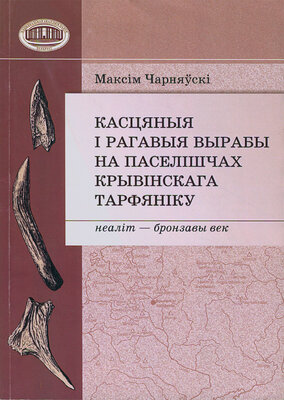
Касцяныя і рагавыя вырабы на паселішчах Крывінскага тарфяніку (неаліт — бронзавы век)
Максім Чарняўскі
Выдавец: Беларуская навука
Памер: 77с.
Мінск 2007
Žне нспользовалмсь разлмчные способы обработкн: рассеченме, отбнтне, пнленме, резанме, скобленме, строганне, удаленме лншней массы с помошью насечек, сверленме й выдалблнванне отверстнй, шлнфованме. В завнснмостм от будутего орудмя колнчество этапов нзготовленмя могло меняться от 2 (для ретушера) до 5—7 (для наконечнмка стрел). В пренмушественном большмнстве случаев под заготовку нзделмя небольшого размера нзбмрался подходяшмй отшеп костм, полученный в результате ее раскалыванпя. Следов технмкн вырезанмя заготовок заданных размеров н формы прм работе с костяным сырьем зафнкснровано не было. Однако подобный способ нспользовался прн обработке рога.
Для стоянок Крмвмнского торфяннка прн нзготовленнм мзделмй характерен полный перевес костяного сырья над роговым (более 75%). Нанболее нспользовалнсь костм лося, медведя, благородного оленя, днкого кабана, тура. Какоголмбо предпочтення в нспользованнн костей одного внда зафмкснровано не было.
SUMMARY
Bone and horn articles at the settlements of Kryvina peat bog (Neolithic — Early Bronze Age)
Over the time of the research of Kryvina peat bog (1934—2005) archeologists detected 999 bone and horn articles and their fragments. This is the largest collection of its kind on the territory of Belarus and one of the richest collections in Eastern Europe. The major reason for the tradition of mass usage of such articles was flint shortage in the region. Therefore, the local population was looking for alternative raw materials. This situation was characteristic of Belarusian Paazerje (Lake District) up to Bronze Age (inclusively).
This work presents the analysis of two categories of bone and horn articles found at the open settlements of Kryvina peat bog (the research does not comprise the category of art and cult artifacts or musical instruments). The two categories discussed in the research are I) hunting and fishing tools; 2) work and household tools. Among them we distinguish 25 classes of articles. Among hunting and fishing tools there are: arrowheads (159 specimens1’), spearheads (12 specimens), daggers (40 specimens), harpoonheads (35), fishing hooks (25), large fishing hooks (9), pegs (small needleshaped articles) (6). Among work and household tools there are: axes (83), adzes (9), chisels (25), a shovel (I), punches (160), pressure tools (33), retouchers (8), paletteknives (10), ornamentors (12), «fish» knives (81), a burin made of a whole bear fang (1), spoons (4), a haft (1), small triangular articles with flattened section (3), thrust articles made of horn remains (14), a socket (1), articles made of elk horn with remaining appendix and part of hornblade (4), scraping and cutting articles made of beaver’s lower jaw with brokenoff hookshaped appendices (2).
263	artifacts constitute the group of unidentified fragments of articles and halffinished products.
The bone and horn articles form Kryvina district are chronologically and culturally classified in the following way (fig. 67. 68).
Early Neolithic (the early period of the Narva Culture — IV millennium BC). The arrowheads characteristic of this period are as follows: all types of biconic plain ones with a tang and elongated arrowheads with a detailed tang, fragments of needleshaped ones. For harpoon heads: singleand doubletoothed articles. For daggers: articles made of elbow bones with a remaining epiphysis, the usage of lancetshaped daggers with a detailed haft is probable. Among the work and household tools the following were in use: axes made of nonsplit fragments of horn remains, axeshaped horn adzes made of massive split cortical bones, thrust tools made of slate and split cortical bones, combined «fish knives» made of wild bore fangs with working surfaces on the concave edge and side surface, and a burin made of a bear's fang.
13	Here and further including halffinished products and production fragments
73
The bone and horn articles mentioned above were detected at the open settlement Asavets 4 and were accompanied by flint ware and pottery, typical of the early period of the Narva culture. Their closest analogies can be found in the area of the Narva culture antiquities both in Belarus (Zatsenne in the NorthEast of Minsk region) and in SouthEastern Baltic Region (predominantly in Eastern Latvia and Estonia).
The major types of Early Neolithic bone and horn ware of Kryvina region bear distinct features of Mesolithic tradition of the Kunda culture which in Northern Belarus came prior to the Narva culture.
The most determinant for the Early Neolithic of Kryvina peat bog are: arrow heads — biconic plain with a nozzle and elongated arrowheads with tangs (with truncated lensshaped and rhombic section, sometimes with a denticulated edge), flat largetoothed harpoon heads, adzes made of massive split cortical bones, a burin made of a bear's fang.
Middle Neolithic (late period of the Narva culture — first half — third quarter of the III millennium BC). It is impossible to precisely identify the arrow heads typical of this period. The majority of their forms that came into usage at this time reach the peak of their development with the emergence of the Northern Belarusian culture bearers. One can only more or less confidently speak of willowleaf shaped arrow heads without a detailed tang. Closer to the end of this period spindleshaped tang arrow heads predominantly with rounded cylindrical body came in use as well as bottleshaped tang arrow heads with a round section, a detailed spindleshaped head and concavity on the body with a supportshoulder towards the tang, arrow heads with flattened body and detailed tang, which inherit the form of group IV a (with a head and a concavity of the body), bulletshaped elongated arrow heads with hardly detailed tangs. These are also articles with detailed flattened head and with the body similar to a cylinder, which smoothly runs into a haft with round section. The following artifacts can be attributed to this period, too: a damaged onesided singletoothed harpoon head with a flattened body and a wide tooth, and daggers made of elbow bones with remaining epiphyses and lancetshaped ones with a detailed haft made of split bones. The spear heads of this period are elongated with scarcely detailed or without a detailed haft. The fishing hooks are represented only by a Ushaped article made of small jaw bone. Among the work and household articles the following are typical: socket axes made of nonsplit straight and concave horn fragments, at the end of the period split articles appear, too; punches made of small bones with remaining epiphysis and single specimens made of split bones; «fish» knives on narrow concave chips with concave working surface at one end of the tool and one or two bladeshaped sides as well as specimens with concave working surface at the tool's side and small ornamentors of the same type.
The bone and horn inventory defined here as Middle Neolithic one, lay at the Asavets site 2 in the lower layers of the monument predominantly at its NorthEastern part where a large amount of pottery of the Narva culture's late period was concentrated. It was followed by scarce flit inventory which typically comprised short leafshaped arrow heads with a twoside retouch including rhombic ones.
At this time the Kunda tradition can no longer be traced and the types of artifacts characteristic of Asavets 4 are practically absent except singletoothed
74
pendants with a ringshaped cutting at the root, «fish» knives and such widespread in space and time articles as punches made of slate bones, daggers made of elbow bones and cutting tools made of whole horn fragments. At the same time, the overwhelming majority of bone and horn inventory forms came over into the material culture of Late Neolithic — Bronze Age, typical of the Northern Belarusian culture.
Late Neolithic / Bronze age (the Northern Belarusian culture — late III — third quarter of II millennium BC). Among the arrow heads of this time one can encounter: all types of biconic tang arrow heads with a round body section and detailed transition to the point, all types of spindleshaped tang arrow heads, all types of bottleshaped tang arrow heads with a round body section, a detailed head and a concavity with a supportshoulder towards the tang, tang arrow heads of a complicated form with a detailed head and body, bulletshaped arrow heads of both types, all types of needleshaped arrow heads, willowleaf shaped (predominantly with detailed tangs), vane, rhombic arrow heads with a square section haft, all types of arrow heads with a flattened body and detailed tangs, biconic elongated arrow heads with a flattened body section and a round or square section haft, and swordshaped tang arrow heads. The characteristic spear heads are as follows: articles with a slantwise cut top of both types made of broken harpoon head. For daggers: both types of articles made of bones with remaining epiphyses and lancetshaped ones. At this time all groups and types of harpoon heads can be encountered as well as Ushaped fishing hooks and all groups of «large hooks» and pegs (small needleshaped articles). The following picture is characteristic of the work and household tools. Axes: made of nonsplit fragments of horn appendices (of both types), made of split fragments of horn appendices (of all types) — are predominant. These are also horn adzes, chisels of all types, shovels, all forms of punches, squeezers, retouchers, paletteknives, ornamentors and «fish» knives, spoons, hafts, small triangular articles with flattened section, thrust tools made of horn remains, articles made of elk horns with a remaining appendix and part of hornblade.
The arrival of the Northern Belarusian culture in the region stimulated further development of bone and horn industry. A number of new classes emerge: chisels, shovels, squeezers, retouchers, adzes, ornamentors, spoons, hafts, small triangular articles with flattened section, articles made of horns. Out of the classes that existed before the most characteristic of the Northern Belarusian culture are: spindleshaped tang arrow heads, bottleshaped tang arrow heads, tang arrow heads of a complicated form, needleshaped and willowtree shaped arrow heads; spear heads with a slantwise cut top, doubletoothed harpoon heads, Ushaped fishing hooks and axes made of split horn.
In Late Neolithic the quantity of different classes’ models rises (late period of the Narva culture), which is caused by the influence of other cultural traditions (the Globular Amphora culture, the CombPit Ware culture).
The considerable growth of the classes' quantity and diversity at the end of Neolithic can be attributed to the emergence of new cultural traditions in the region — the Upper Dnieper Neolithic culture and the Corded Ware culture (from the Dnieper Region and the Baltic Region), which were adopted on the basis of the Neolithic (late Narva) features.
Bone and horn ware of Late Neolithic — Early Bronze Age can be found in all Kryvina peat bog settlements apart from the Early Neolithic monumen
 КНІГІ ОНЛАЙН