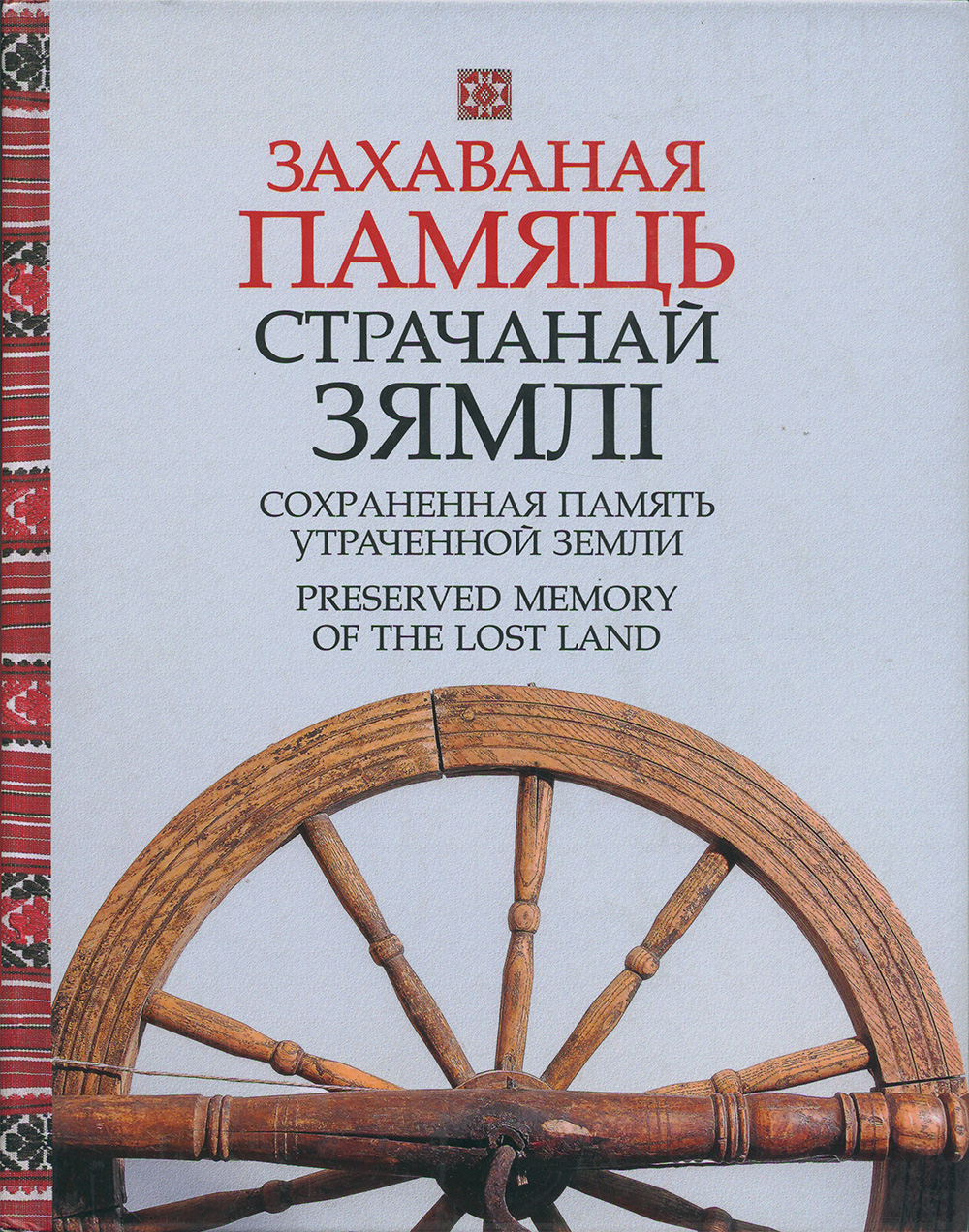
Захаваная памяць страчанай зямлі
Барыс Лазука
Выдавец: Беларусь
Памер: 206с.
Мінск 2016
В сельском быту с середлны XIX века появляются прялкл лнструменты для механлзлрованного пряденля льна л овечьей шерстл в домашнлх условлях. Пользоваллсь как прялкамлстоякамл (онл былл налболее распространены), так л прялкамллежакамл, лмевшлмл локальное распространенле. Чернобыльская коллекцля насчлтывает почтл два десятка первых л два — вторых. Прелмуіцественная часть прялок лмеет традлцлонные формы л пропорцлл, но на некоторых можно увлдеть роскошную отточку с элементамл резьбы л нанесенным шнуровым орнаментом. Унлкальной является одна небольшая по размерам прялка: она предназначалась для молодых невысоклх девушек л в своей конструкцлл лмела стойкутрубу, куда вставлялся спецлальный лнструмент с прлкрепленным прясллцем с куделью. Такая конструкцля очень редкая л встречается в едлнлчных экземплярах. Вместе с прялкамл обычно лспользовалл прясллца с выплленнымл краямл л обработаннымл ножкамл, которые вставлялл в скамьл ллл в перпендлкулярные доскл ллбо просто садлллсь на нлх.
Belarus is a country of numerous rivers and lakes, so from ancient times fishing was a very common and profitable activity. Illuminated by folk beliefs, customs and traditions, praised in songs, from times immemorial fishing was an integral part of people’s everyday life. Poleshuks (natives of the Polesye area) actively used a variety of fishing tools on their marshes and rivers. Fishing methods conformed to the environmental conditions, the nature of water basins, season, weather, the calculations for a certain kind of fish, regional traditions, etc. Due to the richness of the river and lake fauna, fish was caught just by hands, by a basket in the muddy water or it was driven in shallow water, beaten with a stick, pressed weeds with a pole or a paddle, then it was taken and thrown on the bank. A wide variety of fishing tools made of wicker, splinter and bast were biought fiom expeditions: coneshaped traps made of whole willow twigs to various boxes and baskets. Most of them have a wide neck that gradually narrows, through which fish comes and can no longer get out. For example, wicker cone traps were used in winter, especially during the thaw, to catch loach by putting traps into a hole under the ice.
The collection contains trap nets (a net stretched over hoops) and venters (a trap net type with wide wings that improve fishing efficiency). In addition, there are exhibited two mutniks (nets for catching small fish) used in shallow water and one volok (a net that two fishermen could use at once).
Quite a large canoe was found during the expeditions. It is more than 3 m long and carved from a single log. Along with it, the collection was replenished not only with the paddles of different sizes, but also with a kaganets — a special metal tool for night fishing. The kaganets consists of a metal basketshaped frame and a long iron rod attached to it. The tool was fixed to a boat nose. At night, a pot with a fire or hot embers was put into it and when the fish floated to the light, fishermen hit it with harpoons, which are also represented in the Chernobyl collection.
Another wellknown activity to poleshuks was beekeeping. During the trips to the Chernobyl zone scientists came across a wide range of bee trees. However, due to their relatively large size and weight only one bee tree made of a single piece of thick wood was brought to the collection. Inside it is hollowed by ice chisels. There are wooden plugs in the upper and lower parts. A hole for bees to fly in and out with an insert for closing is cut in the centre. People got honey through the hole. The Chernobyl collection includes beekeeping tools: manufactured bee smokers and homemade wooden queen cells — a space for a queen bee was cut out in a piece of wood. Along the perimeter, wooden pegs were inserted, so the queen bee could not get out. The queen bee was put inside through a hole drilled in the wood and then it was plugged. A special utensil_ lipovka — was used to store the honey. The lipovka is a part of the collection, too.
87
ЗАХАВАНАЯ ПАМЯЦЬ СТРАЧАНАЙ ЗЯМЛІ
Various crafts were common in rural areas from ancient times. A majority of tools were made of wood abundant in Belarus. Different cooper items were used to store food.	,	, 1 r , i
Belarusian craftsmen used cooper tools perfectly and subtly felt the nature of wood. Knowing diverse qualities of certain types of wood, they skilfully used them to create various kinds of dishes. Functional viability and structural rationalism, laconic lines and shapes and modest finish are the distinctive features determining the vitality of folk crafts. Without the written regulations and instructions craftsmen intuitively adhered to optimal settings. The same approach has always been used in carpentry and joinery. These crafts specialized in the production of not only household utensils, but also of buildings and their structural components. Often craftsmen considered it not only prestigious, but even compulsory to produce items without nails using joinery techniques and tools.
The Chernobyl collection contains a large number of craft tools, among which are axes, hammers with both wooden and iron shock foundations, several types of adzes, chisels, drills, ice chisels and boats. Measuring instruments are represented by try squares and compasses of different size. Hand planes and jointers represent the more recent tools.
With the help of these numerous tools craftsmen produced kitchenware for liquid and dry goods. There are dozens of barrels, tubs, pails, buckets and milk buckets in the collection. For example, salted cucumbers and sour cabbage were kept in oak barrels. And as before families were large, the capacity of items for storage measured in hundreds of litres. There are skilfully made watering cans and flasks, as well as tar barrels with a hole or with a spout. Barrels with lids for clothes and various tubs were made to store agricultural products or for domestic use. A lying barrel was brought to the collection from one of the expedition. It is made of solid thick wood and was probably used to store grain. Women used bowls of from 2—3 up to 12—15 litres. The collection presents butter churns of nine different versions with wooden or metal hoops.
Cooper products in the collection show not only the perfection of the forms required for utilitarian use, since all the items were made taking into account the qualities and characteristics of a wood type. In addition to the strength and durability of vessels the ability of wood to give a special taste to food and help
88
Промыслы і рамёствы
fermentation processes was always assumed. For example, barrels for cabbage were made of aspen. The Chernobyl collection demonstrates that the most popular wood types were oak, pine and spruce. Hoops were made of hazel and sometimes of oak, rarely of spruce. Some objects have metal hoops and handles forged by local blacksmiths. In some subjects alternate staves of oak and spruce, which indicates an exceptional knowledge of a master of his craft.
Weaving is one of the most common and ancient crafts, and therefore the appropriate tools improving over the centuries acquired both functionalism to use and outstanding artistic features. Such features found their manifestation in the ease of use, elegance of details and the natural beauty of materials. The expeditions brought to the Chernobyl collection items covering the entire cycle of raw material processing up to the manufacture of yarns.
The fund has seven flax brake machines. All beaters collected during the expeditions are of a sword shape. The beaters were also used for the purification of flax or hemp fibres. The resulting mass was brushed with large combs with wooden or metal teethscratchers. Available examples of these devices vary considerably in their shapes and looks and show the individuality of execution. Already prepared sliver was further combed with small combs. The collection keeps many small and large exquisitely made combs; they have carved shapes, decor, geometric and floral patterns; some have creation dates. A large number of spindles, bobbins and shuttles were collected during the expeditions. The collection contains several reels and 12 sukalas used to wind thread on a bobbin. The sukalas have hollows in their bases, and their legs, crossbars and wheels are decorated with carvings. Among nearly two dozen spinning wheels kept in the collection, examples decorated with carvings and corded ornaments could be distinguished.
Spinning wheels appeared in rural life in the midnineteenth century. They are tools for mechanical spinning of flax and sheep’s wool at home. Both vertical spinning wheels (the most common) and horizontal spinning wheels (local distribution) were used. The Chernobyl collection includes nearly two dozen examples of the former and two dozen — of the latter. The predominant part of the spinning wheels has a traditional shape and proportions, but some display luxurious carved elements and corded ornaments. A small spinning wheel is of a unique kind: it was intended for young girls of small height. Its construction has a pole where a special tool with a sliver attached by a spindle is inserted. This design is very rare and occurs singularly. Together with the spinning wheels, spindles were commonly used with sawn edges and tooled legs, which were either inserted into benches or perpendicular boards or were just laid on them.
Промыслы і рамёствы
Човен і рыбалоўныя прылады. Сяр. XX cm. Вёска Надтачаеўка Нараўлянскага рна Гомельскай вобл.
Лодка й рыболовные снастй. Cep. XX в. Деревня Надточаевка Наровлянского рна Гомельской обл.
A canoe and fishing tackle. The middle of the twentieth century. The village ofNadtochaevka, Narovlya district, Gomel region
91
ЗАХАВАНАЯ ПАМЯЦЬ СТРАЧАНАЙ ЗЯМЛІ
Аднагорлавы буч. Сяр. XX cm.
Нараўлянскі рн Гомельскай вобл.
Одногорловая верша. Cep. XX в.
Наровлянскйй рн Гомельской обл.
A oneneck cone trap. The middle of the twentieth century. Narovlya district, Gomel region
 КНІГІ ОНЛАЙН