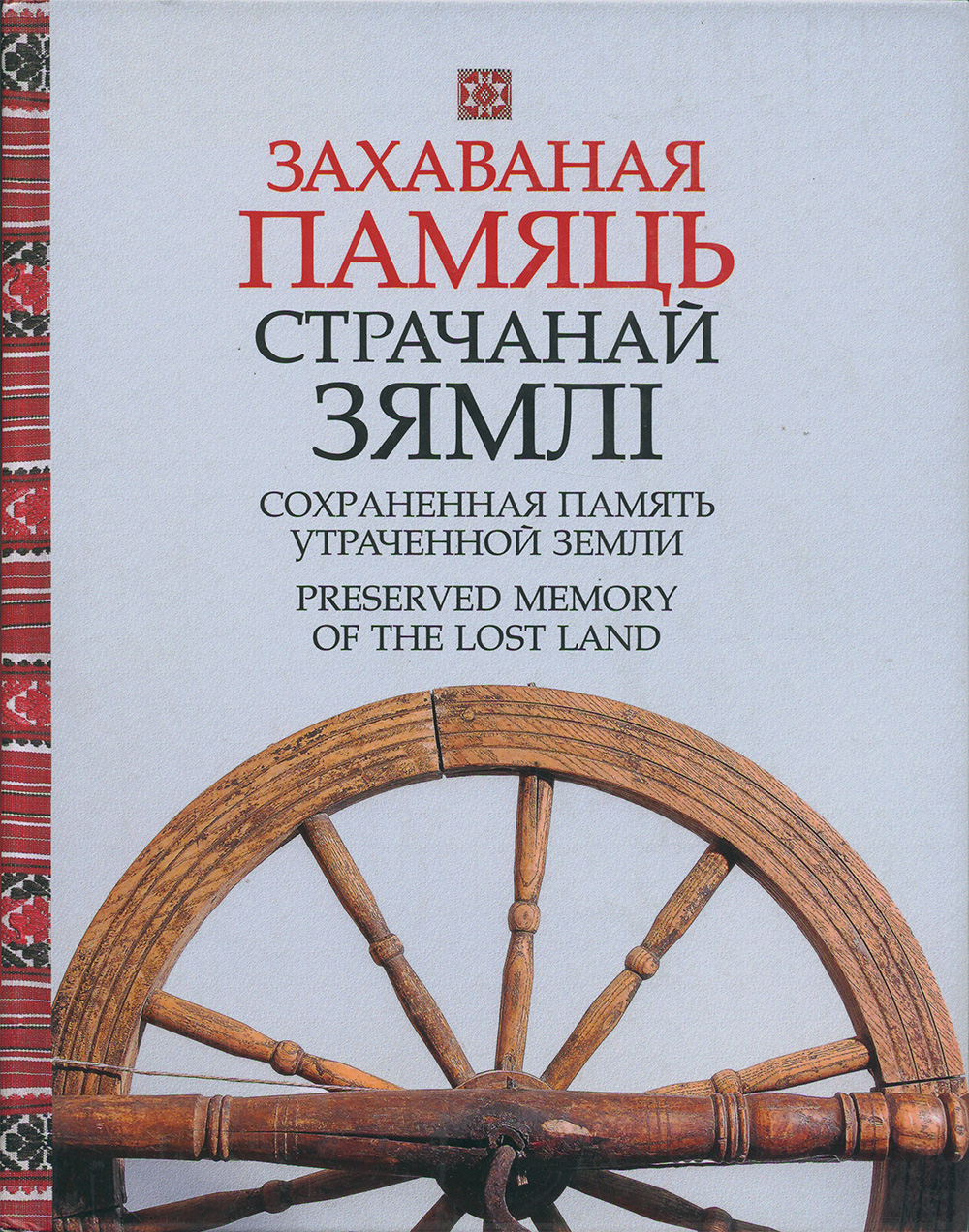
Захаваная памяць страчанай зямлі
Барыс Лазука
Выдавец: Беларусь
Памер: 206с.
Мінск 2016
Народное декоратнвнопрнкладное мскусство Чернобыльского регнона в большом колнчестве представлено мзделмямн мз керамнкн. В экспедмцмях была собрана разнообразная глнняная посуда: от млсок м латок до большнх гляков н макмтр. Коллекцмя содержнт роскошно украшенные мзделмя городнянсклх кераммстов, которые былн шнроконзвестны в бассейне Прмпятм. Онн отллчаются не только белым цветом глнны, но м декором с прмвлекательной ангобной росплсью.
В древной техннке выполнены также задымленные п глазурмрованные нзделмя мз Лоевского района, которых нз экспедмцнй прмвезлм более 20 едмнмц.
When the resettlement of residents from the contaminated region started, the majority of the local population, as known, planned to return to their homes. Therefore, people left not only a variety of household utensils in houses, but also sacred objects. It also applies to traditional fabrics and especially to the rushnyk (ritual cloth), which accompanied a person from birth to death. That is why together with the utilitarian function rushnyks had a deep spiritual meaning. It was displayed in individualism and richness of patterns and at the same time, the rushnyk could tell a lot about a person’s destiny. It is due to the scientific expeditions that the sacred memory of the inhabitants of the resettled villages and their ancestors embedded in traditional weaving and embroidery has been partly preserved. Among the brought woven cloths, a particular majestic composition and the richness of patterns are featured in the rushnyks used as the nabozhniks — they were hung on icons. They remained mostly in the houses.
A large number of the nabozhniks were brought from Bragin district. They are characterized by a rich range of colours and unusual proportions in ornaments. Some rushnyks are quite narrow and at the same time have a great length. They also differ in that they are entirely woven with narrow redandblack rep ribbons and regular white inserts.
Other saved rushnyks have a rich composition of escalloped, smooth and checked strips complemented with concise ornament on the edges. They are made in the ancient technique of filled weaving, which is not limited to simplicity but characterised by laborious manual execution reflected in the moderation of ornamental motifs. This style, along with the semantic load, allowed to combine primary forms of the ornament. A whole life could be traced through patterns. Various wide borders, together with dynamic edge motifs and images of the wings of birds, and intense redblackwhite colour scheme indicate a stormy fate, and at the end of the composition narrowing borders with motifs of lozenges, crosses, rectangles and closely patterned strips tell as if about death.
Such creative methods indicate safety and active continuity of traditions. However, simultaneously with the ageold views of weaving existed more recent and improved types of weaving. An interesting fact is that along with the surviving archaic composition and colour scheme, loom weaving is present instead of complicated filled boarders. This technique allows to develop more detailed ornamental motifs composed of slanting crosses, lozenges, geometric plant rosettes and figures.
Together with compositional and technological features of all woven and embroidered items of the Chernobyl collection, there could be distinguished increased decorativeness and colour intensity, which turned into bright polychromy in the middle of the twentieth century.
151
ЗАХАВАНАЯ ПАМЯЦЬ СТРАЧАНАЙ ЗЯМЛІ
The collection of embroidered rushnyks should be mentioned separately. There could be found a trace of the search for new decorative and artistic finishing techniques that occurred due to penetration of factory fabrics and threads into the villages. It manifested in arbitrary twosided hemstitch embroideries and stem stitches. The rushnyks made in such a technique appeared in the prewar years; there were already displayed a variety of naturalistic themes in the form of vases, birds, bouquets of flowers and ears of corn, vine garlands and other things. The rushnyks of this type found during the expeditions decorated not only icons in the God’s corner, but mainly mirrors and frames with family photos.
The rushnyks brought from the east of Belarus are characterized by interesting techniques and patterns. In particular, Krasnopolsk rushnyks impress with their monumentality, expressive accenting of large ornaments and motifs in the eightpointed stars, lozenges, stylized floral rosettes. The rushnyks from the area bear the luxurious decoration on the edges and the central part is white, as a rule, or embroidered with few strips. Such artistic solution with the introduction of white background divisions gives them greater expressiveness and conviviality. Traditional white, black and red colours are also present in the colour scheme. The use of a large variety of weaving techniques and methods with embroidery creates luxurious integral ornamental and coloristic compositions on traditional fabrics, which once again demonstrate the uniqueness of the region.
Painted carpets started to actively distribute in rural interiors from the 1930s—1950s. It so happened that in this sphere of folk art its own vision of the idyllic image of the world formed with characteristic colourful plots and metaphors. Over time, this phenomenon became so prevalent that the painted carpets even served as gifts for weddings and other celebrations.
At the Gomel region and Brest region, fashion for the painted carpets also became widespread, and they were encountered in every abandoned house in large numbers at the time of the Chernobyl expeditions. These carpets adorned the inner porch and living space. And because their decor motifs and the
152
Народнае выяўленчае і дэкаратыўнапрыкладное мастацтва
composition character similar to the embroidered and woven carpets, it can be said that the painted carpets in the collection generally have a plot and thematic focus. A variety of subjects is found there: meeting or parting lovers, naively realistic images of nature, architectural landscapes. They are often decorated with ornamental and floral motifs.
During the evacuation from the contaminated areas along with farm and household items villagers were forced to leave the most sacred objects — icons. Thanks to the efforts of the scientists, the Chernobyl collection includes a number of home icons. A distinctive feature of these icons is that they were created mainly from the middle to the end of the nineteenth century and they are of small sizes. They were used as folk home icons in the God’s corner. The sacred objects were possibly made by local masters or in the style of a certain icon painting school. They vividly reflect the local traditions of Mogilev province of the time.
Folk arts and crafts of the Chernobyl area are largely represented by pottery. The expeditions collected various clay dishes from bowls and latkas (elongated dishes) to large glyaks (jugs) and makotras (big bowls with a rough surface). The collection includes luxuriously decorated objects made by Gorodnyany potters, who were particularly well known in the Pripyat River basin. They are characteristic of not only white clay, but also of engobe coating.
The expeditions brought over 20 items of smoked and glazed pottery made by the ancient technique in Loev district.
MM^W^MMt/W^^^^^
wwtfH^.H^irtMfcwwwwm*»*^*****1^
Народнае выяўленчае і дэкаратыўнапрыкладное мастацтва
A rushnyknabozhnik
(a ritual cloth to hang on icons). The early twentieth century.
Bragin ditrict, Gomel region
Ручнікнабожнік. Пач. XX cm. Брагінскі рн Гомельскай вобл.
Рушнйкнабожнйк.
Нач. XX в.
Брагйнскйй рн Гомельской обл.
A a
155
ЗАХАВАНАЯ ПАМЯЦЬ СТРАЧАНАЙ ЗЯМЛІ
’i^^SgSS^ESSSSSSES^
Ручнікінабожнікі. Першая пал. XX cm. Краснапольскі рн Магілёўскай вобл.
Рушнйкйнабожнйкй. Первая пол. XX в. Краснопольскйй рн Могйлевской обл.
i Брагінскі рн Гомельскай вобл.
й Брагйнскйй рн Гомельской обл.
^Л^ЛХЯЛЯ^
Rushnyksnabozhniks. The first half of the twentieth century. Krasnopolye district,
Mogilev region, and Bragin ditrict, Gomel region
156
яввяк^в^
ВВвввм
^LLi^vXvx^
»k«o9«K«®o%«.
«««««««k:
ШШШШШШШШШШ
Фрагмент посцілкі.
Сяр. XX cm. Брагінскі рн Гомельскай вобл.
Фрагмент покрывала.
Cep. XX в. Брагйнскйй рн Гомельской обл.
A coverlet fragment. The middle of the twentieth century.
Bragin ditrict, Gomel region
заіЕ
Rushnyks.
The first half of the twentieth century.
The village ofKolyban, Bragin district, Gomel region
Рушнйкй. Первая non. XX e. Деревня Колыбань Брагйнского рна Гомельской обл.
Ручнікі.
Першая пал. XX cm. Вёска Калыбань Брагінскага рна Гомельскай вобл.
158
Ручнік. 19201930егг.
Брагінскі рн Гомельскай вобл.
Рушнйк. 19201930егг. Брагйнскйй рн Гомельской обл.
A rushnyk.
The 1920s—1930s.
Bragin ditrict, Gomel region
159
ЗАХАВАНАЯ ПАМЯЦЬ СТРАЧАНАЙ ЗЯМЛІ
Фрагмент абруса з карункавай прошвай. Сяр. XX cm.
Вёска Старынка Слаўгарадскага рна Магілёўскай вобл.
Фрагмент скатертй с кружевной прошвой.
Сер.ХХв.
Деревня Старйнка Славгородского рна Могйлевской обл.
A fragment of a tablecloth with lace embroidery. The middle of the twentieth century. The village ofStarinka, Slavgorod district, Mogilev region
Фрагмент посцілкі. Першая пал. XX cm. Краснапольскі рн Магілёўскай вобл.
Фрагмент покрывала. Первая пол. XX в.
Краснопольскйй рн Гомельской обл.
A coverlet fragment. The first half of the twentieth century. Krasnopolye district, Mogilev region
160
іі№

«*M»..WS«
яа ж*"ш ж***® “С±.
^ІІІІ нЯ'
ihi «Іі'
ill» »1
ill” ^
B«" "in
і W
Ручнікі. Пач. XX cm. Брагінскі рн Гомельскай вобл. і Краснапольскі рн Магілёўскай вобл.
Рушнйкй. Нач. XX в. Брагйнскйй рн Гомельской обл. й Краснопольскйй рн Могйлевской обл.
н„ Jr *’«н «» 2!“!!!^ ”» ■■
II1* ’’’’ГТн’^Іі —ЙГ^:^ ’ч Н« ІІ|| J*’» ^'^^^^ S:==^==~^^	'$П «
Rushnyks.
The early twentieth century. Bragin district, Gomel region, and Krasnopolye district,
Mogilev region
161
 КНІГІ ОНЛАЙН