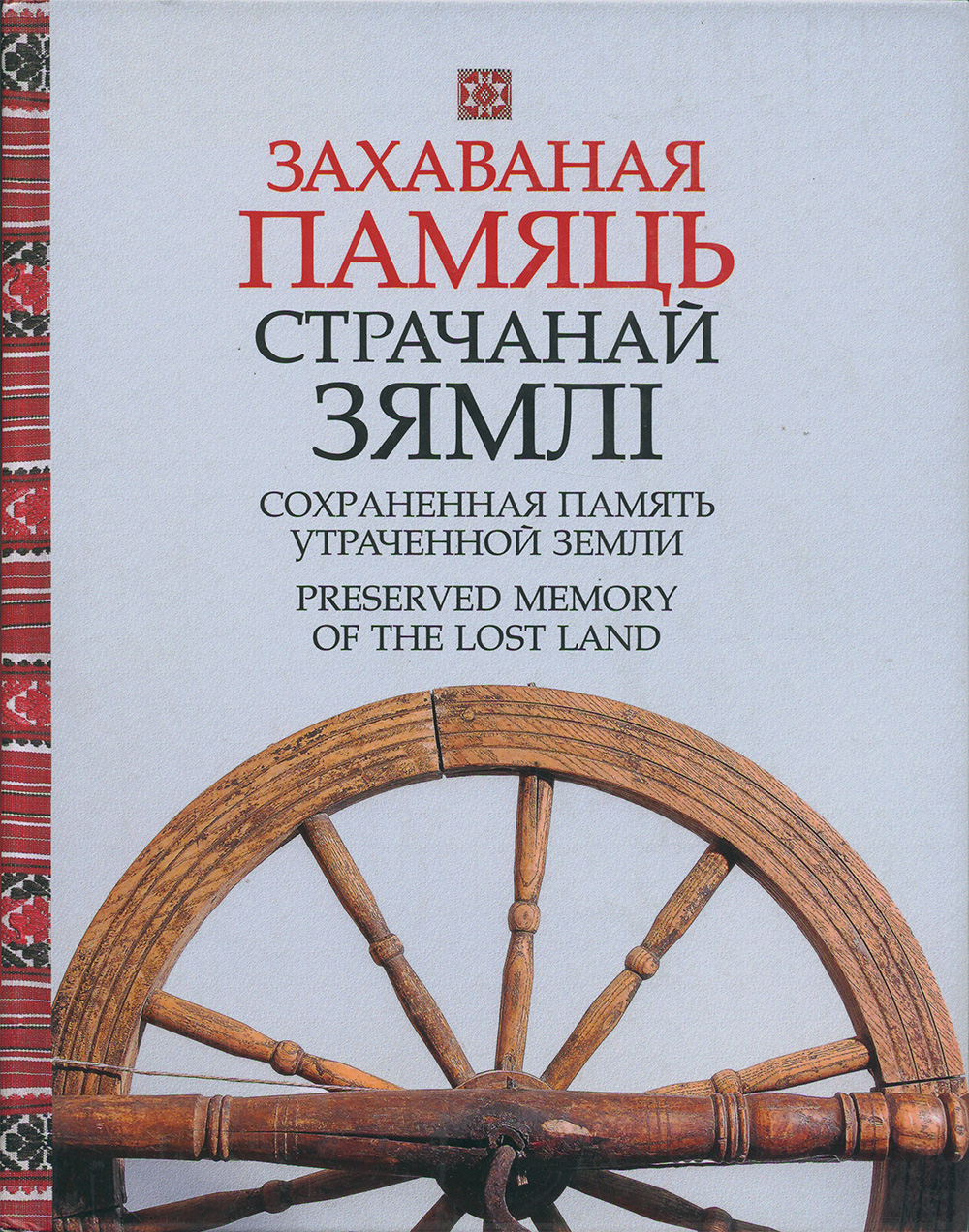
Захаваная памяць страчанай зямлі
Барыс Лазука
Выдавец: Беларусь
Памер: 206с.
Мінск 2016
In the evening, all assembled items were brought to the Braginka River. Since the items had been made before the disaster and kept under the roof, it was enough to scrub them with the help of brushes, river sand and soap in the river — it was the primary “decontamination” in those conditions. Weaving tools were washed later in the evening in the hotel.
In the following days, they visited other villages, which, unfortunately, were poorer compared to Kolyban in the ethnographic and material terms, but found a lot of things there. Afterwards, the collected materials were packed and left in Bragin and almost all the researchers returned to the capital. Only Shmatov did not leave then, because he later brought artefacts to Minsk by truck.
At that time, a panic raised among the institute employees, because, according to them, radiation had been brought! Then representatives of the sanitary and epidemiological station had to be called to carry out the measurements. As a result, the relevant documents were given that the imported items were safe and did not exceed the allowable norms of radiation.
The first expedition of June 1991 proved security, reasonableness and relevance of continuing the “Chernobyl expeditions”. Thus, the “Chernobyl fund” began to form.
The next expedition was held in June 1992. At the time, already eight people started off, including the then chief curator of funds of the Museum of Folk Architecture and Way of Life V. Malyushina. A base camp was situated on a “clean” area in the oak forest not far from Komarin. At that time and later the local Komarin Forestry helped: it provided transport — a doublebridge Gazon66 — relevant in offroad conditions and the lack of people in the study area. There were cases when the researches helped local police to pull their drowned cars. During the expedition, the scientists studied eight villages in Bragin district. And the pattern repeated: collecting artefacts in the villages in the afternoons, even with the participation of local enthusiasts, and washing them right in the Dnepr in the evenings. As a result, around 200 items of museum value were collected.
In 1992, the adequate funding began to be implemented after the creation of the special state historical and cultural expedition. Subsequent expeditions took
26
Экспедыцыі па страчанай зямлі
Удзельнікі экспедыцыі з сабранымі экспанатамі. Май 1991 г. Вёска Камарын Брагінскага рна Гомельскай вобл.
Участнйкй экспедйцйй с собраннымй экспонатамй. Май 1991 г. Деревня Комарйн Брагйнского рна Гомельской обл.
Participants of the expedition with collected artefacts. May, 1991.
The village of Komarin, Bragin district, Gomel region
place not only in Gomel region, but also in Mogilev region. For example, the third expedition took place in Korma district, Gomel region and Krasnopolye district, Mogilev region. The richness of Mogilev folk culture struck with its preservation, intensity and diversity. However, people of the resettled villages in the area had not put protective boards over windows, for they had not hoped to return, therefore the destruction was greater. For example, in June and August 1996, the expedition was present during the burial of contaminated villages in Slavgorod district. Employees of the department not only collected items in the houses that were buried afterwards, but took photos and filmed the entire process. During all expeditions Melnikov and Karelin constantly recorded the research process, and Shmatov also made various sketches. An entire exhibition of those unique paintings was organized later.
The most impressive and valuable expeditions appeared to be to Narovlya district organized in 1993, 1995 and twice in 1997. Ilie Narovlya Department of Culture helped with transport at that time. This region proved to be a rich and varied land, not only in local nature and luxurious and colourful views of the Pripyat River, but also in works of ethnography and arts and crafts. In particular, there was a lot of furniture among the found items: carved tables, numerous beds, chests and painted carpets, various weaving patterns, large cooper utensils also familiar to the neighbouring district of Khoiniki. A unique foot mortar was found in Yelsk district. It is a very rare artefact for Belarus.
In total, during 1991—1994, the scientists conducted eight expeditions and examined almost 70 resettled villages of Gomel and Mogilev regions. Not having their own transport, without uniforms and hardly equipped technically, the employees saved hundreds and hundreds of monuments of traditional folk culture and art. In Minsk, there was held the examination of items at the Institute of Radiobiology and the Main Department of Hydrometeorology of the Council of Ministers of Belarus on the presence of the radiation hazard to humans. As a result, the relevant documents were issued with recommendations for possible future use in the museum expositions.
April 25, 1995, on the eve of the ninth anniversary of the disaster, the official opening ceremony of the exhibition “Monuments of Ethnography and Folk Art of the Chernobyl Zone” in the Department of Ancient Belarusian Culture took place. Nearly a thousand of saved artefacts were presented in the exhibition halls. They were mainly from Bragin district, Gomel region and partly from expeditions to Mogilev region.
In 1996, G. M. Shary became head of the state historical and cultural expedition instead of M. N. Filistovich. M. N. Shary also took an active part in the trips to the contaminated areas. After studying the thirtykilometer zone, the scientists began the next phase of research — they recorded on video manifestations of intangible cultural and historical heritage. Unfortunately, the expedition was disbanded in 2000. However, from 1991 to 1999, the department employees conducted 23 expeditions and examined Bragin district (1991, 1992,1996, 1997, 1999), Vetka district (1999), Yelsk district (1997), Korma district (1992, 1999), Lelchitsy district (1998 ) Narovlya district (1993, 1995, 1996, twice in 1997), Khoiniki district(1994, 1996, 1997,1998), and Chechersk district of Gomel region and Bykhov district (1997), Kostyukovichi district (1994), Klimovichi district (1994), Krasnopolye district (twice in 1998), Slavgorod district (1995, twice in 1996), Cherikov district of Mogilev region.
хаце, клеці, на падворку В доме, клетн, на подворье
In the house, in the barn and in the yard
Да канца 1990х гг. у Аддзеле старажытнабеларускай культуры сфарміравалася адмысловая, аб’ёмная і грунтоўная калекцыя прадметаў, якая займела назву «Помнікі этнаграфіі і народнага мастацтва Чарнобыльскай зоны», ці папросту Чарнобыльская калекцыя. У яе складзе на дадзены момант багата розных вясковых хатніх і гаспадарчых прылад ды рыштунку: усё тое, што атачала жыццё палешука як у самім жытле, так і паза ім. Сабраная калекцыя прысвечаная гаспадарцы, промыслам і рамёствам, сакральнаму і народнаму дэкаратыўнапрыкладному мастацтву, якое адлюстроўвала светаўспрыманне простага чалавека праз кераміку, іканапіс, маляванкі і традыцыйныя тканіны.
У вясковым побыце чалавека атачалі рэчы, зробленыя ў асноўным сваімі рукамі. Таму адпаведна ў іх укладвалася не толькі ўтылітарная функцыя, але і нешта іншае, больш высокае. У жылой пабудове прысутнічала ўсё тое, што было неабходна для жыцця: ад мэблі да рознага дапаможнага хатняга начыння і прадметаў інтэр’еру. Чарнобыльская калекцыя ўнікальная тым, што захоўвае рэчы, якія сведчаць пра цесную сувязь горада і вёскі, пра пэўны пераходны перыяд, калі вёска ўсё болей пачынае ўбіраць у сябе некаторыя праявы гарадскога жыцця. Найперш гэта адлюстравалася ў мэблі. У калекцыі прысутнічаюць не толькі звыклыя для вясковага жыцця разнастайныя лавы і зэдлікі, але і іх больш мадэрновыя, удасканаленыя віды. Пры цесных сувязях горада і вёскі звычайныя лавы застаюцца, але ўжо з’яўляюцца са спінкамі і бакавінамі, робяцца розных памераў: як у сярэднюю даўжыню чалавека, так і невялічкія, для сядзення. Ёсць і лавы, аздобленыя разнымі спінкамі з разнастайнымі ўзорамі і формамі. Па краях прымацаваны папярочкі: простыя, а таксама выкананыя з мастацкім падыходам. Такім чынам, атрымліваліся сапраўдныя вясковыя канапкі, якія з цягам часу нават пачалі фарбаваць у розныя колеры. У фондзе захоўваюцца і пафарбаваныя, і непакрытыя лавы, што паказваюць і саму тэкстуру дрэва, і дэталёвасць формаў.
Як правіла, за абедзенным сталом збіралася ўся сям’я. Таму гэтаму прадмету інтэр’ера надавалася значная ўвага. Фонд змяшчае як простыя абедзенныя сталы, так і выкананыя з сапраўдным мастацкім густам: ад точаных ножак, бакавін з разьбой да шуфлядак з ручкамі, унутранымі замкамі і металічнымі накладкамі. Усё гэта сведчыць не толькі пра мастацкую фантазію вясковага чалавека, але і пра вопыт і ўмельства майстра, які адначасова з утылітарным сэнсам надаваў прадмету пэўную грацыёзнасць і велічнасць. Звычайным становіцца і выкарыстанне сярод вясковай мэблі крэслаў, якіх у выніку экспедыцый па Чарнобыльскай зоне было прывезена ажно восем штук. Кожнае з іх мае індывідуальную канструкцыю і даволі ўдала гарманізуе з астатнім хатнім начыннем.
31
ЗАХАВАНАЯ ПАМЯЦЬ СТРАЧАНАЙ ЗЯМЛІ
Адной з праяваў гарадскога ўплыву з’яўляецца шафа, якая ўражвае як сваімі памерамі, канструкцыяй, так і багатым знешнім дэкорам. Унутраная прастора падзелена з дапамогай перагародкі на дзве часткі, якія маюць асобныя дзверцы; у ніжняю частку шафы ўдала ўпісваюцца дзве масіўныя шуфляды. Ўяўляе цікавасць пасуднік, які выкананы з дубу і падзяляецца на дзве асобныя часткі. Ва ўнутранай прасторы верхняй часткі за дзвюма зашклёнымі дзверцамі знаходзяцца прымацаваныя адмысловыя планкі для лыжак. У ніжняй частцы пасудніка сканструяваны дзве высоўныя шуфляды для рознай гаспадарчай дробязі. Пад гэтымі шуфлядамі ёсць ўмацаваныя паліцы; яны зачыняюцца з дапамогай дзверцаў, якія па знешнім перыметры маюць разныя накладкі, а ў цэнтры — інкруставаныя раслінныя арнаменты з моранага дубу. Увесь пасуднік аздоблены дэкаратыўнымі накладкамі і ўзорамі.
 КНІГІ ОНЛАЙН