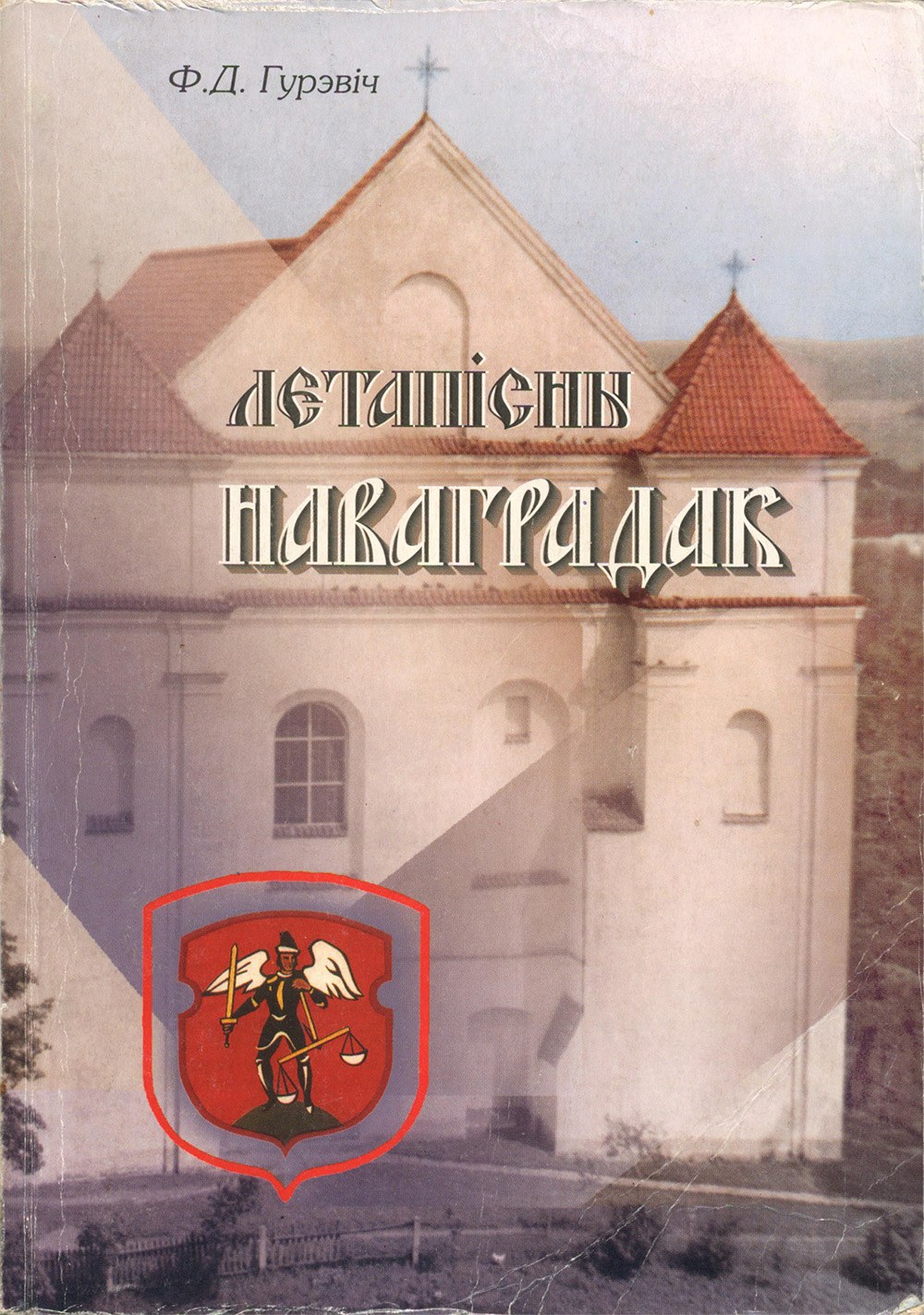
Летапісны Новгородок: Старажытнарускі Наваградак
Фрыда Гурэвіч
Памер: 324с.
Мінск 2003
лшшмн
Ф.Д. Гурэвіч
ЛЕТАПІСПЫ НОВГОРОДОК (СТАРАЖЫТНАРУСКІ НАВАГРАДАК)
СанктПецярбург — Наваградак
2003
ББК63.4
Ф.Д. Гурэвіч
Летапісны Новгородок (Старажытнарускі Наваградак). — СПб.: «Агентство ,,РДКпрйнт“», 2003. — 324 с.
Выданьне кнігі Ф.Д. Гурэвіч змагло адбыцца дзякуючы дабрачыннай працы і фінансавай падтрымцы Чэслава Германовіча, Мікадая Гурына, Аскара Дэлятыцкага, Ігара Жураўскага, Зінаіды Ківач, Людмілы Аапко, Анатоля Лукоўскага, Віктара Міхея, Таццяны Раждзественскай, Марыі Ткачэнка, Міхаіла Ханевіча, Івана Чэрнякевіча.
Пераклад на англшскую мову — Аскар Дэлятыцкі.
Рэдактар — Мікола Нікалаеў
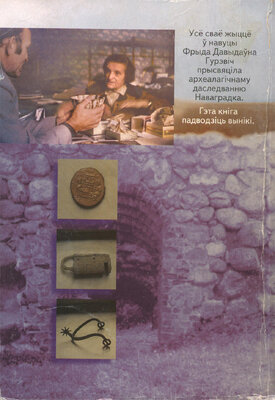
Кніга прысвечана вынікам 25гадоаага археалагічнага вывучэньня Старажытнага Наваградка — дзяцінца і вакольнага города. Шмат увагі аўтар аддае даследваііьню летапісных успамінаў аб гэтым помніку.
© Гурэвіч Ф.Д., 2003
© Нікалаеў М.В., 2003
© «Агентство ,,РДКпрйнт“», мастацкае афармленьне, 2003
SUMMARY
This book summarizes longterm (19561985) archeological investigation of the Byelorussian town of Navagradak. A peculiar feature of it is systemic juxtaposition of archeological data and the few accessible data from chronicles. That permits the author to reconstruct historical and cultural details of the emergence and further development of Navagradak for the early period of its existence  from late tenth century till late thirteenth century. The town had emerged from a kind of pretown settlement, probably a tribal centre, which in its turn  existed in the VVII centuries. The foundation of a fortified town in the late eleventh century is typologically compared with that of other Old Russion towns, certain specific features marking this town out of a series of contemporary (XIIXIII centuries) urban settlements are stressed.
The layout of Navagradak differs considerably from that of other Old Russian towns: fine planning of dwelling houses as well as mighty brickwork of its fortifications are convincing proofs of that observation. Most remarkable are monumental constructions with large glass windows and humansize frescoes.
Detailed social and trade mapping of old Navagradak is proposed; the development of handicraft  such as potteryjewelry and gunsmith's work  has been noted. Agriculture and different other crafts were also characteristic for that town. Navagradak had in those remote times intensive trade connections with other towns of the «Kiev Rus», as well as with the Orient  this observation is proved by the discovery of highly sophisticated glass objects of Bysantine, Syrian and Iranian origin.
For the spiritual culture the coexistence of Christianity and pagan beliefs is quite noteworthy. The first Christian temple was erected in the ХХП centuries. An outstanding place in early Navagradak belonged to the worship of saint martyrs Boris and Gleb.
The town had also been notorious for its tradition in manuscripts, music and chess.
There is a supplement to this book, which includes very important archeological sources, thus serving as base of data evaluation. It contains a detailed description of the excavations which had been undertaken on the Zamak tumulus, definite chronology of archeological culture layers, laboratory analysis data about materials excavated in Navagradak and surrounding area.
The book depicts Navagradak as a unique monument of ancient Byelorussian culture — which makes it a major contribution to the study of urban development.
3
F.D. Gurevich Navagradak Chronicle (Ancient Bielorussian Navagradak)
INTRODUCTION
In 1981 a book «Ancient Navagradak (trading postdefended town)» was published by the author of the present book. The first section consisted of information gathered by the Navagradak archaeological expedition of Leningradskoie Otdielenie Instituta Archeologii (Leningrad Division of the Institute of Archaeology), obtained during the exploration of the mound Maly Zamak in 19571967. The second section of the book dealt with the construction of dwellings, the history of trades and external contacts from the end of the X century to the end of the XIII century. These dates were established from the archaeological findings. In a short summary it was pointed out, that it will be possible to arrive at firmer conclusions concerning ancient Russian Navagradak when archaeological findings from the trading postdefended town would be augmented with the archaeological information about the Navagradak citadel as well as with a review of the literature. This is the aim of the present work. In the present volume, the results of many years of the archaeological endeavour in Navagradak and it’s surroundings are outlined.
The layout of this work is different from that of the previous one. In the main body of the text the results of all archaeological findings in Navagradak and surroundings are broadly outlined. The published information was incorporated and an attempt was made to recreate the history of the culture of this west Belarussian town to the end of the XIII century. The findings of the excavations on the Zamak mound — the citadel of the ancient Belarussian Navagradak — are listed in the Appendix to the book, where the results of the laboratory analyses have also been included.
The book «Ancient Navagradak» contains a description of the archaeological investigations of the ancient town. A detailed account of this, including the history of the investigation of the monuments in the Navagradak district is given in the book.
The first information about the burial mounds of the Navagradak district was obtained in the middle of the previous century (XIX c) and the names of A.I. Dmitrov and K. Tyshkevich are prominent among the investigators. In preparation for the IX Archaeological Conference, N.P, Averius dug open three burial mounds next to the village of Maruliny. M.A. Cybishev, in 1892, investigated two burial mounds along the highway to Korelichi, close to Navagradak, as well as two burial mounds at the village of Garadzilouka.
Rumours circulated of excavations of burial grounds in the Navagradak district in the twenties and thirties of our century (XX c), when the district
4
Introduction
was part of Poland. Treasure hunts were conducted in the village of Garadechna and, probably in the villages of Kamenka and Kasheleva.
An object of note in Navagradak is the Zamak mound, where, till the twenties of our century (XX c.) there were two stone towers — Shchitovaya (Shchytouka) (shield) and Kascielnaya (church). In 1906 the Kascielnaya tower collapsed. Due to the efforts of a local historian T. Karvan the tower was reenforced in 19091910. During the first world war the southern wall of the Shchitovaya tower collapsed. The Governor of the Minsk gubernia (to which Navagradak belonged) asked the administration of the town to provide the means to reinforce «this rare memorial of the past history». However, work did not commence until 1922. At the same time the Kascielnaya (church) tower was provided with an escarpment.
Significant restoration and conservation works of the Zamak mound in Navagradak were undertaken by Polish investigators and restorers under the direction of S. Lorentz and J. Roemer. The summary of their work is given in the book about the defended trading town Navagradak. Their work deserves to be looked at in more detail.
The work of restoration and conservation of the Zamak mound commenced in conjunction with erection (on the southeast corner) of the neighbouring hill, the Maly Zamak, of a memorial mound to Adam Mickiewicz, where later the remains of the trading post — defended quarters of ancient Navagradak were discovered, The soil for that mound was taken from the top of the Zamak mound, which was used in the XIX century as a garbage tip. During the earth works, new and previously unknown memorials of monumental architecture were discovered on the Zamak mound. On the south side of the ground was the stone Vyezdnaya (Drivein) tower which was connected to the newly discovered stone wall, which was surrounding the ground. On the southern hillside of the Zamak mound were the remains of the Kolodeznaya (Water well) tower, which was providing the entry to the water supply. A wall connected the tower to the Zamak. On the northwest of the ground the remains of the Uglavaya (Corner) tower were discovered.
Between the Szchytouka and Kascielnaya towers the investigators cleared the foundation stones of a palace, which they dated to be of the XVI or early XVII century. To the southwest of Szchytouka were the ruins of an orthodox church and of a catholic church, which were known to have been standing, (though without a roof), as late as 1850.
Whilst working on the Szchytouka, the investigators discovered the remains of a previous tower, built, according to them, at the same time as the orthodox church. The charred logs led the investigators to conclude that initially the Zamak mound was surrounded by a wooden wall and one tower.
The Polish architects restored the Kascielnaya tower by essentially rebuilding it and reinforcing the defensive stone wall, which is 2.40 m high.
Around the edges and the centre of the ground six trenches were dug and the following stratification was revealed: at the depth of 1.90 m there is a
5
Introduction
layer of clay and sand containing broken bricks. Under it there is black soil with a small amount of broken bricks, and lower still (to the depth of 3.20 m) there is grey soil with remains of burned and rotting timber. Findings of coins and stone missiles led the investigators to the conclusion that in the history of the Zamak mound there were two stages of which the first was dated to the first half of the XV century and the second to the beginning of the XVI century.
The work of the Polish architects is of the highest order. Due to their endeavours, the Zamak mound of Navagradak was shown to have been a multitowered defensive structure, and the conservation of the towers and defensive wall has prevented further destruction. On the other hand, their results were confined to the history of the Zamak in the late middle ages. There were no discoveries pointing to the earlier history of the monument.
 КНІГІ ОНЛАЙН