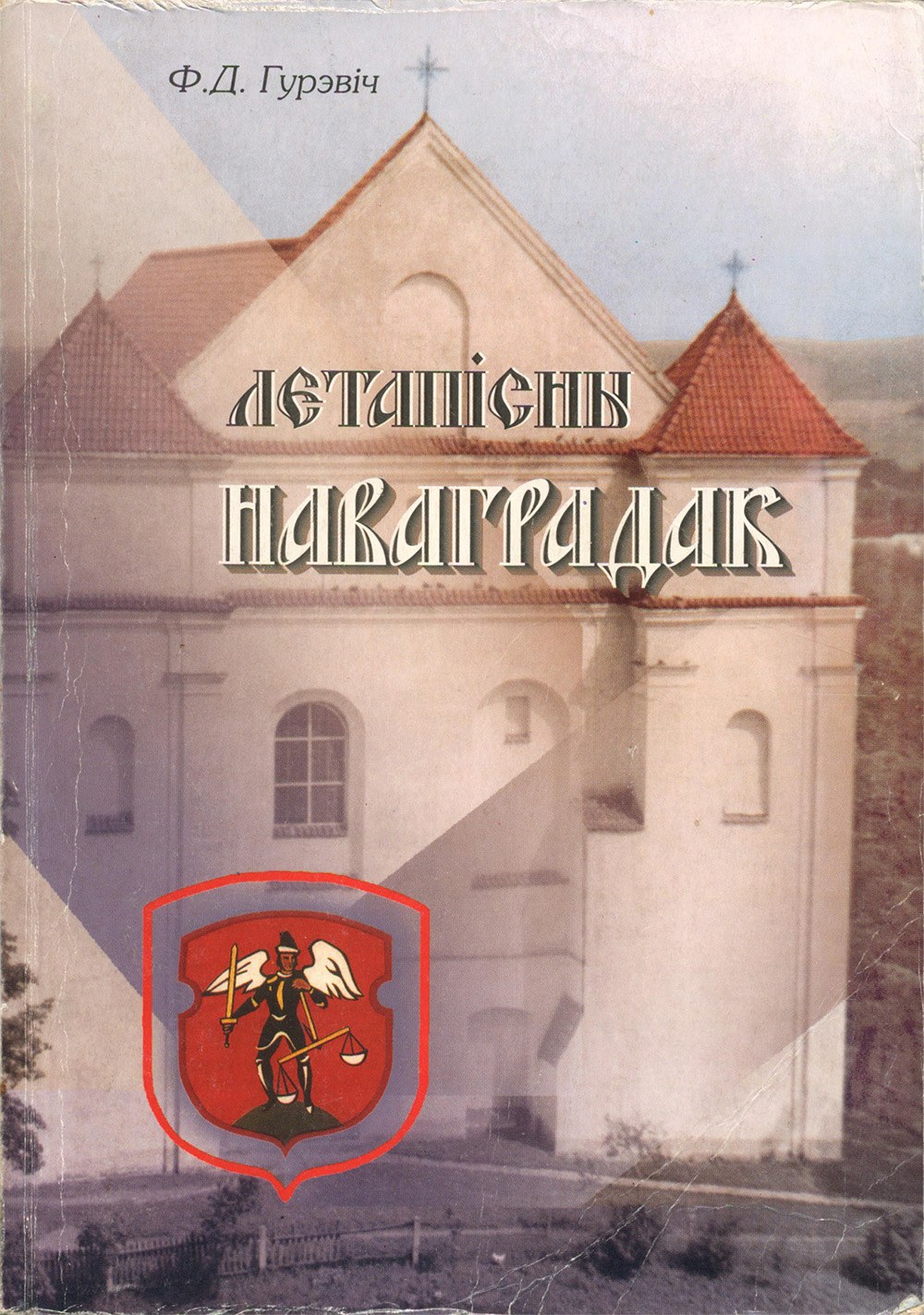
Летапісны Новгородок: Старажытнарускі Наваградак
Фрыда Гурэвіч
Памер: 324с.
Мінск 2003
From the beginning of the settlement of the Navagradak hills, the surrounds are forming actively. Along the banks of the nameless stream, which flows into the river Volovka, 34 km from Navagradak the following memorials can be found: 1) a kurgan cemetery next to the village Selec, consisting of 50 kurgans 610 m in diameter. 2) a hamlet on the shore of a river next to the village of Garadzilouka , which occupied an area of 130x125 m and nearby 13 kurgans of 512m in diameter (Garadzilouka I) 3) a kurgan cemetery consisting of 42 kurgans 510 m in diameter to the west of the settlement (Garadzilouka II). 4) township next to the village Garadechna on the right side of the river. The area of the township is elevated to 3.54 m and covered at present by a dense forest. 5) on the west edge of the village in the fields are signs of kurgans which have been ploughed in. It is probable that from these kurgans came the finds which have been kept in the museum of Krakov.
About 1 km south of Navagradak there was a cemetery on both sides of the rivulet Chyemerovka. In 1956 9 kurgans were there, and 5 km to the north of the town next to the village Ladenniki our expedition discovered 23 kurgans 515 m in diameter.
Within the radius of 1012 km from Navagradak next to the villages Sulyatychi, Molnichi, Maruliny etc settlements and kurgan cemeteries have been found.
Archaeological works were conducted in the village of Garadzilouka , where in an area of 160 sq m few moulded ceramics were uncovered as well as spun ceramic products. Some of the products were pots with bent rounded rims and a waving ornaments, similar to those found in the early settlements in Navagradak.
When digging prospecting shafts in the village of Garadechna, in a historical stratum 60 cm thick, most ceramics found were spun, but a few were moulded. It would appear that the township was developing synchronously with the settlements and later town of Navagradak.
In the excavated kurgans in the district around Navagradak burials by the ritual of burning of the body were found in the cemeteries of Garadzilouka I and in Ladzeiniki. The burned bones were lying mostly on an embankment. In Ladzeiniki blocks were found on the ground and in the embankment, which were remains of coffins. In the embankment coal and stones were found. Judging by the materials found in the kurgans of Garadzilouka I, burials by the ritual of burning of the body were performed there
20
Introduction
in the XI century, which can be determined by the lyrelike yarn and other finds. A body burned through an inlet pipe was found in one of the kurgans in the village of Selec.
The transition from burning of the body the ritual of laying out of the body in the district of Navagradak can be seen in one of the kurgans in the village of Molnichi, where the upper part of the skeleton was lightly burned and the skull was carbonised. The ritual of body burning was continued in the villages later.
Kurgans with calcine bones were found in the cemetery by the village of Sulyatichi. They were of the XIIXIII centuries.
In the kurgans where the ritual of laying out of the body was used the skeletons were laying extended with the head facing west. An eastern orientation was noticed only once in a kurgan in the village of Molnichi. In that cemetery were the remains of coffins  boxes made of logs, covered by an embankment. Sometimes there were stones in the kurgans. Under the bodies and above them were layers of ashes.
Next to the skeletons were remains of pots. Often remains of pots were found in the embankment. The inventory of the kurgans is not rich. They are domestic items (knifes, remains of a wooden bucket). An interesting find were two battle axes. In women’s graves were dresses and decorations. All the items found in the kurgans of the district of Navagradak, except for two cricoid rings in a kurgan at Garadzilouka I, identical to the things found in the Navagradak settlements. In the villages were items which were made on the spot or they were brought from the settlements on the hills. Before the settlements became a town, they were the economical centres of the district, and they were forming synchronously with the population growth on the Navagradak heights.
Those are the archaeological materials which illustrate the development of Navagradak from a nest of settlements at the end of the X  first half of the XI centuries into a town, which began its existence in the second half of the XI century. The pretown period was not appreciated initially by the author, who thought in terms of two periods: late X century  time of the first settlement on the Maly Zamak to the end of the XI century and the second period was in the XIIXIII centuries. A better division is late X century  first half XI century is the pretown period, and the second is early town period  the second half of the XI century.
The culture of the memorials of Navagradak and its surroundings at the end of the I millennium and the beginning of the II millennium are typically Slavonic, in which were preserved the tribal peculiarities of the dregovichi. The defining ethnic characteristics take many forms. In the 80’s of the previous century (XIX) V.Z. Zavitnevich, who excavated the largest number of dregovichi kurgans, saw the peculiarities in the location of the buried in the kurgan embankments. E.I. Timofeev of the 60’s of this century is inclined to agree with this. A.A. Spicyn thought that characteristic for the
21
Introduction
dregovichi were timber frames and little chambers in the kurgans and in the attire cricoid temple rings and metallic grain beads. A.V. Uspenskaya supports the view of Spicyn about the decorations of the dregovichi. V,V. Sedov considers the most important ethnic defining characteristic of the dregovichi the metallic grain beads, whereas all the other characteristics ascribed to the dregovichi by other investigators can be found among other Slavonic tribes.
In the Navagradak cemetery and kurgans, which were investigated in the surroundings of Navagradak there are all characteristics which are ascribed to the culture of the dregovichi. In the burial ritual this is confirmed by the location of the bones on the ground and the construction of the coffins and among the items found cricoid temple rings (Garadzilouka II, Molnichi, Kamenka) and metallic grain beads. The last have been also found in the Navagradak cemetery and also in the kurgans of Garadzilouka II, Garadechna, Molnichi and Kamenka. Some grain beads were found in the historical stratums of the Zamak mound and the Maly Zamak.
The skeletons of the Navagradak cemetery and kurgans in the vicinity of the town were examined by L.M. Kazei, who was looking for the physical development of the ancient inhabitants of Navagradak and surroundings. According to 1.1. Salivon, who investigated the skeletons of the XI1X1II centuries cemetery on the territory of the Maly Zamak, the craniological peculiarities and their dimensions are similar to the anthropological indicators of the dregovichi.
Determining ethnic characteristics of the dregovichi are supported by the discovery that in Navagradak their living quarters were build above ground level with pise (of clay, mixed with straw, gravel etc) ovens or stoves made of stones.
The majority of the population was Slavonic and were the descendants of the dregovichi, but in the early Navagradak there were indications of the presence of other groups of Slavonic populations. This is evidenced by the remains oi sunken buildings and braziers, in navershie ovens, characteristic of the southeastern peoples and also ceramics of the Volyn type. Those finds should be connected with the penetration into Navagradak of a certain part of the population from Volkovysk, which is 100 km southwest of our town. In Volkovysk in the second half of the X century settled emigrants from the southwest lands, who's only stile of house building till the end of the XI century were half dugouts with stone ovens. In the oldest settlement in Volkovysk “Swedish Hill” (Shvedskaya Gora) the leading type of ceramic in the second half of the X  beginning of the XI centuries were pots of the Volyn type.
Small quantities of ceramics have appeared in Navagradak ornamented with a punch, which was typical of the ceramics of western slavs. Few fragments of pots of the so called drogichinski type M.V. Malevskaya connects with inhabitants of Volyn or Podlasie on the Bug, where this type of dishes was typical in the IXXI centuries.
22
introduction
Some findings allow to see in the Navagradak district signs of the presence of krivichi. One of the indications is the kurgan cemetery on the Korelichi highway, which was mentioned previously. As is known, elongated kurgans, which were excavated in this cemetery, are characteristic of the burial mounds of the krivichi. In the kurgan of the 10th Navagradak cemetery calcine hones were laying in a rectangular pit, almost in the centre of the kurgan. The dregovichi did not practice the ritual of this form of burning of the body, but the krivichi have been known to use it. This is similar to the cemetery in Zaslavl, a substantial part of which belonged to the krivichi. In this cemetery, different to the cemeteries of the dregovichi, the buried were surrounded by stones. Stones were also logged in the tops of the kurgans.
Remarkable are also bronze temple rings with tied ends from the kurgan Garadzilouka I. They are reduced copies of the krivichi bracelet like rings. Similar adornments can be found in the second and third group in the cemetery of Zaslavl.
A nonarchaeological indication of the penetration of the krivichi into the territory of Navagradak is a village named Krivichi not far from the Nioman.
Such a toponym indicates the ethnic composition of the settlement, different from the indigenous population of the land. We should also recollect the words of Peter Duisburg about the magister of the Order who attempted to capture Navagradak, which the author places in the land of the krivichi. This was written by a man who does not know who lived on the land along the Nioman, where the crusaders went. However it is interesting to note that in the XIV century the chronicler heard of the krivichi in those lands.
 КНІГІ ОНЛАЙН