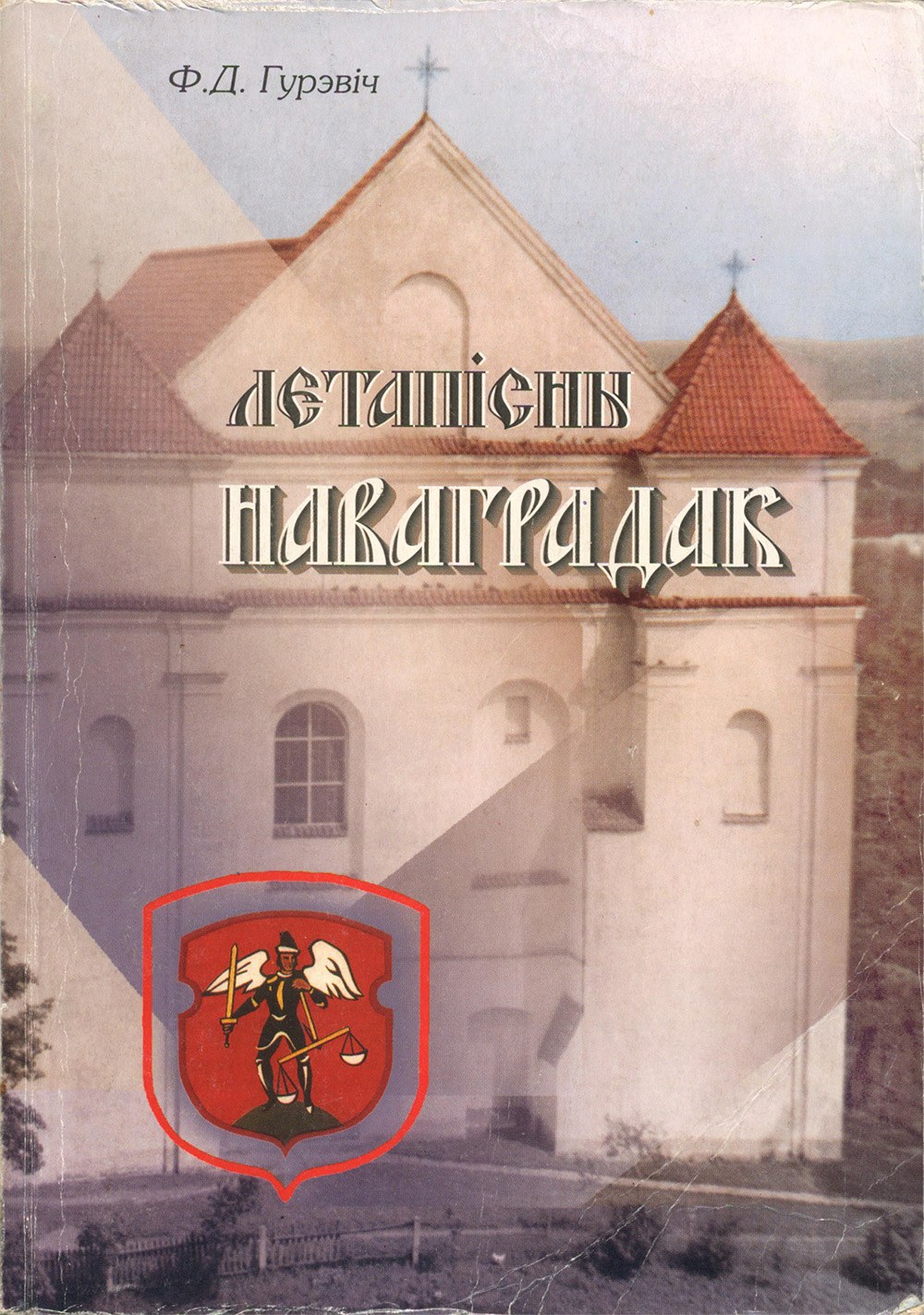
Летапісны Новгородок: Старажытнарускі Наваградак
Фрыда Гурэвіч
Памер: 324с.
Мінск 2003
Though V.V. Sedov considers that the Navagradak kurgan cemeteries are memorials to the dregovichi, he points out that in the upper Nioman they were not the basic original population and agrees with the linguists (K. Buga, Ya. Rozvadovski, V.N. Toporov etc) that on arrival the slavs found in those'lands the balls. Did the balls live in the early Navagradak and surroundings? In the burial memorials of Navagradak there is no sign of their presence. The nearest east lithuanian kurgans are to be found on the right shore of Nioman. Stone kurgans, which Sedov considers to be the burial mounds of the yatvyags who changed to become slavs, are also to be found some distance from the lands in which we are interested. Il is possible that baits were buried in the kurgans outside Navagradak that were excavated in the past century (XIX). In those were found: pots, arrowheads, a siecle, a silver pleated grivna (russian unit of currency), a platelike hoop and a ring. There was a kurgan in the cemetery in the village of Sulyatichi which had a stone cover and stones on the burial ground, which showed baltic influence.
More basic is the study of the influence of balls on the culture of the settlements of Navagradak and, firstly, on decorations and attire. Along the
23
Introduction
production of general Slav and specifically Navagradak products (temple rings with a spiral curl) the jewellers were making decorations which were characteristically baltic. They were horseshoe shaped buckles, spirals, trapeziform weights etc. It is possible that it reflects the presence of baits, primarily Lithuanians, in early Navagradak.
As to the origins and early history of Navagradak, in the light of the available evidence, it can be answered at present as follows: the settlements which were started on the Navagradak hills at the end of the X century and the beginning of the XI century were settled by the dregovichi, among whom were small groups of other slav tribes  the krivichi, volynians, inhabitants of Podlasie and Mazowsze. They came from east, west and southwest and stopped in Navagradak. As to the basic population, the dregovichi, it is not clear how their culture at the end of the I millennium is connected with the culture of the few settlers and the Slav moulded ceramics, mentioned at the beginning of this chapter. Unexplainable are the origins of the baltic culture which influenced the early settlers. It is necessary to learn more about the memorials of the third quarter of the I millennium and specifically the IXX centuries to find the answer.
Independent of the solution of the problem of continuity in Navagradak and its surroundings of the earlier developments, it is certain that the situation which existed there at the end of the X century was connected with a basic change in the economic condition of the population.
Settlement of the empty hills of Navagradak and its surroundings, was connected in all probability with the progress in agriculture, which led to the mastery of the local medium and highly opozolennych lands. The soil of this land is known for its fertility. Even al the beginning of the XX century the land of Vsielub, Shchorsy and other places of the Navagradak region were renown of their fertility. At the end of the X century what happened in our lands is typical of what happened in many slav regions, where the population was concentrating in suitable areas not overgrown by forests. As the history of the Moscow district of the X century is showing, settlement was mainly taking place on unoccupied lands.
The culture of the early town, the birth of which is connected with the erection of a bank on the Zamak mound, is in many ways connected with the culture of the pretown population. The burial place of the town’s people was the old kurgan cemetery, where they were still burring people in the XII century. Only at the end of the XI century new characteristics of the culture of the town began to appear  large living quarters, glass crockery, glassed ceramics and other changes characteristic of the mature Navagradak.
In the generally russian culture of the original settlements and of the early town archaic characteristics can be seen. This is the absence of the differentiation of the property ownership and culture of the dwellers, which is seen in the homes, inventory and also burial ritual. Among the kurgans of the Navagradak cemetery there was almost none, in which one could find a
24
Introduction
sign of the privileged position of the dead. Also, the kurgans of Navagradak were no different, as far as the contents were concerned, from the kurgans of the district. A certain reluctance to change is seen in the long adherence to paganism (to the end of the XI century).
It is possible that in the initial settlement of Navagradak one can distinguish a tribal centre of the dregovichi, similar to Turov, which was such at the beginning of its existence. According to V.V. Sedov the oldest towns in Rus have grown out, in general, from tribal centres, which were in the zone of concentration of agricultural population and were the centres of trade and commerce. The information quoted above convince that the settlement in Navagradak started in the zone of fertile lands and was a place of trade and commerce and a centre of the district.
Why did the town obtain the name Novy gorod (new town)? In relation to what settlement was it new? Was it because that it replaced a settlement in another place, or did it replace a settlement on the same spot? As is known, many of the ancient russian town are called “Novgorod”. However, only in respect of Great Novgorod is the question asked about the meaning of its name. It is thought that the predecessors of Novgorod on the Volchov were Rurik’s Old Township, 2 km from Novgorod, Old Rus, Old Ladoga and other towns. In the early 70’s (of the XX century) the investigators were impressed with the view of V.L. Yanin and M.Ch. Aleshkovski according to which Novgorod was preceded by three settlements of slav tribes: krivichi, sloven and chudski measure. When a common fortification for the three was erected, Novgorod was created.
In the recent times the question of the origins of Novgorod was investigated by E.N. Nosov. Considering a wide range of information about the district of Novgorod and Old Township (he was excavating the later) Nosov comes to the conclusion, that in the IXX centuries the main military, commercial and administrative centre was Old Township and only later were those functions taken over by Novy gorod.
It was seen that not always did the name Novgorod mean the transfer of the older settlement to a new place. For instance at the excavations of Novgorod Severski, first mentioned in the chronicle of the year 1096, it was established that this town was formed a hundred years earlier in a place where a settlement of romens culture existed. Thus the name Novgorod in this case reflects the change in the character of the town that existed previously in that spot.
Archaeological materials of Navagradak and its surroundings did not reveal a previous settlement on the Navagradak hills. There is a local legend that the town was previously in Garadechna, 4 km from the town. From the evidence sighted previously it can be concluded that our town was called New Town relative to the settlement which existed previously on the Navagradak hills.
The beginning of Navagradak was part of the process of formation of towns in the lands along the river Nioman in the end of the first and the
25
Introduction
beginning of the second millennium. At one stage we tried to show the similarity of the historical fate of Navagradak and Volkovysk, though the later had a somewhat different composition of the population. Due to the similarity it is possible that Volkovysk also originated as a tribal centre.
Seemingly the ancient Slonim had a different origin. In 1 km from the town there was an old township and an old village on the Kosovo highway. In the historical stratum of the old town a lot of moulded ceramic was found as well as spun crockery of the XXIII century. Archaeological findings in Slonim permit to establish its origin in the second half of the XI the beginning of the XII century. It is possible that the settlement on the Kosovo highway had its origin earlier than Slonim, and after formation of Slonim, the old village continued to exist.
Grodno on the river Nioman, established at the end of the XI century, was considered to be initially a fortress which gradually attracted tradesmen. Archaeological works of the recent times revealed on the territory of the Grodno citadel, Stary Zamak, a fair amount of early spun ceramics of the X century, which moves back the time of the establishment of a settlement there.
Ancient russian towns in the lands along the river Nioman have been established in various ways. One of them  is the growth of the pretown, probably tribal centre into a town. This is the origin of Navagradak.
26
Пра кнігу і яе аўтара
Выданьнем гэтай кнігі, якая прысвечана вынікам больш як 25 гадовага археалагічнага вывучэньня старажытнага Наваградка, мелася пачынацца новая серыя — «Мінулае Наваградчыны — Istoria Novogrodensiae». Гэтая серыя аб’яднала б работы сучасных аўтараў, якія прысвечаны розным аспектам наваградскай мінуўшчыны, а таксама перадрук (у большасьці выпадкаў і пераклад) даўніх сачыненьняў, у якіх Наваградак і яго ваколіцы фігуруюць альбо як галоўны прадмет, альбо займаюць значнае месца. Дарэчы было б сабраць у асобныя тамы датычныя гораду дзяржаўныя акты: часоў Вялікага княства Літоўскага, часоў Расійскай імперыі, перыяду другой Рэчы Паспалітай, эпохі Савецкай Беларусі. Дакументы лепш чым што паказваюць хаду гісторыі: як змяняліся межы Наваградскай зямлі — ваяводства — павету — раёну, як рос і забудоўваўся горад, як гінуў падчас пажараў і войнаў, як паўставаў і аднаўляуся. Даследваньні сучасных гісторыкаў пакажуць механізмы кіраваньня горадам і паветам (раёнам), раскрыюць ролю і значэньне захаваных помнікаў архітэктуры, раскажуць пра тое, што не захавалася. Падобныя кнігі будуць абавязковым чыганьнем не толькі школьнікаў, краязнаўцаў і аматараў гісторыі, але і тых асобаў, якія займаюць выбарныя і штатный месцы ў гарадской і раённай адміністрацыі і самакіраваньні — бо ведаць мінулае — значыць лепш арыентавацца ў сучаснасьці. Задума серыі і пачатак яе абмяркаваньня належаць грамадскай ініцыятыве Канстанціна Аляшкевіча, Георгія Бакі, Тамары Вяршыцкай, Міколы Гайбы, Івана Грыня, Яўгена Лецкі, Міколы Нікалаева, Вячэслава Чамярыцкага. Неспрыяльнасьць умоваў пры падрыхтоўцы гэтага малатыражнага выданьня, прынамсі немагчымасьць патрэбнага паліграфічнага выкананьня, вымушаюць адкласьці (але не пахаваць) ідэю такой серыі.
 КНІГІ ОНЛАЙН