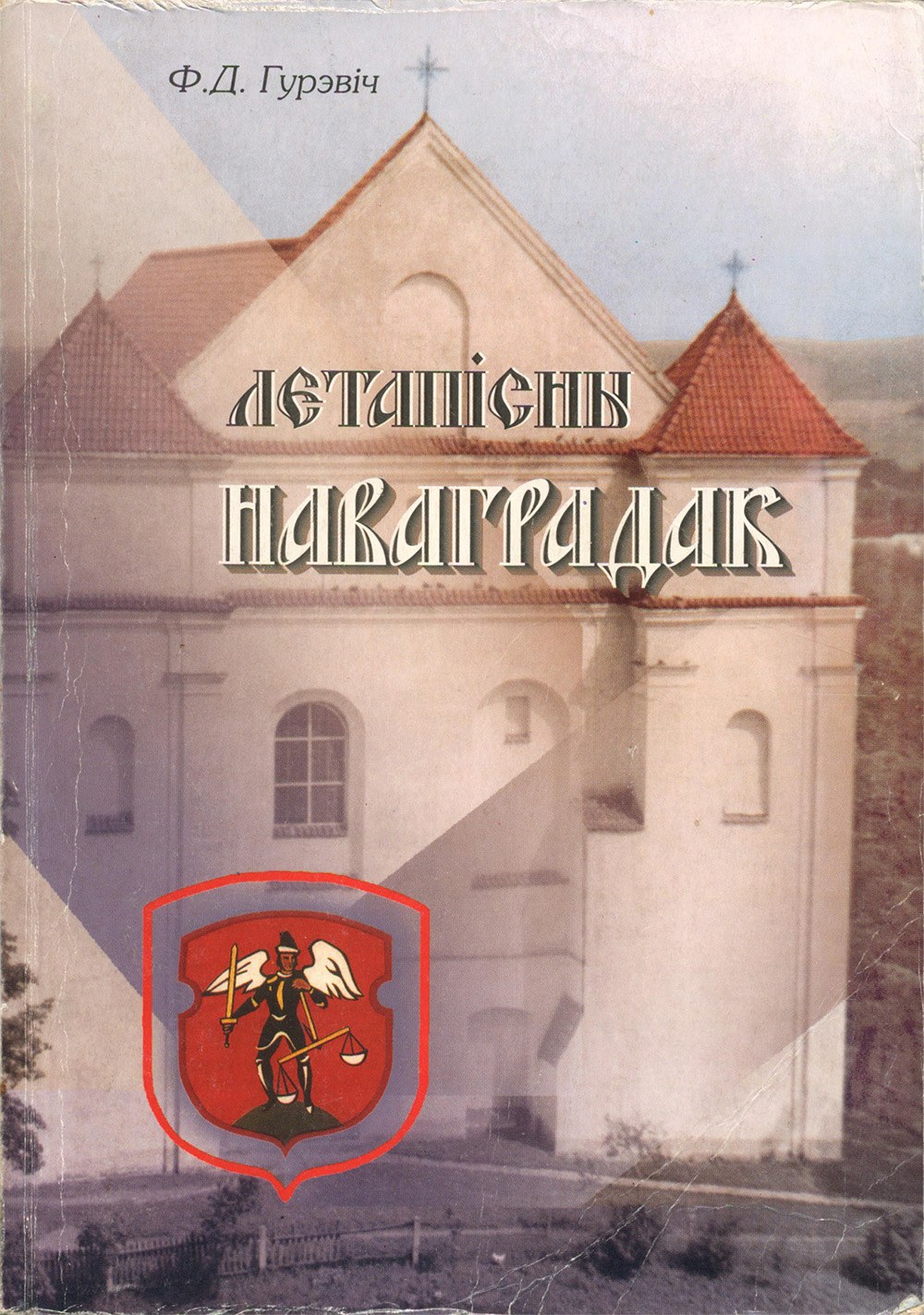
Летапісны Новгородок: Старажытнарускі Наваградак
Фрыда Гурэвіч
Памер: 324с.
Мінск 2003
Navagradak can not be considered a town founded in the 40’s of the XI century to fight Lithuania, for the reason that, as shown by the archaeological excavations early Navagradak was not a fortress. Modest settlements, of which the town consisted, could not be known to the authors of the Novgorod and Sofia chronicle, who lived a long way from the Nioman region.
Yermalovich writes that Novgorod of the XI century founded in 1044 was the Navagradak described by Tatishchev. As was shown previously, Tatishchev was inclined to think that the Novgorod he describes was Novgorod Seversky and refers to the year 1119. “Glab Minskyi prince started fighting with the polovians in the Novgorodok and Smolensk regions (belonging to) the children of Vladimir” The Belarus’n historian (Yermalovich) considers Novgorodian lands as the lands of Navagradak. The fact that the land of Novgorod was considered alongside the land of Smolensk means that the lands of the children of Vladimir were large territories, and in all likelihood the lands of Novgorod the Great.
Lets look at another statement of Tatishchev, which Yermalovich is trying to tie with the history of Navagradak. In the “History of Russia” under the year 1130 it is written: “The Great Prince Mstislav went to war on Lithuania having destroyed many homes he returned to Novgorod with many captives and founded in pirogoschi a church of the holy Mother of God. And from there he went to Kiev. ” According to Yermalovich this citation speaks of Navagradak and the church mentioned by Tatishchev is in all likelihood the one the remains of which were discovered by M.K. Karger. The citation from Tatishchev has nothing to do with Navagradak. In this text there is an error. The church of the Holy Mother of God Pirogoshchei
13
Introduction
was built in Kiev and not Novgorod. “In that summer (under 1132) a stone church was founded to the Holy Mother of God called Pirogoshcha.” Remains of that church were excavated in Kiev in 19761979.
It can be shown that, despite the attempts by Mikola Yermalovich, there is no mention of Navagradak of the XI and XII century in the chronicles. We examined in detail the article by the Belarus’n historian, because it is one a the few works dedicated to our town. Also, at the beginning of the 70’s, when the article was published, a considerable body of archaeological material about Navagradak and its region has been accumulated, which was not used by Yermalovich.
The old controversy about the location of the capital of Lithuania did not disappear in the Soviet literature, but it has become the matter of interest of Lithuanian historians and archaeologists, who attempted to locate the capital within the territory of Lithuania. Written evidence about Navagradak was the subject of interest to Polish historians. In 1759 a book by J. Pazowski appeared in Lviv, in which, in latin, the information about the town, taken from the chronicle by Stryjkowski and a historian of the XVII century A. Kojalowich, who also used the material of the Polish chronicler.
A historian and publicist T. Narbut, who published in the 30’s of the XIX century a multivolume history of Lithuania, based the history of Navagradak on the information contained in the GalicyaVolyn chronicle, which assumed that Mindovg resided in Novgorod.
Among the works of the Polish historians, concerning the treatment of written information about Navagradak, the investigation by J. Latkowski deserves attention. He held in high regard the GalicyaVolyn chronicle, but considered the Bychovec chronicle “muddled and erroneous”. Latkowski tried to separate genuine and mythological Lithuanian princes. He thought that Prince Ringolt, considered to be the father of Mindovg, was a mythological figure. According to Latkowski, Navagradak was one of the important towns of Mindovg, but he was not conceived that in the year 1252 was the wedding of the prince in Navagradak, because in that year there was Prince Daniil’s campaign on the towns along the Nioman. He thought that the wedding was held in Lithuania, in Voruta, where Mindovg resided.
The work of Latkowski, who rejected Navagradak as the capital of Lithuania in the days of Mindovg, influenced the thinking of subsequent Polish historians, though later, such as in the work of A. Prochaska, Navagradak was declared the place of the coronation of Mindovg. The search for the capital of Lithuania continued. W. Ketrzynski thought that it was the fortress of Utury on the river Dubisa (a tributary of Nioman). Kernovo and other places were also named as the likely capital.
In 1931 a small book was published about the town and its surrounds. In it were mentioned Belarussian chronicles and narratives about the legendary rulers of the town. The most valuable was the list by the author [Jozef Zmigrodzki whom we knew well], who was an engineer , of preserving
14
Introduction
works carried out on the Zamak mound of Navagradak till the 30’s of our century (XX).
The known Polish historian H. Lowmianski produced in the 30’s a capital work about the history of Lithuania. A special part was devoted to the ancient Navagradak. He rejects the notion of previous investigators, who, when Novgorod of the 40’s in the XI century was mentioned in the chronicles, thought it was Navagradak. The author joins Latkowski in his belief of the impossibility of the coronation of Mindovg in Navagradak and suggested that the capital of Mindovg was in Lithuanian lands, because, for one thing, in the 30’s of the XI century Navagradak was ruled by the Russian prince Izyaslav. Lowmianski considered the towns of Black Rus to be sentry posts, which belonged to the princes of Polesie, and the lands along the Nioman scanty and poorly colonised, which could not provide Mindovg with sufficient support.
The Polish emigre historic H. Paszkiewicz considered that Navagradak was the town from which lithuanians would raid SouthWestern Rus.
The above is a brief, incomplete summary of the written sources about Navagradak, which were written over hundreds of years. Because of limited written information, the thoughts of the historians concentrated on deciding if the town of the 40’s in the XI century mentioned in the chronicles was Navagradak and if it was the first capital of Lithuania. On the whole the answer to both those questions was negative.
The real significance of Navagradak has become obvious as a result of many years of archaeological investigations, conducted on its territory and surrounding countryside.
Chapter 2.	About the origins of Navagradak and its early history (to the end of the XI century).
The accounts of the formation of ancient Belarussian towns, which are subject of live discussions among historians and archaeologist, are considered now a separate section of the soviet urbanistics.
The author of the current work has written previously about the formation of Navagradak. However, this is such a difficult and multifaceted problem that we need to address it again, based on new information and new interpretations of previously known history.
The history of the formation of each ancient Belarussian town is difficult to deal with. The study of the formation of our town presents additional difficulties. Navagradak of the chronicles belongs to a group of ancient Russian towns (M.N. Tichomirov lists 47 such towns) which were first mentioned in writing in the XIII century ie at the time when the vast majority of the towns of Ancient Rus were already mentioned in writing. Indirect information, as we mentioned before, about the exist
15
Introduction
ence of Navagradak can bo found under the year 1235 when Izyaslav of Novgorod was mentioned. Direct mention of the town occurred in 1252, in the description of the campaign by Daniil of Galicia on the towns along the Nioman.
Though the references to Navagradak and other towns of Black Rus were late, it can be concluded that in the middle of the XIII century those towns were significant and important settlements because they attracted the attention of the volynian princes. This is particularly true of Navagradak, which Daniil tried to capture again twice (1253 and 1255) after his first campaign on Black Rus.
Archaeological findings have shown, that the above conclusion was right. Settlements on the territory of Navagradak appeared at the end of the X century, and when Navagradak was mentioned first in the chronicles, it was an ancient Belarussian town with a colourful and unique culture.
Every investigator of the foundation of any town endeavours to give a concept of the territory where the town was settled. Alas, there is little information about the land of Navagradak. Archaeological findings dated to the first millennium and particularly to its third quarter and the IXX centuries, prior to the foundation of Navagradak, are known only from the archaeological findings. The investigation of the land of early Navagradak as well as other Belarus’n lands along the Nioman, is less advanced than of other ancient Belarussian territories.
Some idea about the ancient relics of the first millennium on this land have been obtained by the findings at the village of Chereshlya, at the confluence of the rivers Belanozka and Nioman. At the northern end of the village, on the boundary “Zamachak” there is a settlement. Here our expedition dug an area of 16 sq m and discovered a historical stratum in which there were hatched ceramics from vessels with prominent ribs, fragments of rough ceramics, which were similar to the findings in the settlements of Lithuania, fragments of moulded profiled pots and frying pans, similar to the Slavonic ceramics of the VIIIIX centuries and ancient Russian pots made on a potter’s wheel with grooves, at times decorated with a wave. A restored pot from that settlement is similar to the ceramics of Ilie X century found in Navagradak. L.D. Pobol’ was also working in Chereshlya. He noticed ceramics characteristic of the late stage of the Zarubinec culture and of the Bancerov culture.
 КНІГІ ОНЛАЙН