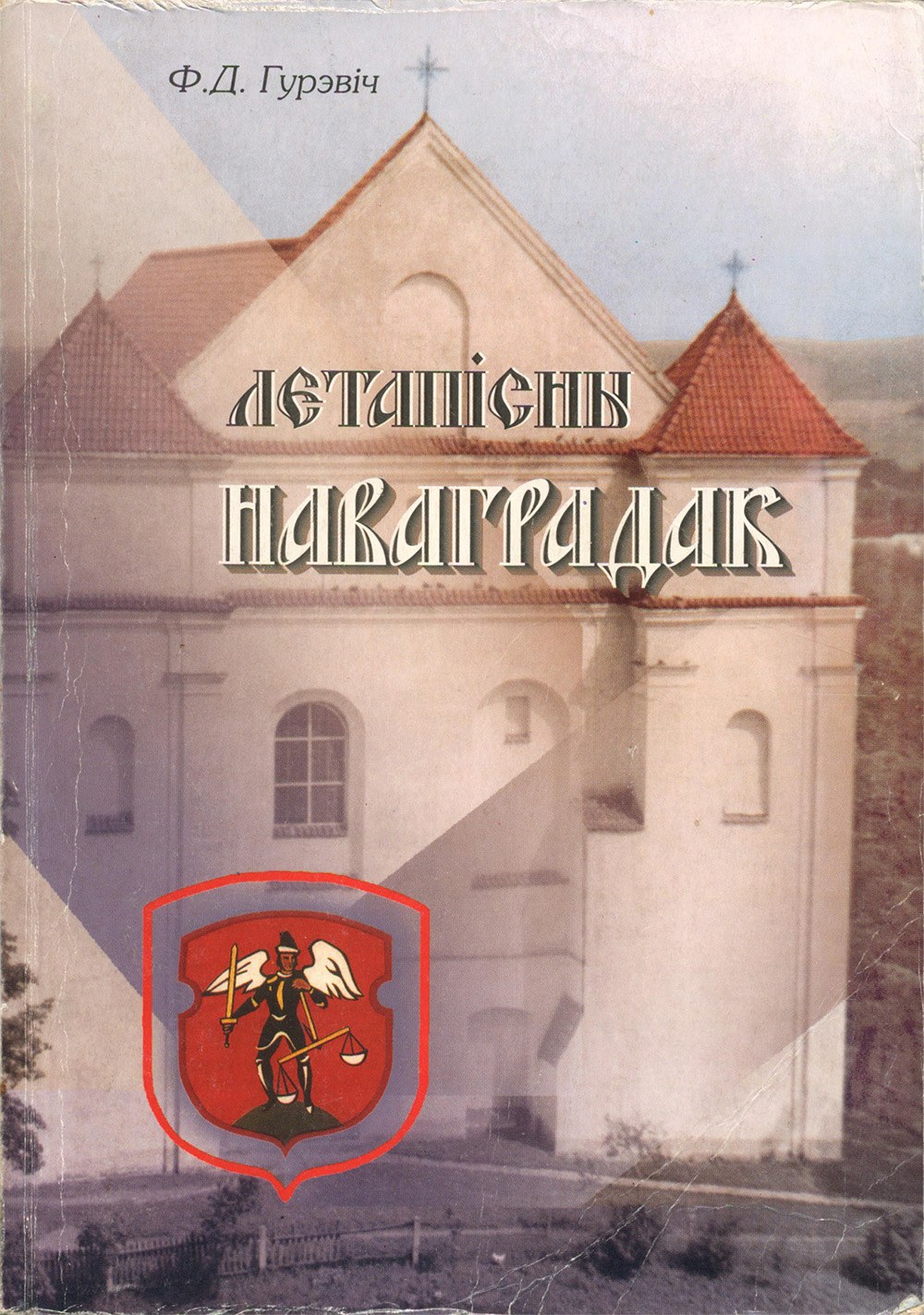
Летапісны Новгородок: Старажытнарускі Наваградак
Фрыда Гурэвіч
Памер: 324с.
Мінск 2003
9
Introduction
town without the Tatars but the citadel remained (untouched)». The other princes were angry, they thought that «having taken Novgordok they could continue their campaign in Lithuania, but because they were angry with Lev, they returned home from Novogrodok».
After three years the volynian princes heard the news that the Tatars had taken the town. «M’stislav, Volodimir, Jur’i said that they too could have taken Navagradak but the tatars have conquered all».
1 his news of 1277 complete the written evidence, which without doubt was describing ancient Navagradak and was recorded by the GalicianVolynian chronicle. The passage describing the inhabitants of Navagradak bemoaning the death of Vladimir Vasilevich, together with the germans, surozans and others, was probably referring to another town.
The information about Navagradak contained in the GalicianVolynian chronicle concerns the events in the history of the town in a quarter of a century of the XIII century (12521277) and describes the attempts of Volyn and Lithuania to rule the town by force or peaceful means. The christening of Voishelk in Navagradak was also done with the aim to strengthen his hold on the town.
The amount of information about Navagradak in the GalicianVolynian chronicle is not large. The town is mentioned 11 times, but it is the most valuable source of material about the ancient Navagradak, and we will return to it frequently.
Of later documents, which would be of interest in the recreation of the history of ancient Navagradak, the «The list of cities of near and far» is a memorial of the XIV century where Navagradak is mentioned among the Lithuanian towns. Peter Duesburg a priest of the crusaders writes that in 1314 magister Heinrich von Plocke has surrounded and tried to capture the town of Navagradak, which was in the country of the krivichi. Interesting is the message of Prince Gedimin, who in 1323 invited to Lithuania the citizens of Luebeck, Schtralzend and other german towns. He promised them the freedom of their religious beliefs. The Prince told them that he built places of worship for the minorities of the Order in Vilno and Navagradak.
There is also information of interest about the ancient Navagradak in a later chronicle of a Polish historian Maciej Stryjkowski (XVI century). This document can not serve as a source of information for the period of interest to the students of ancient Navagradak, but some echoes of the past could be of use if handled critically.
In one West Belarussian chronicle of the XVI century there is a story of a mythical prince who, with his troupes «crossed the river Nioman and found within four miles from the river a beautiful mountain where they created a town which they called Navagradak and created a great prince whom they called the great prince of Navagradak».
Stryjkowski repeats the above story almost word for word. “An so they crossed the Nioman and found within four miles a beautiful and toll moun10
Introduction
tain on which there was the first capital of the russian princedom Navagradak, which was destroyed by the tsar Batyi. There Erdivil created his capital and defended without blood letting a big part of the russian lands, he became known as the Great Prince of Navagradak .
Both stories obviously refer to Navagradak, which is situated 28 km (4 miles) from the Nioman and is situated on high hills. Without doubt the town is distinguished in its significance among the towns along the Nioman, which is obvious also from reading the GalicianVolyn chronicle.
In the Gustyn chronicle (XVII century), in the first part of which much is borrowed from the Ipat’ev chronicle for the year 1252, it is said “In that summer the great prince of Lithuania Mindovg was crowned to be the king of Lithuania in Navagradak with the blessing of Pope Innocent (IV 12431254) by Henryk Bishop of Chelm, in Prussia the Papal Cardinal”.
The list of written sources would not be complete without mentioning the words in the IV Novgorod and Sofian chronicles in which under the year 1044 it reads “Yaroslav went to Lithuania and in spring he founded Novgorod and he did it”.
The written information about Navagradak were used by Belarussian investigators in general works on the history of Russia and in special works about the Western Belarussian lands. They were mainly accounts based on chronicles and other sources and, more seldom, conclusions based on the sources.
Considering the information contained in the chronicles that Navagradak was founded by Yaroslav in the 40’s of the XI century, the first Russian historian V.N. Tatishchev writes “This is meant to refer to the Lithuanian Novgorodok, but is more likely to bo the Seversky (Northern), because it too was mentioned at about the same time”. Tatishchev was pul of by the story of Stryjkowski that Navagradak was founded on the spot where a town was destroyed by Batyi and he writes: “Batyi was never in Lithuania, not even in Smolensk”.
Snippets of information about Navagradak are contained in the capital work of N.M. Karamzin “Who built Navagradak  asked the author we don’t know. Probably the Belarussians.”
In the 8090’s of that century (XIX) a series of works about the Western Belarussian lands have appeared. Those were based largely on the historical sources about Navagradak. Some of the sources were judged critically. Thus, for instance, N.P. Barisov and V.B. Antonovich did not consider the information in the IV Novgorod and Sofia chronicles about Novgorod to refer to Navagradak. Antonovich saw in the Western Belarussian chronicles compiling (?) devices, but believed in the veracity of the Gustyn chronicle about the marriage of Mindovg in Navagradak in 1252. This evidence is also believed by N.P. Batyushkov and P.D. Bryancev. The well known historian M.K. Lyubavski concludes that Navagradak had become the main town of Black Rus’ and the permanent home of Mindovg.
11
Introduction
The question of where was the first capital of Lithuania occupied the historians in the later years. In 1910, when V.l. Picheta had written that it was Navagradak, a professor of the St Petersburg university Е.Л. Vol ter thought that the first capital should be found further in the depth of Lithuania.
Among the soviet historians we should mention the ideas of M.N. Tichomirov, who thought that Navagradak was created in 1212. He quotes the Ipolit chronicle for that year which said: “Les’tka has complained of his shame and sent to Navagradak for Mstislav and told him ‘take me if you go and occupy Galicia’.” However, the events mentioned in the chronicle refer to Galicia and the place named must be another Navagradak.
V. Г. Pashuto has subjected to a serious analysis the written sources about Navagradak, and considered them together with other information about Black Rus and its towns. The author thinks that Novgorod of the IV Novgorod chronicle is not the same as Navagradak. It is interesting to note that the author considers the history of Mindovg and other Lithuanian princes as imbued with enlightenment and could have been subject to a separate chronicle written in one of the orthodox monasteries along the Nioman, possibly in the one founded by Prince Voishelk in the land of Navagradak.
In 1972 appeared an article about the early history of Navagradak by the Belarus’n historian M.I. Yermalovich in which the author disagrees with the notion that “Novgorod” of the IV Novgorod and Sofia chronicle was not Navagradak. Yermalovich considered that Yaroslav the Wise founded the town to fight Lithuania.
To support his views the author shifts the Lithuania of the chronicles Irom the land which has become the eastern part of soviet Lithuania to the immediate vicinity of Navagradak. “Lithuanians” of the Belarussian chronicles, as Yermalovich assumes, lived on land between Minsk and Navagradak from east to west and from north to south between Molodechno and Lyachovichi. The migration’ of “Lithuania” is not supported by any archaeological indings. Only in one case, establishing the lithuanianrussian border, the author mentioned that the line of toponyms (place names) coincides with the southern border of the findings of hatched ceramics ie with the border of settlement of Balts, who inhabited “Lithuania”. In other words, to explain events of the XI century Yermalovich is using as evidence findings which have been dated to the first half of the first millennium.
Io prove that Lithuania” of the chronicles existed close to Navagradak, the author is trying to use information from the chronicles about campaigns against it. However, the evidence which he uses shows the directions of that campaigns. The territory occupied by “Lithuania” of the Belarussian chronicles is to be found not too far from Navagradak, but not in the immediate neighbourhood. This is clear from the description by the chronicler of Voishelk who in 1263, having collected people from Pinsk, came to Navagradak “and otgole, poya with him the people of Novgorod and went to rule Lithuania”.
12
Introduction
It is difficult to agree with Yermalovich that the toponym “Lithuania” found in the upper Nioman country indicates that the whole nation lived their. This finding does show that isolated groups of baltic people lived there and were different from the primary inhabitants of this land.
Yermalovich has transplanted “Lithuania” of the 40’s of the XI century onto a Slavonic territory. Here was the ancient Izyaslavl’, which the “Story of temporal years” places in the X century. Close to the town was a large cemetery (344 kurgans) were mainly krivichi were buried. V.V. Sedov shows that the land which Yermalovich had assigned to “Lithuania” is Slavonic land, settled by dregovichy, which can be established by studying their settlements and burial places. As to the lands which were indeed lived on by Lithuanians, they have been well established by archaeological investigations in the eastern part of present day Lithuania. Investigations by A.Z. Tauttavichyus and R.K. VolkaiteKulikauskene, which showed uninterrupted inhabitancy of that territory by baltic people, starting from the first centuries of our era till the middle ages and the affinity of their culture to the culture of the latgals, zemgals and other baltic tribes. These findings are well supported by the chronicle about the tribes living in the neighbourhood of Russia, among whom were “Lithuania, Zimergola, Kors’ and Let’gola”.
 КНІГІ ОНЛАЙН