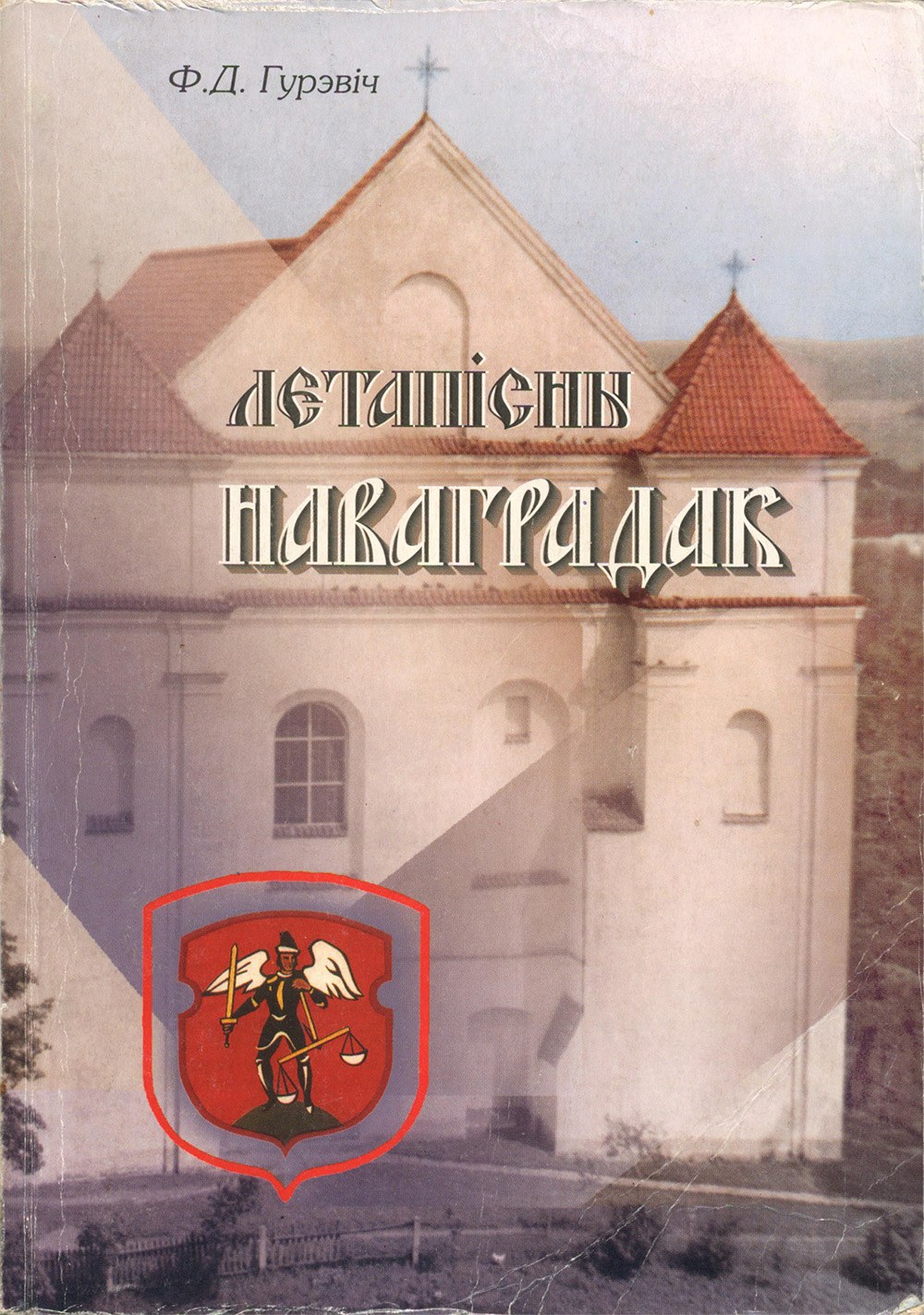
Летапісны Новгородок: Старажытнарускі Наваградак
Фрыда Гурэвіч
Памер: 324с.
Мінск 2003
The archaeological investigations of the LOI A (at that time the Leningrad Division of the Institute of the history of the material culture) started in Navagradak in 1956. On the territory of the Zamak mound a trench was dug some 10 m to the south from the stone foundations of the palace. Initially the stratification was similar to the one observed previously. However, at the depth of 3 m unburnt planks, ceramics, an axe and other realia of the XIIXIII centuries were discovered. It could be firmly asserted that the Zamak was inhabited at that time. At the same time a historical stratum was investigated on the Maly Zamak mound. The summary of those findings is contained in the book «Drevnii Navagradak».
In 1959 on the Zamak mound, close to the Vyezdnaya tower, excavations of an area 20 sq.m, in size were started. An historical stratum up to 5 m thick was investigated only in 1962. As the diggings in depth continued, the area of the hole was reduced, till at the subsoil the area of the hole was quite small. Nevertheless, based on the findings one could conclude that there existed on that spot an ancient Belarussian settlement.
Systematic excavations on the Zamak mound began in 1968. The area of the excavations was 320 sq. m. and was started 20 m to the west from the Szchytouka. In the SouthWest part of the excavations were the ruins of the late middle age monumental memorials, among them was an orthodox church, first found by the polish architects. It was considered necessary to add to those excavations an additional 104 sq. m., thus extending it to the bank (earthen wall) and the stone wall.
Investigations of this northern digging continued until 1973. In that time some new areas were added to the investigation. In all, an area of 1250 sq m was dug, of which 850 sq m was occupied by the residue of the architectural constructions of the late Middle Ages.
In 1974, on the south side of the grounds, 20 m to the east from the excavations of 1959 and 1962, excavations of an area of 140 sq m were begun. They were completed in 1977. The historical stratum of the ancient Russian period was destroyed by later constructions. Its existence was con
6
Introduction
firmed by the findings of ceramics, fragments of amphoras, glass bracelets and other characteristic objects.
After a considerable halt, the work of the Navagradak expedition was renewed in 1983, together with the division of archaeology of the Institute of History of Academy of Sciences of the Belarus’n SSR led by the Belarus’n archaeologist L.G. Ranicheva. An exploration of an area of 100 sq m, adjacent to the excavations of 1974 and 1977, was started. The ancient russian stratum of this digging was investigated under the leadership of the author in 19841985.
Apart from the work on the Zamak mound of Navagradak, other archaeologists were conducting investigations, studying defensive structures and memorials of monumental architecture. In 1959 P.A. Rappoport cut a bank in the middle of the grounds and in 19691970 M.A. Tkachev investigated the defence structures, adding substantially to the observations of the Polish architects. In the beginning of the 1970’s a group was formed, which was part of the Navagradak expedition, under the leadership of M.V. Malevskaya. The group dug the ruins of the XIV century orthodox church and a temple dated to the XVII century. Of great interest are the remains of a dwelling of the second half of the XIV century — the only, at the time, monumental home of a feudal lord in Belarus’.
In Navagradak investigations were conducted on the elevation southwest of the Maly Zamak. On that hill in 1961. 1962 and 1965 M.K. Karger excavated the remains of the ancient russian temple, which was found under the orthodox church of Boris and Gleb, which was built in the XVI century.
At the same time when investigations in Navagradak were conducted, archaeological memorials were found and excavations were conducted in the vicinity of Navagradak. A large study of kurgans (burial mounds) around Navagradak was performed by K.V. Pavlova. From 1963 to 1972 her team had excavated 75 kurgans in the villages of Garadzilouka , Sialec, Molnichy, Sulacichy and Batarouka.
In all, in the archaeological works on the territory of Navagradak, an area of 3000 sq m was investigated. 23,500 pieces of ceramics were found as well as about 11,000 other findings. In addition, information was obtained about an ancient russian temple and 105 burials in a Christian cemetery on the Maly Zamak. Outside the town, evidence of several settlements and about 100 kurgans was obtained.
As a result of the archaeological studies in Navagradak, we can view anew the scarce written documents about the town, and come to new conclusions about the history of that memorial from the end of the X century to the end of the XIII century. The findings in Navagradak have been compared, where possible, with the findings of other western russian towns. This aids in finding the place which was occupied by Navagradak among the towns of Western Rus’.
7
Introduction
The chronicle of Navagradak was written with the help of many investigators. In the book about the trading postdefended town is a list of archaeologists who headed the excavations on the Maly Zarnak. In the investigation of the Zamak mound the leading investigators were: M.V. Malevskaya, l.D. Zilmanovich, K.V. Pavlova, T.S. Ponomareva, K.T. Kovalskaya, L.G. Pancheva and N.V. Nikalaeu. Our work was conceived and formulated in the department of slavonicfinish archaeology (previously the group of Slavonic russian archaeology of LOIA). The author had for the last thirty years the unfailing support of all her friends in the department. The author dedicates this work with gratitude to all who helped in its accomplishment.
Chapter 1.	Written sources
and their attribution in the works of historians.
In the Ipat’ev chronicle under the year 1235 Yazyeslav Novgorodski is mentioned (in ancient russian) «In that year Daniil lead against Kondrat Mindovg’s Lithuania, Izyeslav (Yazyeslav) Novgorodski». In the 30th of the XIII century the polish prince Kondrat Mazowiecki tried to enter into a coalition with the Teutonic Order, to defend himself from Volyn and Lithuania, and among Daniil’s supporters was the ruler of Navagradak Izyeslav (Yazyeslav), who’s name is not mentioned again in the chronicle.
Basic written evidence about Navagradak (Novogrodok, Novgorod, Novyi gorod) was contained in the GalicianVolyn chronicle, which was preserved as a separate part of the Ipat’ev chronicle and is a tale of the events of years 12381292. Investigators have shown that the first part of this most important source about the history of Western and SouthWestern Rus was written on the order of Daniil Galicki, probably in Chelm and was extended and amended later during the reign of his brother Vasilka Romanovich.
The first mention of Navagradak refers to the campaigns of Daniil into the lands along the river Nioman. Under the year 1252 it is said that «Danila and Vasilko went to Novougorod». At the same time Volynian princes have conquered other towns of that land — Volkovysk and Slonim and also Zditov. The chapter concludes with a remarkable phrase: “and having taken many towns they returned home”.
The conquest of the towns along Nioman was not secure, because under the next, 1253 year the chronicler informs of a new campaign by Daniil. With him were: his son Lev, Vasilko, his sons (daughters) inlaw Teak "from the polovci (tribe)”, an the princes of Pinsk. There is a lively description of the campaign. The detachment of the Volyn princes, having reached river Shchara  a tributary of Nioman refused to go further. Daniil had to exert much effort to be able to complete the campaign. “Using wise words” said the chronicle about the prince “it would be a shame before Lithuania and all lands if we don't reach (our goal) and return”. The campaign was
8
Introduction
completed and its finish was marked with these words: «in the morning all the land of Navagradak was captured».
The third campaign on Navagradak was also headed by prince Daniil. As is known, under the year 1255: «Daniil went to war on Lithuania, on Navagradak».
The intension of Daniil to take possession of Navagradak resulted in the campaigns of 1252, 1253 and 1255 and were aimed at severing the centre of the Navagradak district from Lithuania, which under the rule of Mindovg, penetrated there somewhat earlier. It would appear that it was not possible to achieve this by military means and in the year of the third campaign there were peace negotiations between Lithuania and Volyn. Mindovg, through his son Voishelk, married his daughter to Daniil’s son Shvarn and Voishelk handed over Navagradak, on behalf of Mindovg, to another son of Daniil, Roman. Voishelk also gave Daniil «Voslonim and Volkovyesk». The transfer of Navagradak to Roman is mentioned again in the chronicle under the year 1257.
Having taken over Navagradak, Roman., answering a call from his father, comes to his help to fight the yatvyags. «And he sent for Roman in Novgorodok and Roman came to him with all the Novogrudians». There was however, still a dependence of Roman on Mindovg, who told Daniil «And send word Mindovg to Daniil 1 will send you Roman and Novgorodians so that he can get to Vozvyagl and from there Kiev».
After Mindovg was murdered (under the year 1262) «Voishulk (previously spelled Voishelk) became the prince of Novegorod». There is a long description, how the pagan prince had converted to Christianity in Navagradak «and he was christened in Novegorodce» and his activities as a neophyte. In a year Voishelk «went with the Linyans to Novougorod and from there with novgorodce went to Litvoy to be a prince».
Under 1268 the chronicler reports that Shvarn rules Navagradak «at that time Shvarn rules Novegorod». From Navagradak the Prince goes to Volyn’ to help his family fight Poland.
One of the last and vivid mentions of Navagradak is found for the year 1274. The Volynian prince Lev — son of Daniil, preparing a campaign against Navagradak is seeking help from the Tatar chan Mengutimur, and the last obliges sending troops under Yagurchin. Among the volynians were numerous Russian princes. The chronicle mentions the voivode of a district beyond the Dniepr, Roman dobryanski with his son Oleg, Gleb the Prince of Smolensk «a lot of other princes, because they were beholden to the Tolars». And thus all went to Novougrodok». The combined forces arrived to the land along the Nioman. They slept on the shore of Servech a tributary of Nioman. At dawn «the troops approached the town». On the right marched the Tatars, next to them was Lev with his solders and on the left was Prince Vladimir with his regiment. «The army stopped next to the town». The campaign was in winter and steam from the running water was rising over the Navagradak mounds. Lev outwitted his allies «he took the defended
 КНІГІ ОНЛАЙН