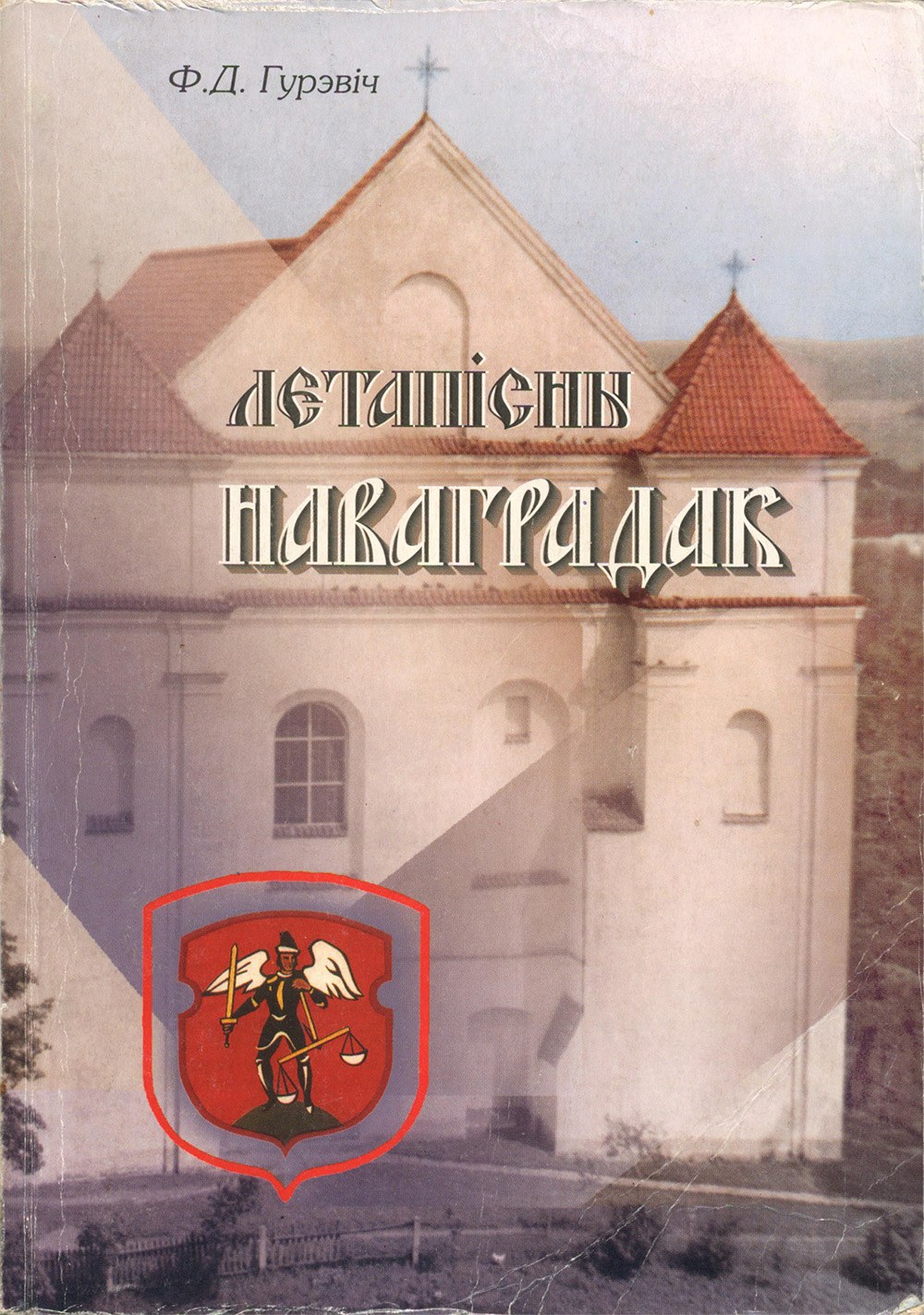
Летапісны Новгородок: Старажытнарускі Наваградак
Фрыда Гурэвіч
Памер: 324с.
Мінск 2003
Ceramics similar to those found in Chereshlya are also known in different combinations in various places of the Navagradak district. For instance, hatched ceramic, fragments of late Zarubinec vessels and vessels of the Bancerov culture have been found in the village of Tolkuny. Moulded ceramics of the VIIIX centuries were found in the villages of Agarodniki, Garadki, Skrundi and others. The same type of ceramics together with early spun ceramics were found in the villages of Radagoshcha, Selishche, Maruliny and others.
16
Introduction
We will take a closer look at two memorials in the vicinity of Navagradak. One of them is Garadishche next to the village of Boiki 6 km to the northwest of the town. Within 1 km from the village on a high hill, which did not have defensive structures, a 30 cm thick historical stratum was discovered. In it were unitary fragments of hatched ceramics. Most of the finds were ceramics of the Bancerov culture. Among them were fragments of tulip shaped vessels and a fragment of a vessel with a smoothed out rib.
The second memorial is connected with investigations of the previous century (XIX). The information about it are incomplete, but are of great interest. In 1892 M.A. Cybishev noticed next to the road to Korelichi, on the eastern border of Navagradak, elongated and round kurgans (burial mound) of which he excavated two elongated mounds. At the ground level there were open fire places, calcined bones and fragments of vessels. In one of the kurgan on an elevation stood nine moulded vessels, in one of them were human bones in another bones of a horse. Other items found in three kurgans were: knife with a thick pick, scissors, grinding stone, kresalo, a buckle, a bronze spiral and a bell. The significance of those finds was that close to the town there were not only round kurgans but also elongated ones, which were undoubtedly older. The assortment of items made of iron and bronze is similar to the inventory belonging to the original population of Navagradak and only the large assortment of moulded vessels is different to the ceramics of the early Navagradak.
Attempting to determine the composition of the population living in the territory which was later called Navagradak, we need to attribute to the ethnic groups the archaeological materials of the first millennium. We mentioned previously the Slavonic moulded ceramics. As to the ceramic of the Bancerov culture of the VVII centuries and at times VIII century, a large number of investigators consider that they belong to the baltic population (P.N. Tret’yakov, A.G. Mitrafanau, V.V. Sedov). Sedov is of the opinion that the Bancerov culture and the related to it I ushemlinski Kolochinsk culture, beginning with the VI century started to penetrate into the Slavonic population. L.D. Pobol’, however, is of the opinion that the Bancerov culture was related to the Slavonic peoples.
Judging by the archaeological findings, the land of Navagradak in the second half and the last centuries of the I millennium were not empty. Numerous memorials don’t provide the real picture of the settlement of this territory at that time and show that this part of the land along the Nioman was not investigated adequately. The verity of this statement can be tested by looking at a archaeological map of the neighbouring district of Slonim, where as a result of active and systematic investigations by the archaeologist V.R. Supin, many memorials of the VIIX centuries have been found in the basin of the upper and middle flow of the river Shchara, were there were many ancient Belarussian settlements of the end of the I and the beginning of die II millennium.
17
Introduction
The late entry of Navagradak in the chronicles and paucity of archaeological findings in regard to the I millennium, force to consider the origin of the town solely from the findings in the town, the local burial grounds and memorials of the XXI centuries.
Archaeological works have shown that at the end of the X century and in the first half of the XI century three empty hills were settled at the northern end of the present town. Two of them were the Zamak mound and Maly Zamak, where among early spun dishes were few moulded ceramics and also some forms of beads, among them pierced mosaic, dated to the IXX centuries. The third mound was to the southwest of the Maly Zamak.
As to the population on the Zamak  the highest hill  under an ancient bank, which was moved later, a historical stratum was found contained ceramics, which first appeared on the Maly Zamak not before the first half of the XI century. It can be concluded from this that the Maly Zamak was settled earlier than the Zamak. On the Zamak, in the stratum just above the subsoil, a moulded slightly profiled pot was found  the only whole moulded pot in Navagradak.
The third settlement was found on the height adjacent, on the southeast from the Maly Zamak, where in the XII century an orthodox church was built. Having installed a prospecting shaft the investigators found a historical stratum up to 1 m thick with stones and clay coating. Among the ceramics, fragments of a vessel were found with pressed ornaments of the XXI century. Ceramics of the XI century were found in the historical stratum, when the temple was excavated. Among other finds were: a bushed twopinned arrowhead of an iron arrow.
The hills of Navagradak were settled at the same time, they were a nest consisting of three settlements. The Maly Zamak was settled around the periphery and in the centre, whereas the Zamak mound was initially settled only around the periphery of the ground.
None of the settlements had in the early period a defensive structure. I heir security was achieved by the height of the hills, among which the highest was the Zamak mound, rising 20 m above the valley, which was the highest point of the Navagradak height. Early in the second half of the XI century a bank, 10 m from the edge of the plateau, was raised. It would appear that for more than 50 years the Navagradak settlements did not have manmade defences, therefore the settlements were not considered to be a town.
The people who occupied the Navagradak hills had a fully developed culture. Ihe residues of most houses found on the Maly Zamak were predominantly built above the ground and made of logs, though some were built in the ground. Among the ceramics which were found were mostly pots with bent rims, some of which had the upper part ground on a potters wheel. Among the many findings of moulded items are interesting fragments of thick walled braziers, which served as the tops of ovens.
18
Introduction
The original inhabitants of the Maly Zamak were producing iron products. Melting of iron was done in the living quarters in pots. Findings of ingots as well as various metal articles (working and domestic tools, articles of attire) allowed to observe the development of the blacksmith’s and locksmith’s art. The production of nonferrous metals by the first inhabitants of Navagradak was done in pits, found in the southern part of the grounds. In the pits were preserved samples of smelted bronze. Many pits had domestic uses and were filled with ceramics and the bones of animals.
Items found in the early settlement on the Maly Zamak illustrated the occupations of the inhabitants in agriculture and various other enterprises and also home craft. Examples are many clay and, less frequently, stone pryaslica, bone tools and other findings.
The existence of connections with the outside world at the time of the first settlement can be confirmed by the findings of specific metal items from the baltic region and glass beads of eastern origin.
Though the settlers had a large inventory of goods, they had practically no arms. The only finding was a binding for a quiver, found in one of the oldest buildings.
The burial memorial of the settlers at the end of the X century is a kurgan cemetery 1.5 km northeast from the present town. Burial in those days consisted in burning of the dead on the spot or on the side. Burning on the spot can be identified by the burial bonfires, in which calcine bones can be found as well as ceramics and fragments of iron and bronze products. When burned on the side, the burned bones were put in a small hole, dug in the ground.
Such was the material culture at the time of settlement of the territory of Navagradak at the end of the X century, which is reconstructed by sets and individual findings in the settlement on the Maly Zamak and the oldest burials in a kurgan cemetery. At the beginning of the XI century the Zamak mound is settled, which is proven by the findings in the historical stratum under the original bank, and findings on the hill southwest of the Maly Zamak.
In the second half of the XI century a bank is erected around the settlement of the Zamak, which made it a citadel, an Maly Zamak with the neighbouring hill became suburbs (trading quarters). Settlements changed into a town, in which the material culture was typical of the time. Casting of bronze was done in the domestic quarters. This will become later characteristic of this trade. New types of decorations appear, in particular bronze and silver temple rings with a spiral curl. Arms appear among the inhabitants, mainly iron arrowhead of bushed arrows. Among the suppliers of imported goods Kiev appears, which supplies slate pryaslica (from pryast to spin?).
From cremation the settlers changed to laying out of the body. In one of the kurgans the transfer from the old to the new rite was observed: the body was layed out with the head pointing west and the skeleton was partly
19
Introduction
burned. In the other burials by inhumation the skeleton was always in the same position, on the level of the subsoil. Their hands were extended or crossed on the chest. On the burial grounds there were stains of ashes and coal, sometimes stones spread at random. At the feet of the buried or alongside them pots were standing. The rest of the inventory in the kurgan were decorations or a certain amount of domestic articles. In one of the kurgan a battle axe was found.
 КНІГІ ОНЛАЙН